Newcastle vs Bournemouth: A Tactical Analysis of the 2–1 Defeat
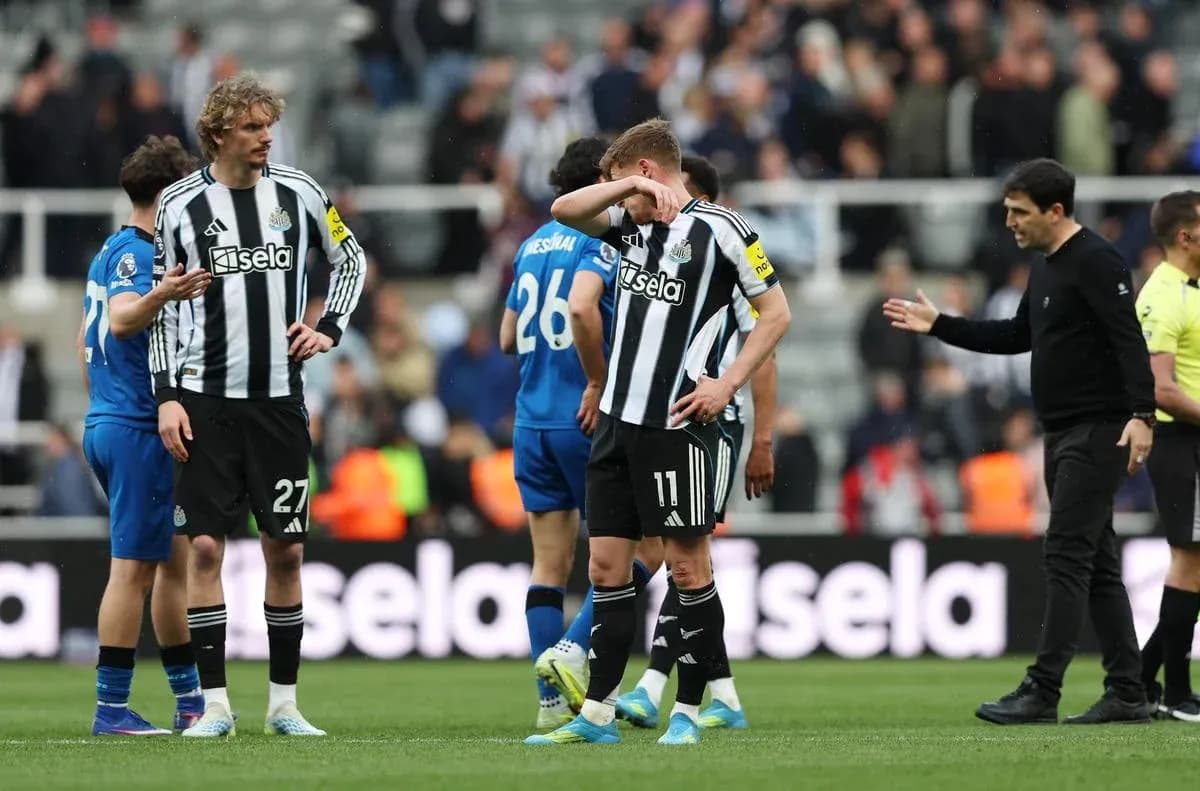
Newcastle’s 2–1 home defeat to Bournemouth at St. James’ Park unfolded as a study in contrasting attacking structures and penalty-box efficiency. In a Premier League Round 33 fixture overseen by Thomas Bramall, the visitors exploited their superior expected goals profile (3.03 xG to Newcastle’s 1.65) and more balanced shot map to edge a contest where overall possession (54–46) and total shots (12–12) were level. Newcastle’s 4-3-3 produced heavy occupation of the Bournemouth box but few truly clean looks, while Andoni Iraola’s 4-2-3-1 generated clearer, higher-value chances and protected the lead better in key phases, particularly after going back in front late on.
First Half
The scoring opened on 32 minutes when Bournemouth’s left-sided structure finally pierced Newcastle’s back four. With Newcastle’s 4-3-3 pushed high, Bournemouth’s 4-2-3-1 found width and timing: Rayan drifted into a pocket between the lines and fed Marcus Tavernier, whose “Normal Goal” gave the visitors a 1–0 lead. That advantage held to the interval, reflected in the 0–1 half-time scoreline.
Eddie Howe’s first adjustment came immediately after the restart at 46', when Kieran Trippier (IN) came on for Lewis Hall (OUT), signalling a need for more progressive passing and crossing from right-back. Bournemouth’s first card arrived on 52': Ryan Christie was booked for a foul, highlighting the visitors’ willingness to break Newcastle’s rhythm with tactical infringements. On 55', Tavernier was shown a yellow card for argument, an emotional spike from a player central to Bournemouth’s attacking plan.
Second Half
Newcastle’s double midfield/wing reset on 62' was pivotal: Bruno Guimarães (IN) for Jacob Ramsey (OUT) and Jacob Murphy (IN) for Anthony Elanga (OUT) shifted the home side towards a more assertive central presence and direct wide threat. Bournemouth responded on 65' with Tyler Adams (IN) for Christie (OUT), reinforcing the double-pivot’s defensive range, and on 66' David Brooks (IN) for Eli Junior Kroupi (OUT), adding fresh legs in the advanced band.
The hosts finally broke through on 68' when William Osula struck a “Normal Goal” to level at 1–1, a moment later confirmed by VAR at 71'. This equaliser was the product of Newcastle’s renewed central pressure and more aggressive rest defence, allowing them to pin Bournemouth in and force a broken-play chance inside the box. At 74', Dan Burn (IN) for Valentino Livramento (OUT) further tilted the side towards aerial dominance and back-post threat from the left.
The game then grew increasingly fragmented. Sven Botman’s yellow card for a foul on 77' reflected Newcastle’s higher defensive line and occasional desperation in transition. Bournemouth countered by introducing Ben Gannon-Doak (IN) for Rayan (OUT) at 78', prioritising fresh pressing energy on the flank. Murphy’s own yellow card for a foul on 80' underlined Newcastle’s struggle to contain Bournemouth’s counters as they chased a winner. Alex Scott was booked for a foul on 82', evidence of Bournemouth’s willingness to break up play centrally as Newcastle tried to sustain pressure.
The decisive moment came on 85', when left-back Adrien Truffert surged into the attack and finished a “Normal Goal” to restore Bournemouth’s lead at 2–1. This was tactically significant: Bournemouth’s full-back, previously conservative, exploited the space left by Newcastle’s advanced wide players and a stretched back line, turning what had been a stable 4-2-3-1 into a late, opportunistic 2-3-5 in possession.
Newcastle’s final attacking roll of the dice came on 86', with Nick Woltemade (IN) replacing Sandro Tonali (OUT), effectively adding another forward and thinning the midfield shield. Bournemouth then locked down game management at 89' with a double change: Alex Tóth (IN) for Tavernier (OUT) and Enes Unal (IN) for Evanilson (OUT), refreshing both the left side and the lone striker role to hold territory and chase clearances. In stoppage time, at 90+4', goalkeeper Đorđe Petrović received a yellow card for time wasting, emblematic of Bournemouth’s late-game strategy to protect their 2–1 advantage.
Team Structures
From a structural perspective, Newcastle’s 4-3-3 was built on Aaron Ramsdale behind a back four of Livramento, Malick Thiaw, Botman and Hall, with Tonali, Lewis Miley and Ramsey in midfield and a front three of Elanga, Osula and Harvey Barnes. The model emphasised box occupation (11 shots inside the box out of 12 total) but lacked variety: only 3 shots on target from 12 attempts, and just 2 corners, point to limited success at creating unopposed finishing positions. Ramsdale’s workload was surprisingly light numerically—only 1 recorded save—yet Bournemouth still scored twice, consistent with the away side’s 3.03 xG and Newcastle’s inability to protect high-value zones.
Bournemouth’s 4-2-3-1, with Petrović in goal; a back four of Álex Jiménez, James Hill, Marcos Senesi and Truffert; a double pivot of Scott and Christie; and an advanced trio of Rayan, Kroupi and Tavernier behind Evanilson, was more balanced in its shot profile: 7 attempts inside the box and 5 from outside, for 3 shots on target and 12 overall. Petrović’s 2 saves were modest in volume but crucial in context, especially once the game was level at 1–1 and Newcastle were chasing. The visitors’ substitutions—Adams stabilising midfield, Brooks and Gannon-Doak refreshing the press, and late introductions of Tóth and Unal—maintained their defensive compactness and counter threat.
Match Statistics
Statistically, the match underlines why Bournemouth’s approach was more sustainable. Despite having less of the ball (46% to Newcastle’s 54%), they matched the hosts in total shots (12–12) and produced a much higher expected goals figure (3.03 vs 1.65). Newcastle’s 79% passing accuracy (344 of 433) compared to Bournemouth’s 75% (286 of 380) suggests cleaner circulation, but not the penetration to turn possession into clear chances. Defensively, both sides conceded a similar number of fouls (Newcastle 11, Bournemouth 12), yet the card distribution—two yellows for Newcastle (Botman, Murphy) and four for Bournemouth (Christie, Tavernier, Scott, Petrović)—reflects Bournemouth’s more frequent use of tactical fouling and late game management.
Overall Assessment
In overall form terms, Newcastle controlled territory and phases but lacked cutting edge, while Bournemouth’s overall form in this fixture was defined by clinical exploitation of space and superior chance quality. Defensively, Bournemouth’s index is stronger: they allowed 1.65 xG away from home, kept Newcastle to 3 shots on target, and used their defensive structure plus strategic fouling to protect a narrow lead. Newcastle, by contrast, allowed 3.03 xG and conceded twice from open play despite limiting Bournemouth to 3 shots on target, a sign that their defensive index in this match lagged behind their territorial dominance.