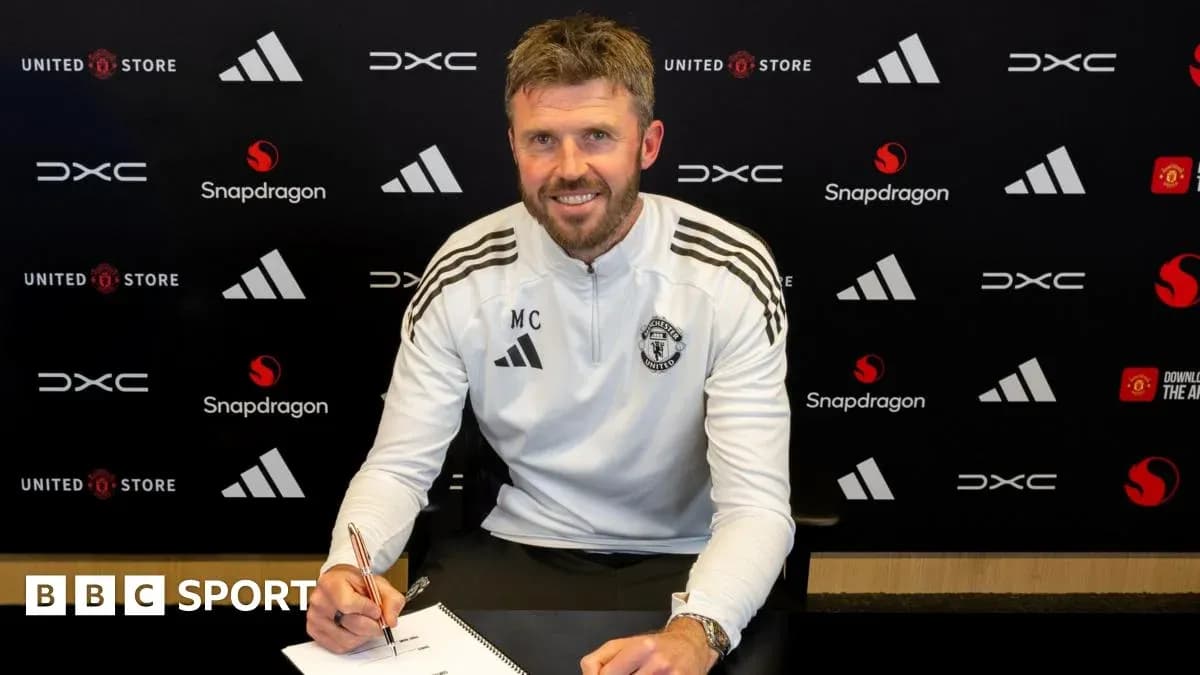
Michael Carrick Confirmed as Manchester United Head Coach on Two-Year Deal
Manchester United have finally put ink to paper on the question that has followed every Carrington press conference for months. Michael Carrick is no longer the caretaker. He is the man.
The 44-year-old has been confirmed as United’s permanent head coach on a two-year contract, rewarded for a surge that has dragged the club from mid-season uncertainty to the Champions League and a guaranteed third place in the Premier League.
He inherited a mess in January. He has turned it into momentum.
From interim to architect
Carrick stepped in when Ruben Amorim was sacked in January, walking into a dressing room short on belief and a fanbase braced for another reset. Since his appointment on 13 January, no top-flight side has collected more points than United’s 36.
Eleven wins from 16 matches. Champions League football secured. A thrilling victory over Nottingham Forest on Sunday locking in third place with games to spare. The numbers are blunt and emphatic, and they have carried him onto a six-man shortlist for the Premier League manager of the season award.
The transformation has not just been about results. It has been about mood.
“From the moment that I arrived here 20 years ago, I felt the magic of Manchester United. Carrying the responsibility of leading our special football club fills me with immense pride,” Carrick said after the announcement, speaking less like a man surprised by the job and more like one who has been preparing for it for two decades.
“Throughout the past five months, this group of players have shown they can reach the standards of resilience, togetherness and determination that we demand here.
“Now it's time to move forward together again, with ambition and a clear sense of purpose. Manchester United and our incredible supporters deserve to be challenging for the biggest honours again.”
The words fit the club. The task now has to match them.
The real work starts here
Carrick has been asked so often about his future that he could almost have pointed reporters to the transcript of his last briefing. The uncertainty is gone now. The scrutiny will only grow.
Third place in a 40-game season is a neat headline, but it comes with context. United had no European football this year and exited both domestic cups at the first hurdle. Next season could stretch to 60 matches. The margin for error shrinks quickly when the calendar swells.
For Carrick, the equation is simple: recruitment has to be right.
Central midfield sits at the heart of it. Casemiro is leaving. Manuel Ugarte has not convinced. Kobbie Mainoo, as gifted as he is, cannot be asked to shoulder every minute in every competition. That spine needs reinforcing with players who can handle the weight of a season that will not stop for anyone’s fatigue.
Other fault lines are clear. If Patrick Dorgu continues to be used higher up the pitch, Luke Shaw needs genuine competition at left-back, not just cover on a team sheet. The same story runs through the goalkeeping department. Senne Lammens requires pressure and support, but Radek Vitek, outstanding on loan at Bristol City, wants to play every week. Bring him back and his development stalls. Leave him out and United walk a tightrope with depth.
These are decisions that define seasons, not just squads.
Academy promise, but not a shortcut
There is help coming from below. United’s academy continues to hum in the background, offering Carrick options that are young, hungry and already tested.
Eighteen-year-old midfielder Jacob Devaney has caught the eye in the Scottish Premiership with St Mirren, showing the composure and energy that fit the modern Premier League engine room. Shea Lacey, a promising England Under-20 international, looks certain to edge closer to the first team next season.
These are encouraging signs. They are not a strategy on their own.
The academy can add depth, bring freshness, change games from the bench. It cannot be expected to do the heavy lifting in a season that will demand experience, durability and cold-blooded quality in the biggest moments. Carrick needs a recruitment department that matches his clarity on the training pitch.
Beyond the numbers
Some of the data-led analysis has tried to poke holes in United’s revival. Statistical models suggest the performances have not always matched the results since Amorim’s departure, that the points tally flatters them.
That view misses something important.
Carrick has brought calm to Carrington. The training ground feels less volatile, the dressing room more stable. When games tilt against United, there is less panic, more structure. Players know their roles, and they know the manager will not flinch at the first sign of trouble.
You cannot easily measure that in expected goals or shot maps. You can see it in the way a team rides out pressure, in how it closes out tight games in hostile stadiums. United have done that under Carrick.
Next season will test all of it. The travel, the midweek nights, the quick turnarounds from European ties back into domestic battles. In that context, finishing third again, with the extra strain of a full schedule, would not be standing still. It would be a significant step forward.
For that to be possible, Carrick needs more than a title and a two-year contract. He needs players, he needs backing, and he needs a summer in which United’s recruitment finally matches the ambition he has just put into words.
The club has chosen its head coach. The question now is whether it gives him enough to turn a promising surge into a sustained return to the top.