Mexico Dominates South Africa 2-0: Tactical Breakdown
Mexico’s 2-0 win over South Africa at Estadio Azteca was a textbook example of how structure, pressing and ball circulation can dismantle a deep 5-3-2 block, especially once the game state tilted decisively in Mexico’s favour after the interval. Javier Aguirre’s side imposed themselves territorially and with the ball, while Hugo Broos’ South Africa were gradually pushed into pure survival mode, particularly following their first red card on 49 minutes.
Mexico set up in a 4-1-4-1 that functioned as a clear positional play framework. The back four of Israel Reyes, César Montes, Johan Vásquez and Jesús Gallardo provided width and early progression, with Erik Lira anchoring as the single pivot. Ahead of him, Roberto Alvarado, Brian Gutiérrez, Álvaro Fidalgo and Julián Quiñones formed a fluid line of four behind Raúl Jiménez, consistently occupying all five vertical lanes.
In possession, Mexico’s structure was stable and repeatable. Lira dropped between or alongside the centre-backs to form a three-man first line, allowing full-backs Reyes and Gallardo to advance high and pin South Africa’s wing-backs. This underpinned Mexico’s 61% possession and 520 total passes, of which 467 were accurate (90%). The ball circulation was not sterile: 16 total shots, 9 from inside the box and 5 blocked, reflected a team that repeatedly arrived in advanced areas and forced South Africa into emergency defending.
The opening goal on 9 minutes encapsulated the plan. Mexico created central overloads, drawing South Africa’s midfield infield, then exploited the half-spaces. Lira, operating as the free man in front of the South African block, supplied the assist for Quiñones, who attacked the inside-left channel from his nominal midfield role. That early 1-0 advantage allowed Mexico to control tempo, but they did not become passive; instead, they used the lead to keep South Africa stretched horizontally, circulating the ball side to side until gaps appeared.
Out of possession, Mexico’s 4-1-4-1 morphed into a 4-5-1 mid-block, with Gutiérrez and Fidalgo stepping onto South Africa’s double pivot and Alvarado/Quiñones tucking in to close central lanes. The front pressing was selective rather than constant, but it was effective in limiting South Africa to just 3 total shots (only 1 inside the box). With the defensive line holding a relatively high position and Lira screening passes into the forwards, South Africa’s attempts to build through the thirds were largely stifled.
South Africa’s 5-3-2 was clearly designed to absorb pressure and counter through the front two of Iqraam Rayners and Lyle Foster, supported by Teboho Mokoena from midfield. However, with only 39% possession and 335 passes (272 accurate, 81%), they rarely established sustained attacking sequences. Their back five stayed deep, wing-backs Khuliso Mudau and Aubrey Modiba were pinned, and the midfield trio were often outnumbered when Mexico’s advanced midfielders dropped between the lines.
The match’s tactical hinge came on 49 minutes when Siphephelo Sithole was sent off for a “Professional foul last man.” Reduced to ten men, South Africa collapsed into a 5-3-1/5-4-0 low block, sacrificing almost all forward threat. Any residual intention to counter was effectively abandoned, with Rayners increasingly isolated and Mexico able to commit even more numbers forward without fear of transition.
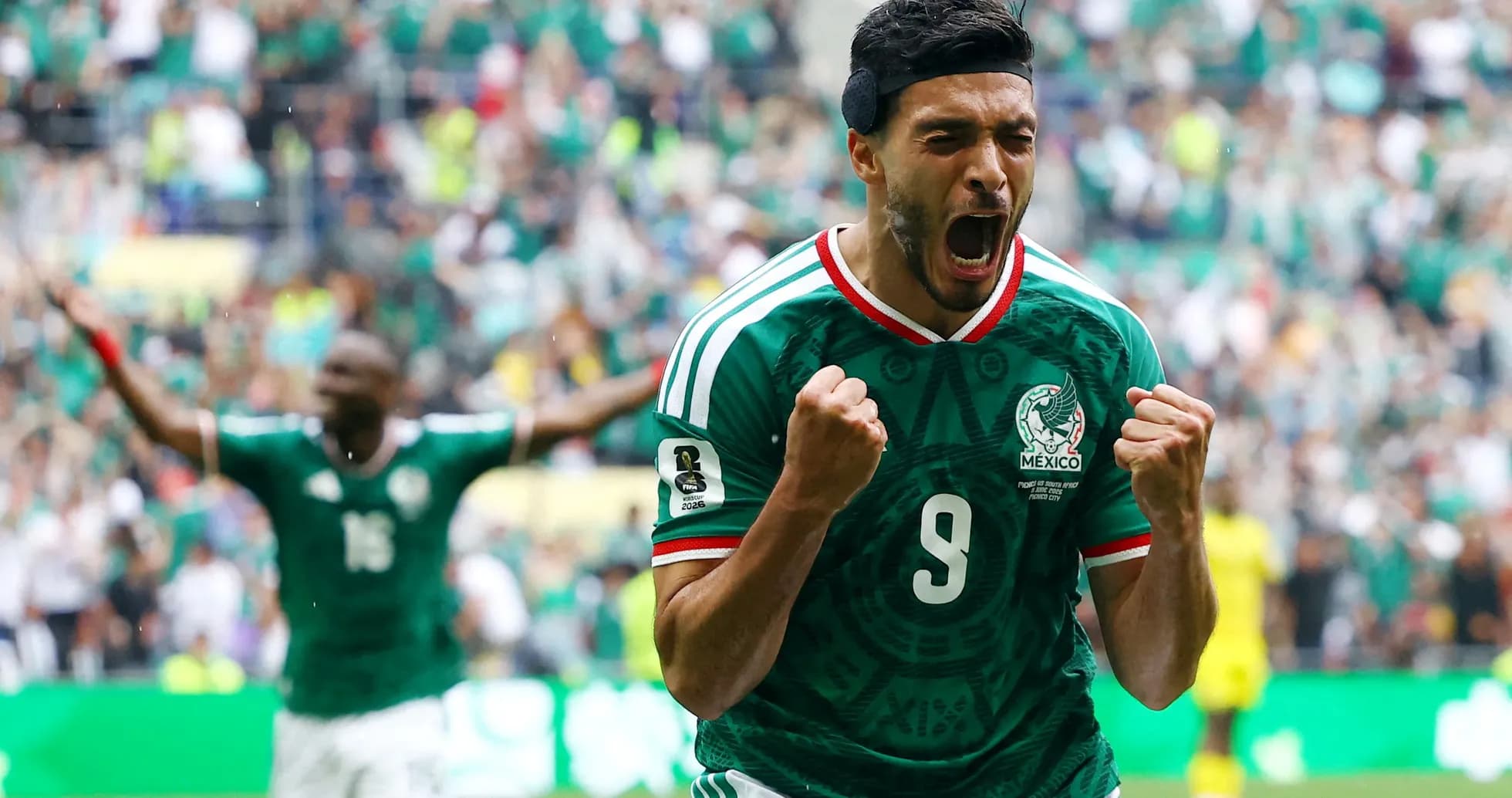
Aguirre’s in-game management reinforced Mexico’s control. On 66 minutes, Gilberto Mora (IN) came on for Álvaro Fidalgo (OUT), injecting fresh legs into the midfield structure, while Luis Chávez (IN) replaced Brian Gutiérrez (OUT), adding more passing range and control in the left half-space. The impact was immediate: one minute later, on 67 minutes, Jiménez doubled the lead, finishing a move assisted by Alvarado. This second goal reflected Mexico’s superior occupation of the right half-space, with Alvarado finding pockets between South Africa’s wide centre-back and wing-back before slipping in Jiménez.
From there, Aguirre shifted subtly towards game management without sacrificing compactness. At 76 minutes, Armando González (IN) replaced Jiménez (OUT), and Edson Álvarez (IN) came on for Lira (OUT), freshening the pivot role and ensuring the defensive structure in front of the back four remained intact. Quiñones (OUT) then made way for Alexis Vega (IN) on 79 minutes, preserving the threat in wide and half-space zones even as Mexico lowered the tempo.
South Africa’s response was limited and largely reactive. Broos tried to adjust with Thalente Mbatha (IN) for Foster (OUT) on 56 minutes and Themba Zwane (IN) for Jayden Adams (OUT) on 61 minutes, seeking more technical security and ball retention in midfield. Later, Oswin Appollis (IN) replaced Modiba (OUT) and Evidence Makgopa (IN) came on for Rayners (OUT) at 77 minutes, nominally to add fresh legs and directness. But by then, playing a man down and pinned in their own half, these changes had minimal structural effect; South Africa still finished with only 3 shots and 1 corner.
Defensively, Mexico’s back line remained mostly untroubled, though the match ended with a moment of individual damage: at 90+2 minutes, César Montes was sent off for “Professional foul last man,” leaving Mexico with ten men as well. Importantly, this did not alter the tactical narrative; the red came too late to change the game state, with Mexico already 2-0 up and in full control.
In goal, Raúl Rangel (Mexico) had a relatively quiet but focused evening, registering 2 saves behind a defence that allowed just 2 shots on target. His opposite number, Ronwen Williams (South Africa), also made 2 saves but was far busier in terms of defensive organization, constantly marshalling a back five under siege. The underlying metrics underline Mexico’s superiority: an xG of 1.41 against South Africa’s 0.07, mirroring the territorial dominance and chance quality. Both teams’ goalkeepers posted the same goals prevented figure (-0.47), suggesting that the scoreline was driven more by shot volume and shot locations than by extraordinary goalkeeping interventions.
Discipline further shaped the tactical picture. South Africa finished with 2 yellow cards and 2 reds, while Mexico had 1 yellow and 1 red. For South Africa, Mokoena’s yellow on 17 minutes for “Foul,” Sithole’s red for “Professional foul last man” at 49 minutes, Sibisi’s yellow for “Foul” at 74 minutes, and Zwane’s red for “Violent conduct” at 84 minutes—upgraded via a VAR “Card upgrade” review at 82 minutes—kept their defensive line constantly on the edge. Mexico’s own bookings, Gutiérrez’s yellow for “Foul” at 23 minutes and Montes’ late red, did not materially disrupt their overall control.
Ultimately, Mexico’s 4-1-4-1 outplayed South Africa’s 5-3-2 through superior spacing, circulation and pressing triggers. The numerical and positional superiority in midfield, combined with intelligent rotations from the attacking line and well-timed substitutions, translated their statistical dominance—61% possession, 16 shots, 90% passing accuracy—into a comfortable 2-0 scoreline that accurately reflected the tactical balance of the contest.