Mexico's Tactical Mastery in 2-0 Victory Over Ecuador
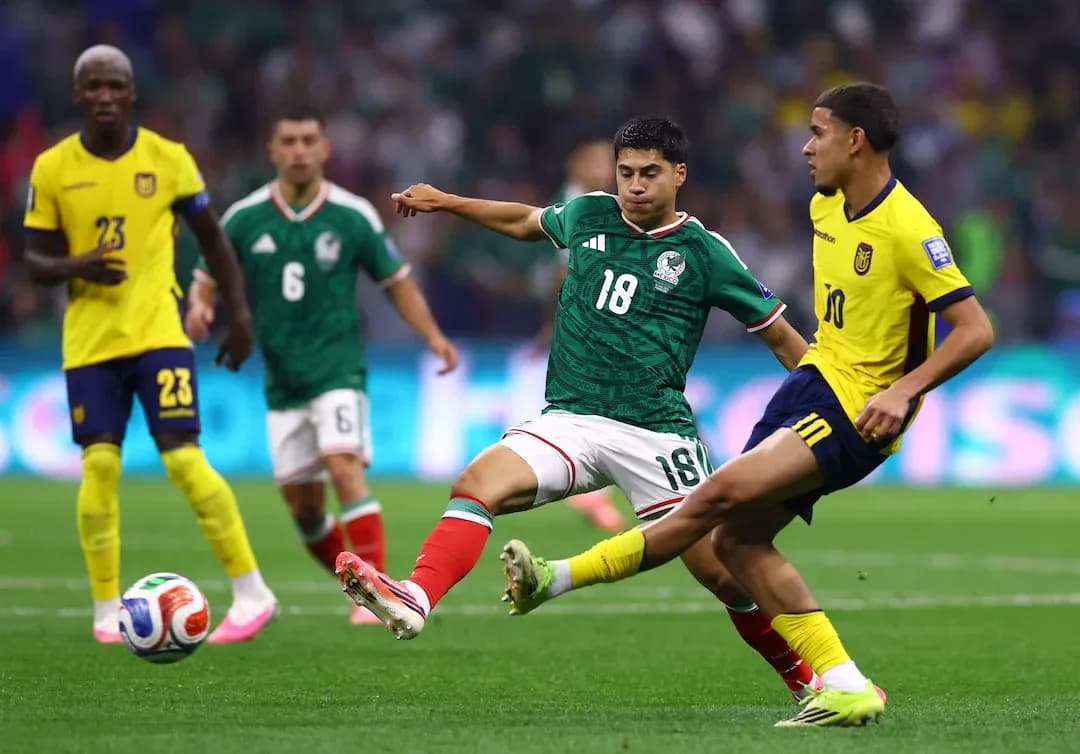
Mexico’s 2-0 win over Ecuador at Estadio Banorte in this World Cup Round of 32 tie was a classic example of scoreboard control over territorial dominance. Despite having only 43% possession and completing fewer passes than Ecuador (319 vs 407), Mexico used a compact 4-3-3 and ruthless first-half efficiency to build a decisive lead, then managed the game with disciplined structure and targeted substitutions.
Javier Aguirre’s 4-3-3 was clearly designed to defend in a mid-block and spring quickly into space. The back four of Jorge Sánchez, César Montes, Johan Vásquez and Jesús Gallardo stayed relatively narrow, inviting Ecuador to play in front of them. In midfield, Gilberto Mora, Erik Lira and Luis Romo formed a triangle that tilted toward the ball side, focusing on screening passes into Enner Valencia and Gonzalo Plata rather than pressing high. That conservative posture is reflected in the foul count (10 for Mexico against Ecuador’s 14) and the fact that Mexico finished without a single card.
The attacking plan revolved around direct connections between the front three. Julián Quiñones and Roberto Alvarado operated as wide forwards who aggressively attacked the half-spaces once Mexico recovered the ball. Raúl Jiménez stayed central, pinning the Ecuadorian centre-backs and providing a target for early balls. The opening goal at 22' — J. Quinones (Mexico), assisted by R. Alvarado — encapsulated this idea: Mexico transitioned quickly, Alvarado finding Quiñones in an advanced lane after bypassing Ecuador’s midfield.
The second goal at 31' — R. Jimenez (Mexico), assisted by J. Quinones — showed the complementary nature of the front three. Quiñones, now acting as creator, exploited the spaces Ecuador left as they tried to step higher, feeding Jiménez in a central channel. With only 3 shots on goal from 15 total attempts, Mexico’s finishing was efficient relative to their xG of 1.02; they converted their best moments rather than relying on volume.
Out of possession, Mexico’s defensive structure was impressively stable. Ecuador were held to just 7 total shots and 1 shot on goal despite enjoying 57% of the ball and 8 corner kicks. The Mexican back line consistently won the first contact on crosses, while the midfield three tracked Ecuador’s wide midfielders tightly enough to prevent free deliveries from advanced zones. The 3 blocked shots underline how well Mexico protected the edge of their box, forcing Ecuador into less threatening shooting positions; Ecuador’s xG of 0.73 reflects the scarcity of truly clear chances.
In goal, Raúl Rangel (Mexico) was rarely tested, making 1 save. The low save count is less a reflection on his performance than on the effectiveness of the block in front of him; Mexico’s defensive line and midfield screen limited Ecuador to speculative efforts and one clear attempt on target. At the other end, Hernán Galíndez (Ecuador) also registered 1 save, but the key difference was the quality of the looks he faced. With Ecuador’s line stretched in transition, Mexico’s two goals came from situations where Galíndez was exposed by breakdowns ahead of him, a point underscored by Ecuador’s negative goals prevented figure.
Sebastian Beccacece’s 4-4-2 for Ecuador was built to dominate the ball, and it succeeded territorially but not in penetration. Moisés Caicedo and Pedro Vite formed the central pair, with John Yeboah and Nilson Angulo wide and Gonzalo Plata partnering Enner Valencia up front. Ecuador’s 84% pass completion (407 passes, 340 accurate) and higher possession suggested control, yet much of their circulation remained in harmless zones. Mexico’s narrow front three and compact midfield forced Ecuador to recycle horizontally, with limited vertical access into Valencia’s feet or runs beyond.
Second Half Changes
The second-half substitution wave was a tactical attempt to change that dynamic. At 46', Alan Franco (OUT) was replaced by Yaimar Medina (IN), and Joel Ordóñez (OUT) by Ángelo Preciado (IN), hinting at a more aggressive right flank and fresh legs in the back line. Later, Enner Valencia (OUT) for Kevin Rodriguez (IN) at 59' added running in behind, while the double change at 79' — John Yeboah (OUT) for Jordy Caicedo (IN) and Nilson Angulo (OUT) for Kendry Páez (IN) — aimed to inject directness and creativity. However, Mexico responded with their own control-oriented changes: Gilberto Mora (OUT) for Brian Gutiérrez (IN) at 58', Luis Romo (OUT) for Obed Vargas (IN) at 73', and then a full refresh of the front line with Raúl Jiménez (OUT) for Santiago Giménez (IN) at 74', followed by Julián Quiñones (OUT) for Orbelín Pineda (IN) and Roberto Alvarado (OUT) for Israel Reyes (IN) at 80'. These moves helped maintain defensive intensity and allowed Mexico to close the game with fresh legs in key pressing and wide defensive roles.
Ecuador’s growing frustration was visible in their disciplinary record: 3 yellow cards and 1 red card. Alan Franco’s yellow at 45+1' for “Tripping” came just as Ecuador were trying to regain control before half-time. In added time at the end, Kendry Páez was booked at 90+3' for “Tripping”, Piero Hincapié was sent off at 90+5' for “Unsportsmanlike conduct”, and Moisés Caicedo saw yellow at 90+9' for “Tripping”. Mexico, by contrast, managed the game without incurring any bookings, a testament to their composure and control of defensive duels.
Statistically, the match underlines a clear tactical story: Ecuador’s higher possession and better pass completion did not translate into threat. Their 1 shot on goal and xG of 0.73 show how Mexico’s structure forced them into low-yield patterns. Mexico, with fewer passes but a focused attacking plan and sharp execution in the first half, aligned their 1.02 xG almost perfectly with the 2-0 outcome. The difference lay not in how much of the ball each team had, but in how effectively Mexico turned their limited possession into decisive, high-quality moments while maintaining a disciplined, low-risk defensive block.