
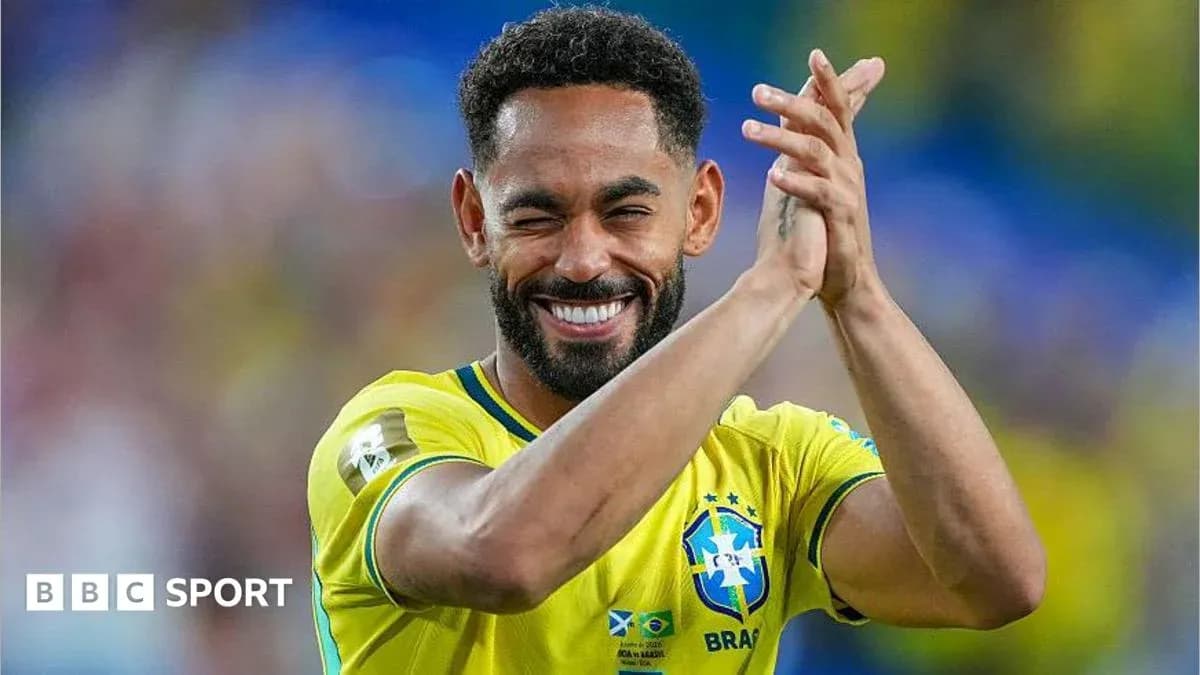
Matheus Cunha: The Key to Brazil's World Cup Success
The World Cup is starting to reveal its contenders. Brazil, at last, look like one of them.
Carlo Ancelotti appears to have settled on his best XI. You can see it in the way Brazil have moved through the group stage: a team that arrived uncertain, growing sharper, more assured, more dangerous with every game. The rhythm is building at exactly the right moment, because Japan in the last 32 will not forgive any hesitation.
At the heart of this new Brazil sits a forward who does not fit the old posters on the bedroom wall.
A different kind of No 9
Matheus Cunha is the key to so much of what is working. Not because he is a classic Brazilian centre-forward, but precisely because he isn’t.
Brazilian fans are used to a certain silhouette leading the line. Ronaldo. Adriano. Romario. The big No 9, living on the shoulder, living for the finish. Cunha breaks that mould. He is something in between – a nine-and-a-half, as those inside the game like to call it. A striker who can play like a 9, but think and link like a 10.
He is not a pure playmaker, either. Three goals already at this World Cup underline that. He drifts, he drops, he creates, he finishes. He gives Brazil a profile at centre-forward they have arguably never had before.
In the way he moves, he evokes Roberto Firmino. The same habit of disappearing into pockets of space that defenders hate. He drops deep, and the centre-back has a decision to make. Follow him and you leave Vinicius Jr and Rayan free to knife into the gaps. Hold your position and Cunha turns, receives between the lines, and suddenly he is facing goal with options.
He is embracing the dirty work as well. Happy to start the press, to screen like a No 6 in front of the midfield when Brazil step up. His work without the ball has become a crucial part of the balance of this side, allowing the more explosive talents around him to stay higher and fresher.
From uncertainty to clarity up front
The strange thing is how recently this all came together. Brazil arrived at this World Cup without a nailed-on No 9, a rarity for a nation that usually knows its centre-forward months, even years, in advance.
Right up to the Scotland game, the role felt open. Ancelotti had rotated through options: Cunha, Igor Thiago, Endrick, Joao Pedro, Richarlison. No one had fully claimed it.
Then football’s brutal selector – injury – forced a change that unlocked the attack.
Raphinha, a wonderfully gifted, roaming attacker who had started as a 10 behind Igor Thiago against Morocco and can operate on either flank, pulled a hamstring in that first match. On came Rayan, a more orthodox right-sided wide player, someone who holds his position rather than constantly drifting.
With Vinicius Jr stretching teams from the left and Rayan fixed to the right, the central channel opened up. That corridor became Cunha’s playground. Often alone, often unmarked, he could find the spaces he loves, turning a tactical problem into a structural advantage.
Brazil still have alternatives. Igor Thiago offers a more traditional reference point if they are chasing a game or facing a side that wants a physical battle. He can pin centre-halves, occupy them, force them to defend their box. The difference now is that Ancelotti has genuine options, not just names on a list.
Back home, the conversation is shifting. With every game, more people are starting to believe Cunha is the answer. Opponents will study him, of course. They will think they know how to close him down. But he is an intelligent forward, and intelligent forwards tend to stay one step ahead.
Ancelotti’s Brazil: control without obsession
All of this flows from the man on the touchline. Ancelotti’s reputation has long been built on his handling of people, but this Brazil reminds everyone how sharp he is tactically.
One of the most striking features of his side is what they are not obsessed with. They do not chase 70% possession as a badge of honour. They are comfortable letting the opponent have the ball and turning that into a problem for them.
If you press at the right moment, from the right positions, with the right intensity, you can hurt teams badly. Brazil have done exactly that. Against Scotland, the first goal came from that approach, and a second – chalked off harshly – followed the same pattern. The same traps had already appeared in warm-up wins over Panama and Egypt.
Brazil allowed Scotland to feel in control, but they were the ones steering the traffic, guiding Scottish players into zones where the press would spring. They surrendered the ball but never the plan. When the trigger came, they pounced. That was not luck. It was design.
People love to label teams: possession-heavy and attacking, or deep and reactive. Ancelotti refuses to be boxed in. He shapes Brazil to the opponent and to the moment, trusting players who can adapt to execute different ideas inside the same tournament.
A new identity without abandoning the old flair
This is not the Brazil of memory, and that is the point. They are not parking the bus or turning their backs on attacking football, but some of the traditional hallmarks have been toned down.
For the first time at a World Cup in decades, the full-backs are not constantly flying forward. No Roberto Carlos, Cafu, Maicon, Marcelo or Dani Alves surging past the wingers on every attack. With Douglas Santos and either Roger Ibanez or Danilo, the approach is more measured. Their runs are selective, not relentless.
That restraint has a purpose. It lets Vinicius Jr stay higher, conserve energy, and become an even more devastating outlet when Brazil break. The back four, as a result, looks solid, and the midfield finally feels balanced.
The shift in system has helped. In the opener against Morocco, Casemiro was left alone at the base of midfield in a 4-2-3-1 that often looked more like a 4-1-4-1. He was exposed, and the criticism followed. But the problem was structural, not personal. At 34, he was never going to cover every blade, making every tackle and every press on his own.
Since then, Brazil have moved into a 4-3-3. When Bruno Guimaraes surges forward, Casemiro now has Lucas Paqueta alongside him, sharing the defensive load. The difference has been clear against Haiti and Scotland, and it will matter even more against Japan, a side far more fluid and threatening in attack than either of those.
Confidence rising, tests looming
The numbers back up the mood. One goal conceded. Seven scored. A defence that looks secure, an attack that suddenly makes sense.
More important is the change in the air around the team. Before the first game, anxiety hung over Brazil. After it, worry grew louder. Now, three matches in, that has flipped. Excitement has taken over. The public are smiling again, and with this team, that always matters.
The World Cup is not won in the group stage. Brazil know that better than most. But with Ancelotti’s plan taking shape, Cunha redefining the No 9 role, and a structure that feels both modern and distinctly Brazilian, the question is no longer whether they belong in the conversation.
It is how far this new Brazil can push the story.



