Manchester United's Tactical Mastery in 3-0 Victory Over Brighton
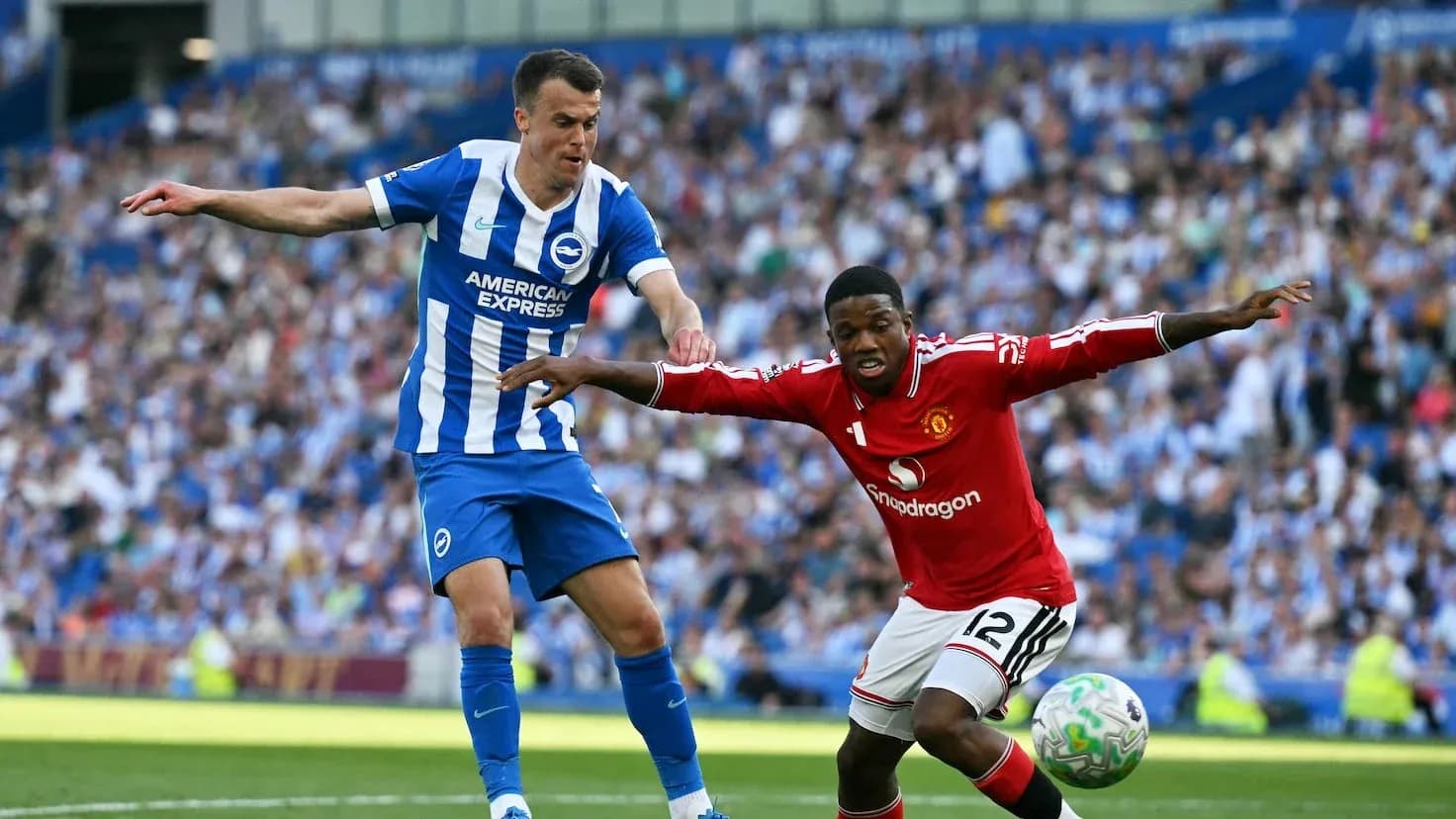
Manchester United’s 3-0 win at Amex Stadium was a clinic in vertical efficiency and defensive control from a 4-2-3-1 base, against a Brighton side using the same structure but with very different behaviours in possession. Despite Brighton edging the ball 51%–49% and out-shooting United 13–11, the visitors generated the higher-quality chances (xG 1.82 to 0.81) and finished decisively through P. Dorgu, B. Mbeumo and B. Fernandes, while protecting their own box with compact spacing and aggressive counter-pressing.
Both teams mirrored each other structurally, but the roles within the 4-2-3-1 diverged. Fabian Hurzeler set Brighton up with B. Verbruggen (Brighton) behind a back four of M. Wieffer, J. P. van Hecke, L. Dunk and F. Kadioglu. In front, P. Gross and J. Milner formed the double pivot, with a fluid three of D. Gomez, J. Hinshelwood and M. De Cuyper supporting D. Welbeck as the lone striker. The idea was clearly to create overloads in the half-spaces, using Gross and Milner to circulate and then release the advanced midfielders between United’s lines.
Michael Carrick’s United also lined up 4-2-3-1, but with a more direct and transition-oriented tilt. S. Lammens (Manchester United) started in goal, shielded by a back four of N. Mazraoui, H. Maguire, L. Martinez and L. Shaw. K. Mainoo and M. Mount were the double pivot, with A. Diallo and P. Dorgu wide, B. Fernandes as the central creator, and B. Mbeumo up front. The front four were tasked with attacking space early, particularly the channels around Brighton’s full-backs when they stepped high.
Brighton’s possession advantage came largely from their build-up patience. With 463 passes to United’s 447 and a strong 86% accuracy (397 accurate), they were comfortable recycling through Dunk and Gross. However, United’s mid-block was set to funnel Brighton into wide areas and then close the central lane into Welbeck. The visitors allowed Brighton to have the ball in the first two thirds, then sprang forward once turnovers occurred, using Fernandes and Mount to play early vertical passes into Mbeumo and the wingers.
The shot profile underlines the tactical contrast. Brighton managed 13 total shots, but only 2 on goal; United took 11 shots, with 7 on goal. United’s 7 shots on target from just 11 attempts reflect the clarity of their attacking patterns: attacks were constructed to end in high-quality final actions inside the box (7 shots inside the box), often after breaking Brighton’s first counter-press. Brighton, by contrast, were forced into more speculative efforts: 9 shots inside the box but with many under pressure, plus 4 from outside, and 5 efforts blocked. United’s back line, especially Maguire and Martinez, consistently stepped out to block and delay, allowing midfielders to recover behind the ball.
In goal, B. Verbruggen (Brighton) was busy and exposed. He made 5 saves and, according to the data, contributed 0.32 goals prevented – a sign that without his interventions the scoreline could have been heavier. United’s finishing, however, meant his work was not enough to alter the result. At the other end, S. Lammens (Manchester United) needed only 2 saves, reflecting how effectively United restricted Brighton’s clean looks rather than any lack of attacking volume. The defensive structure in front of him kept most of Brighton’s play in less dangerous central zones and wide areas, where crosses were either blocked or comfortably defended.
The key attacking axis for United revolved around Fernandes. His assist for Dorgu’s opener and his own goal after the interval captured his dual role as both creator and finisher. With Mainoo and Mount providing the platform, Fernandes could drift into pockets behind Gross and Milner, dragging Brighton’s pivots out and opening channels for Diallo and Dorgu to run into. The second goal, finished by Mbeumo from a Diallo assist, typified United’s wide-to-central pattern: win the ball, release a winger early, then attack the corridor between full-back and centre-back.
Brighton’s attacking midfield trio never fully solved United’s compact 4-4-2 out of possession shape, where Fernandes stepped up alongside Mbeumo to screen passes into Gross and Milner. This forced more lateral circulation and limited the number of line-breaking passes. Although Brighton drew 11 fouls (to United’s 8), they lacked the set-piece threat to convert territorial pressure, especially with 0 corner kicks recorded. United, with 3 corners, had more variety in dead-ball situations and could further pin Brighton back.
Discipline and control tilted towards United as well. They picked up the only card of the game – Kobbie Mainoo’s yellow for “Foul” at 45+3' – but that single infringement did not alter their ability to disrupt Brighton’s rhythm in midfield. The foul count and card profile underline a managed aggression: United broke up play when needed without slipping into chaotic defending.
In statistical terms, United’s 1.82 xG to Brighton’s 0.81 confirms that the 3-0 scoreline was rooted in chance quality rather than just clinical finishing. Brighton’s superior pass volume and accuracy did not translate into dangerous territory because United’s structure consistently protected the central lane and the edge of the box. Meanwhile, United’s slightly lower possession and pass count (447 passes, 369 accurate at 83%) reflect a deliberate choice to value progression over circulation.
Overall, this was a tactically mature away performance. United’s 4-2-3-1 flexed into a compact, hard-working defensive block and a ruthless transition unit, while Brighton’s mirror shape lacked penetration and protection in defensive transition. The numbers – from shots on goal to xG and goalkeeper saves – all converge on the same conclusion: United controlled where the game was played and how the decisive moments unfolded.