Maccabi Tel Aviv's Tactical Mastery in 1-0 Win Over Sheriff Tiraspol
Maccabi Tel Aviv’s 1–0 win over Sheriff Tiraspol at Batumi Arena in the UEFA Europa League 2nd Qualifying Round was a controlled, structurally coherent performance built on a clear 4-3-3 framework and territorial dominance rather than volume of chances. With both sides sharing 50% possession, the decisive edge came from Maccabi’s ability to turn their shape into sustained field position and set-piece pressure, forcing the own goal that ultimately separated the teams.
First Half
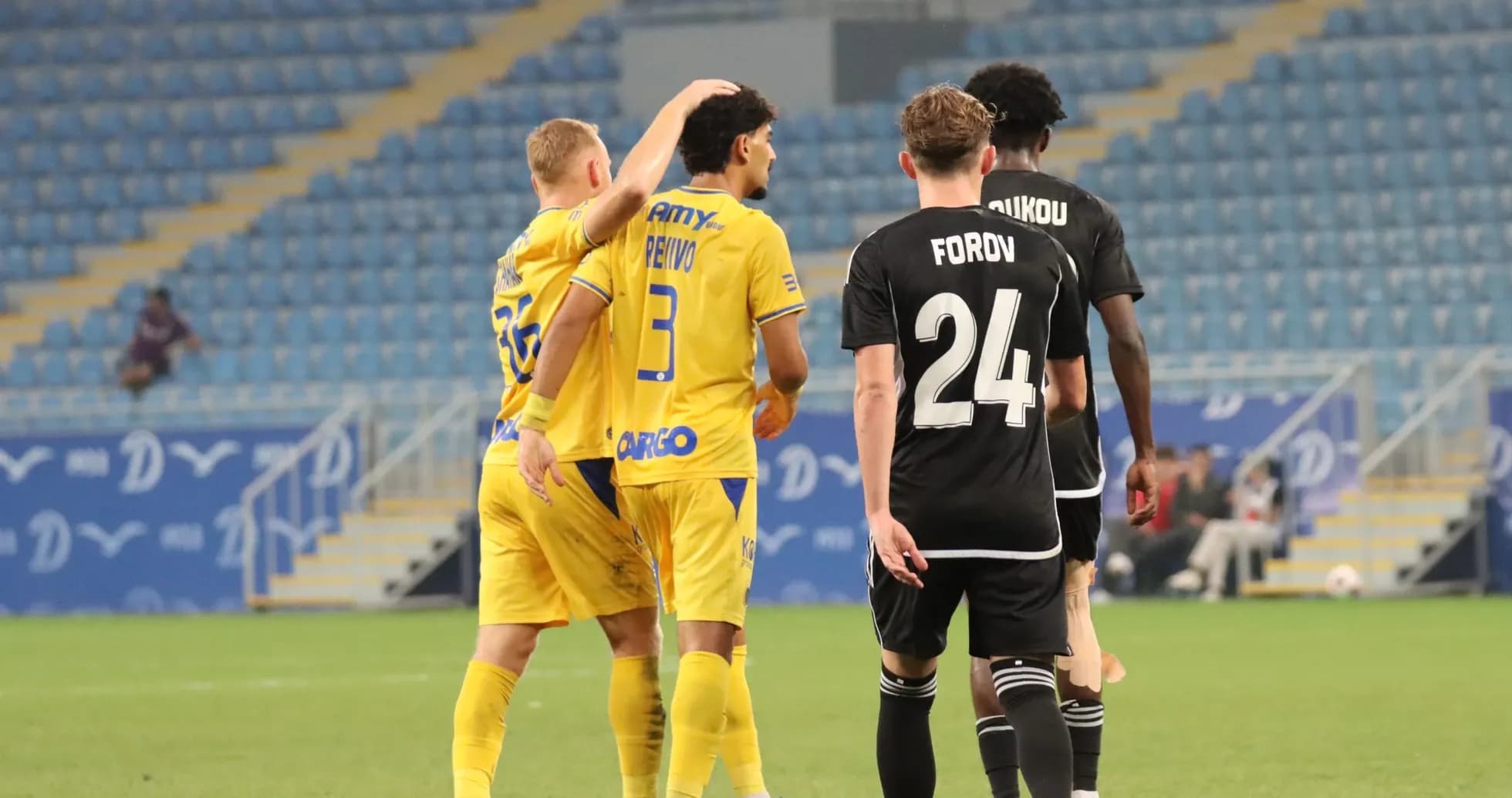
Kenny Miller’s 4-3-3 was textbook in its spacing. The back four of N. Ben Harush, M. Camara, R. Shlomo and R. Revivo gave Maccabi a broad base in the first line, with the full-backs positioned high enough to lock Sheriff in but rarely both committing at once, preserving rest defence against counters. Ahead of them, the midfield trio of D. Peretz, I. Sissokho and I. Shahar provided clear staggering: Peretz as the deeper controller, Sissokho shuttling into the right half-space, and Shahar drifting left to connect with R. Revivo and H. Varela.
In the front line, S. Abu Farkhi through the middle, S. Jehezkel on the right and Varela from the left formed a fluid three that often narrowed to overload the central channels. That compactness, combined with 12 corner kicks and 4 offsides, underlined how frequently Maccabi were pinning Sheriff back near their own box and probing the last line with runs in behind.
The key tactical event came on 29 minutes, when sustained pressure forced S. Kone into an own goal. The fact that the only goal arrived via an own goal rather than a crafted finish does not diminish the pattern behind it: Maccabi’s territorial control and repeated deliveries into the danger zone created the kind of stress that produces defensive errors. Their 3 shots on goal and 3 blocked shots show that, while they did not pepper the target, they consistently occupied the right zones and forced Sheriff into last-ditch interventions.
Defensive Strategy
Defensively, Maccabi’s structure was rarely stretched. Sheriff failed to register a single shot on goal, limited to 4 shots off target and just 2 blocked efforts. That points to a well-managed block rather than deep, desperate defending. Peretz screened the centre-backs effectively, and the distances between lines were short enough that Sheriff’s midfielders struggled to receive on the half-turn. When Sheriff tried to escape via the flanks, Maccabi’s wide players tracked diligently, and the full-backs chose their moments to step up, keeping the Moldovan side mostly in front of them.
Substitutions
The substitutions on 63 minutes further underlined Maccabi’s game-state management. I. Ben Simon (IN) came on for I. Shahar (OUT), and O. Davida (IN) for S. Jehezkel (OUT), refreshing the wide and midfield energy without altering the core 4-3-3 structure. Later changes – I. Noy (IN) for H. Varela (OUT) and I. Ben Hamo (IN) for N. Ben Harush (OUT) at 79 minutes – were clearly aimed at preserving intensity and defensive concentration down the flanks as Sheriff chased the game.
Opponent's Strategy
Sheriff Tiraspol also lined up in a nominal 4-3-3 under Victor Mihailov, but their interpretation was far more conservative. The back four of M. Ouedraogo, B. Ciss, B. Fomba and Rai often flattened into a low line, with Mota sitting close in front to form a quasi-back five in the non-possession phase. The midfield of D. Klas, A. Pergjoni and L. Jaures-Ulrich lacked vertical connections; too often, the distances to the front three – S. Kone, D. Forov and L. Jaures-Ulrich initially operating higher – were too large to sustain counters.
Sheriff’s 7 corner kicks suggest they had moments of territorial advancement, but the absence of shots on goal illustrates how sterile those phases were. Their 11 fouls and 2 yellow cards, both for “Tripping” (V. Nihaev at 71' and B. Ciss at 90+3'), reflected a side frequently arriving late into duels as they tried to disrupt Maccabi’s rhythm rather than impose their own.
The substitution pattern from Mihailov was aggressive in volume but limited in tactical impact. Sapata (IN) for Mota (OUT) at 57 minutes and V. Nihaev (IN) for S. Kone (OUT) at 59 minutes signalled a desire to add more ball progression and attacking threat, but the structural issues in linking midfield to attack persisted. A triple change at 77 minutes – N. Swen (IN) for A. Pergjoni (OUT), V. Cozma (IN) for L. Jaures-Ulrich (OUT), and J. Modelo (IN) for D. Forov (OUT) – reshaped the personnel but not the fundamental pattern: Sheriff remained too deep and too disconnected to convert possession into penetration.
Statistical Overview
From a statistical perspective, the match was defined more by control than volume. Both sides shared 50% possession, but Maccabi translated their share into 3 shots on goal, 5 shots off goal and 3 blocked shots, compared to Sheriff’s 0 shots on goal, 4 off goal and 2 blocked. The corner count (12–7 in Maccabi’s favour) reinforces the impression of territorial superiority and repeated final-third entries by the Israeli side.
Discipline also tells a tactical story. Maccabi committed 9 fouls and received no cards, suggesting largely controlled aggression and good timing in challenges. Sheriff’s 11 fouls and 2 yellow cards for “Tripping” highlight more reactive defending, especially as they pushed late on and were forced into riskier tackles.
With no recorded data for passes, passing accuracy, xG or goals prevented, the clearest indicators remain the shot profile and set-piece volume. In that context, Maccabi Tel Aviv’s 1–0 win appears fully aligned with the underlying dynamics: a structurally sound 4-3-3, territorial control, and enough pressure to force the decisive mistake, while restricting Sheriff Tiraspol to a threat profile that never seriously endangered the lead.