Liverpool and Brentford Draw 1-1: Tactical Analysis
Liverpool’s 1-1 draw with Brentford at Anfield was tactically defined by Liverpool’s territorial dominance against a compact 4-2-3-1 block, and Brentford’s efficiency in turning limited attacking moments into a decisive equaliser. Both sides mirrored each other structurally on paper, but the interpretation of the 4-2-3-1 systems diverged sharply in possession and in how they managed the central corridor.
Liverpool's Tactics
Liverpool’s 4-2-3-1 under Arne Slot was aggressively tilted towards sustained pressure. With 60% possession and 503 passes (434 accurate, 86%), they built consistently through the back four, using Ibrahima Konaté and Virgil van Dijk as the first playmakers. Curtis Jones, nominally at left-back on the grid, repeatedly stepped high and inside, effectively becoming an extra midfielder in the second phase. That positional freedom was rewarded on 58', when Jones arrived from deep to score, assisted by Mohamed Salah, a pattern that reflected Liverpool’s intent to overload the half-spaces rather than rely solely on the centre-forward.
The double pivot of Ryan Gravenberch and Alexis Mac Allister operated on staggered lines: Mac Allister more involved in initial circulation and tempo, Gravenberch driving into the inside channels. With 24 total shots, 17 inside the box and 8 on target, Liverpool constantly attacked Brentford’s penalty area, but often through crowded central zones. The 8 blocked shots underline how frequently Brentford’s back four plus double pivot were in position to contest shooting lanes, even when the line was forced deep.
Out wide, Salah and Dominik Szoboszlai worked as narrow attacking midfielders rather than chalk-on-boots wingers. Salah’s assist for Jones came from occupying the right half-space and drawing Brentford’s right-sided defenders infield, opening the blindside lane for Jones. On the left, R. Ngumoha looked to stretch and drive diagonally, but Liverpool’s attacks still gravitated centrally, which partly explains the high xG of 2.9 but only one goal scored: many of the chances were created in traffic rather than into completely unmarked zones.
Cody Gakpo, as the lone forward, often dropped between the lines to connect play, allowing the “3” behind him to run beyond. This created good combination play but sometimes left Liverpool without a true penalty-box reference when crosses were delivered from advanced full-back zones. The late substitutions reinforced the attacking structure rather than changing it: Florian Wirtz (IN) for Ngumoha at 73' and Jeremie Frimpong (IN) for Salah at 74' added fresh legs and verticality, but within the same 4-2-3-1 framework. M. Kerkez (IN) for Andrew Robertson and T. Nyoni (IN) for Gravenberch at 83', plus Joe Gomez (IN) for Konaté at 89', were more about energy and stability than a systemic reshuffle.
Brentford's Response
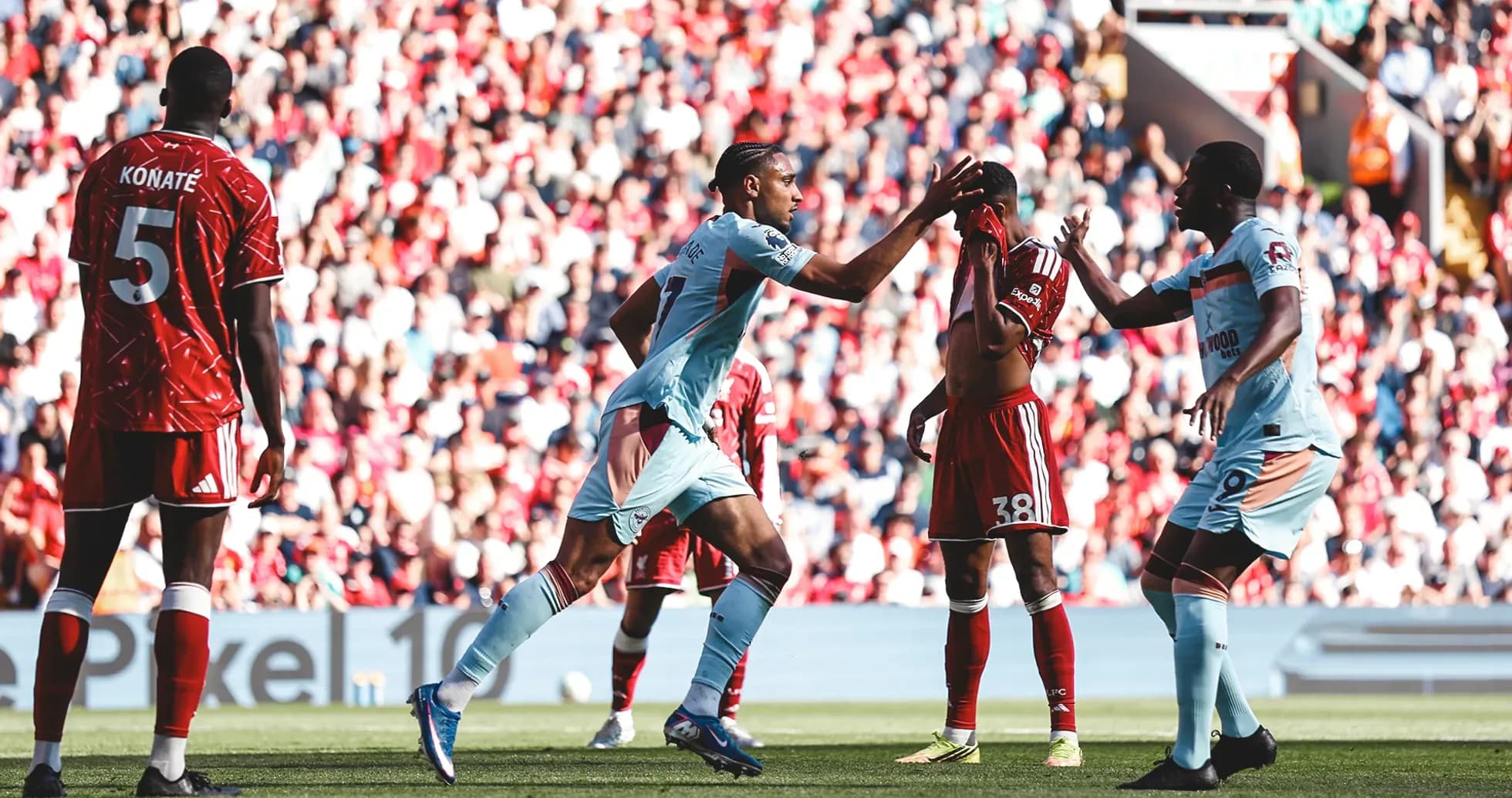
Out of possession, Liverpool’s press was front-footed, but Brentford’s equaliser on 64' exposed the risk margin. After Jordan Henderson (Brentford) had been withdrawn for Aaron Hickey on 60', Brentford gained fresher legs on the flank and slightly more vertical thrust. K. Schade’s goal on 64' came in the wake of that change, with Brentford exploiting transition space and Liverpool’s high defensive positioning. The fact that Brentford managed 9 shots inside the box from only 11 total attempts illustrates how they largely bypassed speculative efforts and focused on high-value situations when they did break Liverpool’s structure.
Brentford’s 4-2-3-1 under Keith Andrews was compact and reactive. With 40% possession and 331 passes (262 accurate, 79%), their priority was to maintain a narrow defensive block. The double pivot of Henderson and Vitaly Janelt shielded the centre, while the full-backs, M. Kayode and K. Lewis-Potter, tucked in to reduce the channels Liverpool wanted to exploit. The front four – D. Ouattara, M. Jensen, K. Schade and I. Thiago – worked primarily as the first line of resistance, with Schade providing the main outlet in transition, culminating in his 64' strike.
The substitution pattern underlined Brentford’s plan: Hickey (IN) for Henderson at 60' added defensive resilience and running power, Damsgaard (IN) for Jensen at 83' offered a fresh presser and ball-carrier, and R. Nelson (IN) for Lewis-Potter at 89' targeted late counter-attacking possibilities. None of these changes altered the base shape; they refreshed roles within an already conservative framework.
Goalkeeping Performances
Between the posts, Alisson (Liverpool) was largely a spectator in volume but crucial in moments, registering 1 save while Liverpool’s defensive structure limited Brentford to just 2 shots on target. His goals prevented figure of 1.4 suggests the quality of the few chances Brentford did fashion was significant, especially around Schade’s equaliser. At the other end, C. Kelleher (Brentford) was far busier, making 7 saves and matching Alisson’s 1.4 goals prevented. That combination – Liverpool’s 8 shots on target against Brentford’s 2, and parity in goals prevented – neatly encapsulates how Kelleher’s performance underpinned Brentford’s point.
Discipline and Game Management
Discipline and game management also shaped the tactical tone. Jordan Henderson’s early yellow for “Argument” set an edge to Brentford’s midfield battle, while late cautions for Konaté (“Foul”), Mac Allister (“Foul”), Nathan Collins (“Argument”) and Janelt (“Argument”) reflected the strain on both sides as Liverpool pushed for a winner and Brentford fought to disrupt rhythm and protect their shape.
Statistical Overview
Statistically, Liverpool’s 14 corners to Brentford’s 2 and their shot volume aligned with a side camped in the attacking half, but the final 1-1 scoreline, against an xG of 2.9 vs 1.22, points to a recurring tactical theme: dominance without ruthless penalty-box occupation. Brentford, by contrast, executed a low-volume, high-quality approach, using their 4-2-3-1 as a containment shell that sprang forward selectively. The draw, in tactical terms, was Liverpool’s control against Brentford’s efficiency and goalkeeping resilience, with both systems largely fulfilling their core objectives – just not enough for Liverpool to turn territorial control into a decisive win.