Lech Poznan's Tactical Domination Over FC Thun
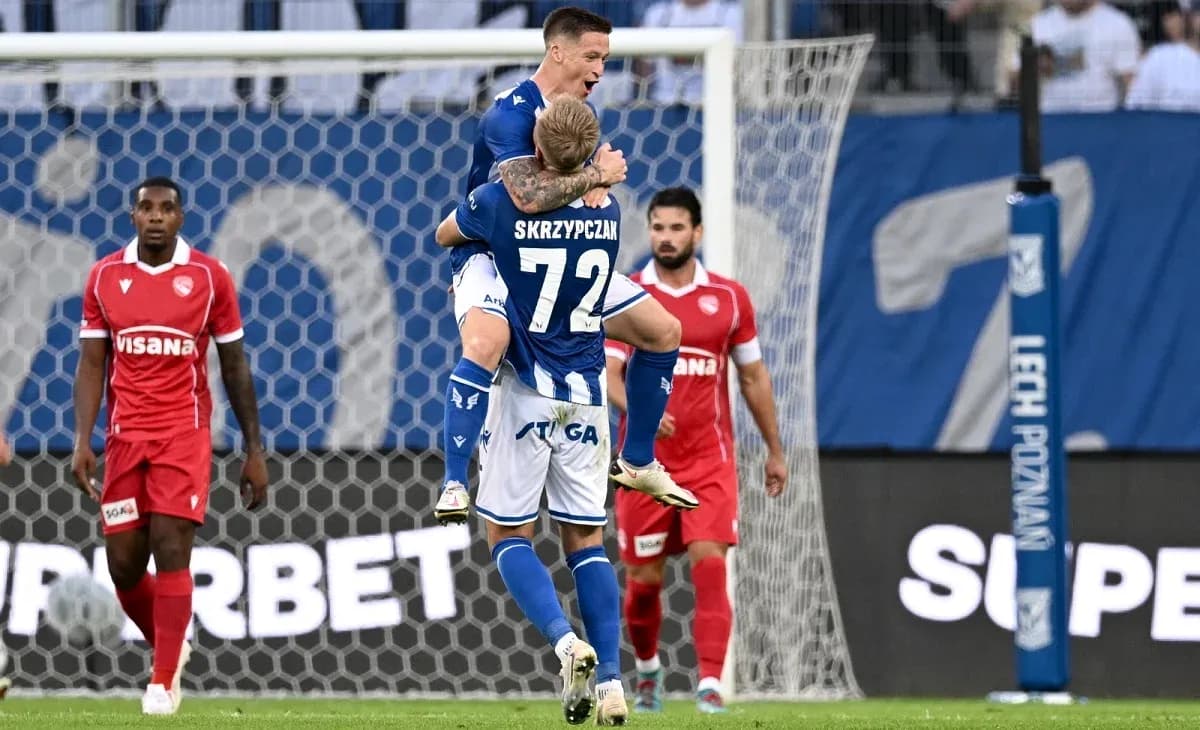
Lech Poznan’s 7-0 dismantling of FC Thun at Enea Poznań was a tactical domination built on structure and tempo as much as on attacking flair. Within a 4-2-3-1 framework, Niels Frederiksen’s side used an aggressive, high-possession approach (56% of the ball) to pin a 4-4-2 Thun block deep, repeatedly isolating their full-backs and centre-backs in wide–half-space channels. The 5-0 half-time scoreline reflected not only clinical finishing but a clear superiority in spacing, rotations between the lines, and second-ball control.
Team Structure
From the outset, Lech’s shape was very clear: M. Lis in goal behind a back four of J. Pereira, W. Monka, M. Skrzypczak and M. Gurgul; a double pivot of A. Kozubal and R. Murawski; an advanced line of three – L. Palma off the left, P. Rodriguez centrally, P. Walemark from the right – supporting A. Sayyadmanesh as the nominal striker. The structure gave Lech both width and verticality, with full-backs stepping high while the pivots staggered their positions to secure rest defence.
Attacking Strategy
In possession, Lech consistently created overloads on the right. Pereira advanced to join Walemark and Rodriguez, while Kozubal slid across to support. That triangle repeatedly drew out Thun’s left midfielder and left-back, opening the half-space for underlapping runs. The opening goals from Walemark and Sayyadmanesh came from this pattern: circulation to the right, a quick vertical action into the channel, and ruthless execution. Eleven shots on goal to Thun’s four underlined how often these combinations produced clean looks rather than speculative efforts.
Crucially, Lech’s front four interpreted their roles fluidly. Rodriguez frequently dropped between the lines to act as a third midfielder, allowing Murawski to push on and arrive late in the box – a movement rewarded with his goal just before the interval. Walemark, while listed as a midfielder, operated more like an inside forward: starting wide to stretch the line, then driving diagonally into central scoring zones. His brace before the 25th minute forced Thun’s back four to narrow, which in turn freed Gurgul to advance on the left and contribute with an assist.
Defensive Setup
Out of possession, Lech’s 4-2-3-1 became a compact 4-4-2, with Rodriguez stepping alongside Sayyadmanesh to press Thun’s centre-backs. The home side committed only 8 fouls, a sign of how often they regained the ball through positioning rather than last-ditch interventions. The double pivot screened effectively, cutting off direct service into B. Labeau and M. Gutbub, and funneling Thun’s build-up into the flanks where Lech could trap and counter. FC Thun’s 4-4-2 struggled to progress cleanly through midfield, and their 16 fouls reflected a reactive, chasing performance rather than a controlled press.
Thun's Struggles
Thun’s initial 4-4-2 setup – with a flat midfield of N. Reichmuth, J. Roth, N. Zoukit and V. Matoshi – never established stable possession. Their 44% share of the ball was largely in deeper zones, and when they did break forward, the attacks were often rushed. The front two were forced to drop very deep just to get touches, which blunted their threat in behind. Despite producing 4 shots on goal and 2 blocked shots, their chances were sporadic and disconnected from any sustained territorial pressure.
Substitutions and Adjustments
Luca Privitelli Gian tried to adjust early. The substitution of M. Gutbub for F. Dursun in first-half added time and the double change at 46' – introducing T. Strannegård and later N. Burgy – were clear attempts to add energy and defensive stability. However, with Lech already 4-0 up and scoring a fifth through Murawski before the break, these changes were more damage limitation than genuine tactical rebalancing. The later introduction of L. Dahler for Labeau at 82' further underlined Thun’s search for fresh legs and defensive cover rather than a coherent attacking plan.
Lech's In-Game Management
Frederiksen’s in-game management, by contrast, was proactive and controlled. With the contest effectively decided before half-time, he rotated key attacking pieces without sacrificing structure. At 37', D. Hakans (IN) came on for Walemark (OUT), a like-for-like switch that maintained the right-sided threat and was rewarded when Hakans scored early in the second half. On 64', R. Gumny (IN) replaced Rodriguez (OUT), and G. Berggren (IN) replaced Palma (OUT), subtly shifting Lech towards a more balanced, slightly more conservative posture while still allowing full-backs and wide players to push on. Later, K. Delikat (IN) for Kozubal (OUT) and W. Szymczak (IN) for Sayyadmanesh (OUT) at 80' continued the pattern: protect starters, preserve the 4-2-3-1 shape, and keep pressing Thun’s fragile back line.
Final Phases
Even as the tempo dropped, Lech continued to manage space intelligently. With fresh legs in wide areas and at full-back, they controlled transitions and limited Thun’s ability to counter, ensuring that the visitors’ late possession phases did not translate into high-quality chances. The yellow card for Radosław Murawski in the 87th minute reflected an isolated late challenge rather than a broader loss of control; discipline remained largely intact in a game where Thun’s frustration showed more clearly in their two bookings.
Statistical Overview
Statistically, the match confirmed the tactical story. Lech’s 56% possession was used to create pressure, not sterile circulation, as evidenced by their 11 shots on goal and 3 blocked efforts. They consistently turned territory into clear chances, and the 7-0 scoreline aligned with that volume of on-target attempts. Thun’s 4 shots on goal and 3 shots off target showed that they did find moments to threaten, but those moments were too rare and too isolated to alter the flow of the game.
The foul count – 8 for Lech, 16 for Thun – underscored the contrast between a side dictating the rhythm and one constantly arriving late into duels. Corner kicks (5 for Lech, 3 for Thun) further illustrated Lech’s territorial dominance, as they spent more time in advanced zones, forcing defensive interventions and clearances.
Without reliable data on passes, passing accuracy, xG or goals prevented, the clearest indicators remain the shot profile, possession split and disciplinary numbers. All three point in the same direction: Lech Poznan imposed their 4-2-3-1 both with and without the ball, used rotations and substitutions to maintain structural integrity, and methodically dismantled a FC Thun side whose 4-4-2 never adapted sufficiently to stem the flow of chances. The result was not just a heavy scoreline, but a comprehensive tactical statement in a UEFA Europa League Play-offs tie.