KuPS vs Universitatea Craiova: Tactical Analysis of UEFA Europa League Draw
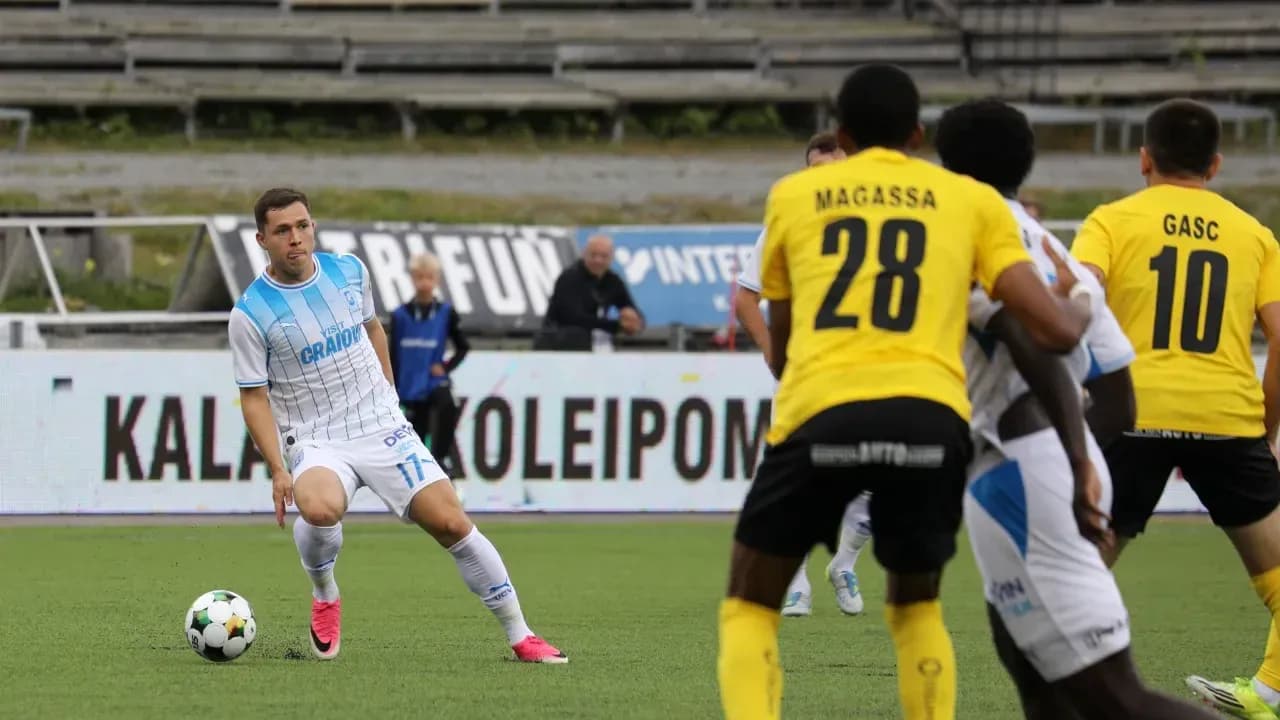
KuPS approached this UEFA Europa League 3rd Qualifying Round home leg at Savon Sanomat Areena in a 4-2-3-1 that was clearly designed to control territory and tempo. With a double pivot of V. R. Gasc and S. Touray and three advanced midfielders behind lone striker J. J. Moreno Ciorciari, the hosts sought to dominate central possession and push full-backs high. That plan is reflected in the 53% share of the ball and a 6–2 advantage in corner kicks. However, their structure did not translate into sustained penalty-area pressure: KuPS managed only 1 shot on goal, 2 shots off target and just 1 blocked effort, underlining how often their positional control stalled before becoming real threat.
Universitatea Craiova, in contrast, lined up in a 3-4-3 that was unapologetically geared towards verticality and efficiency rather than volume. The back three of A. Rus, N. Stevanovic and V. Screciu stayed compact, with wing-backs C. Mora and N. Bancu providing the width. In possession, the Romanians were content with 47% of the ball but produced 4 shots on goal, 3 off target and 1 blocked shot – a more dangerous profile per attack than KuPS. The front line of M. Etim, S. Nsimba and S. Baiaram operated on quick transitions, targeting the space behind KuPS’ advanced full-backs and exploiting any disorganisation in rest defence.
First Half
The first half showed the tactical trade-off in KuPS’ approach. With both full-backs – particularly Clinton Antwi on the left – stepping high, KuPS tried to pin Craiova’s wing-backs deep and create overloads in the half-spaces for T. Jyry and J. Luyeye-Lutumba. But when possession was lost, the home side’s counter-press was not sharp enough to protect the exposed centre-backs B. Magassa and K. Adams. The 38' opener from S. Baiaram for Universitatea Craiova, assisted by A. Rus, was emblematic: a direct sequence where the visitors bypassed KuPS’ midfield and attacked the back line before the block could reset. That goal arrived after KuPS had already committed 19 fouls overall in the match, an indication of how often they were forced into late defensive interventions to stop transitions.
Craiova’s 3-4-3 out of possession looked more like a 5-4-1 or 5-2-3, with the wing-backs dropping alongside the back three to create a strong line of five. This allowed them to defend their box with numbers and funnel KuPS into wide areas where crosses were relatively comfortable to deal with. Despite the hosts’ territorial edge and 6 corners, Craiova’s central block remained difficult to penetrate, which goes a long way to explaining why KuPS produced only a single shot on target across the 90 minutes.
Substitutions
The substitution wave around the hour mark was a clear tactical inflection point. At 59', Universitatea Craiova reshaped their attack: A. Al Hamlawi (IN) came on for S. Nsimba (OUT), Teles (IN) replaced A. Cicaldau (OUT) in midfield, and D. Matei (IN) took the place of goalscorer S. Baiaram (OUT). This triple change suggested a shift towards fresh legs in the press and possibly more control in the middle third, with Teles expected to help Craiova manage KuPS’ growing pressure.
Miika Nuutinen responded immediately on 60' with his own triple change for KuPS. S. Savolainen (IN) came on for V. R. Gasc (OUT), altering the profile of the double pivot; C. Kabuye (IN) replaced B. Armah (OUT), adding more direct running and attacking intent from wide areas; and P. Parzyszek (IN) entered for A. Puukko (OUT), giving KuPS a more traditional penalty-box presence and a stronger aerial reference. These moves collectively tilted KuPS towards a more aggressive, front-foot posture, sacrificing some midfield control for greater attacking threat.
The equaliser at 72' – J. J. Moreno Ciorciari finishing from a T. Jyry assist – was the logical outcome of that shift. With Parzyszek occupying centre-backs and Kabuye stretching the defensive line, spaces opened for Moreno Ciorciari to attack the box from his starting role as the central forward. Jyry, operating between the lines, finally found the pocket he had been searching for all evening, threading the decisive pass that turned possession into penetration. The goal also validated the decision to refresh the attacking structure rather than simply adding more like-for-like midfielders.
Further adjustments followed at 73', with A. Heinonen (IN) replacing J. Luyeye-Lutumba (OUT) for KuPS, adding fresh energy in the attacking midfield band, while Heriberto Tavares (IN) came on for M. Etim (OUT) for Universitatea Craiova, maintaining their counter-attacking threat with a new forward profile. At 83', S. Heiskanen (IN) replaced Clinton Antwi (OUT), a late-game tweak that slightly rebalanced KuPS’ left side, likely with an eye on stabilising transitions while still supporting attacks.
Disciplinary Pattern
The disciplinary pattern underpinned the tactical story. KuPS collected 2 yellow cards – Clinton Antwi at 36' and Saku Heiskanen at 88' – while Universitatea Craiova received 1 yellow, to Adrian Rus at 68'. The 19–15 foul count against KuPS reflects how often the home side had to break up Craiova’s transitions or halt counters after losing possession in advanced zones. Craiova, by contrast, were able to defend more within their structure, relying on compactness rather than repeated tactical fouling.
Goalkeeping data is not numerically specified, but the shot profile provides some context. Universitatea Craiova generated 4 shots on goal to KuPS’ 1, indicating that the KuPS defensive unit in front of H. Riihimaki allowed a higher volume of clear attempts than their own attack could muster against L. Popescu’s back line. Craiova’s defensive organisation, anchored by the back three and screened by midfielders like A. Mekvabishvili, effectively limited KuPS to low-quality, infrequent shots despite the hosts’ territorial advantage.
Conclusion
In strategic terms, the 1-1 draw leaves the tie finely poised but tactically revealing. KuPS demonstrated an ability to control the ball and adjust their attacking structure through impactful substitutions, yet their difficulty in converting possession into shots on goal remains a concern ahead of the away leg. Universitatea Craiova showed that their 3-4-3 can absorb pressure and strike efficiently in transition, with flexible in-game management to refresh key zones. The second leg will likely hinge on whether KuPS can refine their final-third mechanisms without further exposing themselves to the counter-attacking strengths Craiova displayed in Kuopio.