Juventus Secures 2–0 Victory Over Bologna in Serie A
Juventus controlled a mature 2–0 win over Bologna at Allianz Stadium in Serie A Round 33, built on an explosive start and then managed with tactical discipline. Jonathan David’s strike at 2' and Khéphren Thuram’s second-half finish gave the hosts a two-goal cushion that they never looked likely to relinquish. With the score 1–0 at halftime and 2–0 at full time, the pattern was clear: Juventus struck early, then used structure and control to throttle Bologna’s attacking routes while picking their moments to attack, finishing with the better chances and the cleaner defensive sheet.
Scoring Sequence
The scoring sequence began almost immediately. At 2', Jonathan David converted for Juventus, assisted by Pierre Kalulu. The move reflected Juventus’ intent to use their 3-4-2-1 to attack quickly through the right side, with Kalulu stepping out from the back line to provide the key pass. The 1–0 lead held through to the interval, matching the recorded halftime score.
Second Half
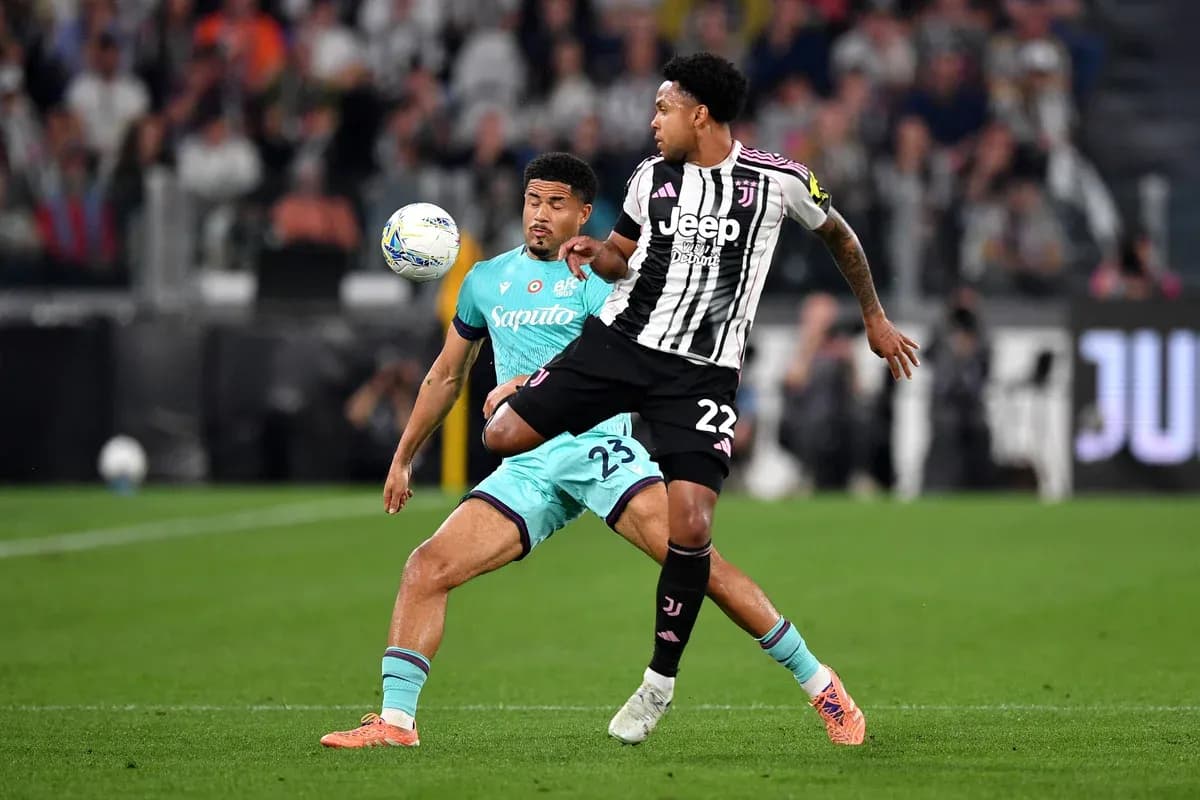
The second half opened with Massimiliano Allegri (coach not listed but structure clear) making his first adjustment at 46': Khéphren Thuram (IN) came on for Emil Holm (OUT), a change that would prove decisive. Thuram added fresh dynamism in midfield and was rewarded at 57', scoring Juventus’ second goal after a combination with Weston McKennie, who provided the assist. That strike pushed the match to 2–0 and effectively changed the tactical landscape, forcing Bologna to chase.
Thiago Motta’s Bologna responded with a triple substitution phase between 58' and 59'. At 58', Nikola Moro (IN) came on for Tommaso Pobega (OUT), looking to add more ball progression from midfield. One minute later, at 59', Jonathan Rowe (IN) replaced Nicolò Cambiaghi (OUT) to freshen the left wing, and Lewis Ferguson (IN) entered for Simon Sohm (OUT), seeking more verticality and late box runs. Juventus’ only card of the match arrived at 60', when Manuel Locatelli was booked for a foul, underlining his combative screening role in front of the back three.
Bologna continued to adjust at 68', with Torbjørn Heggem (IN) replacing Eivind Helland (OUT), a defensive reshuffle to cope with Juventus’ transitions and to add energy in the back line. Juventus then managed their own attacking resources at 72', making a double change: Edon Zhegrova (IN) came on for Francisco Conceição (OUT), and Kenan Yıldız (IN) replaced Jonathan David (OUT). Those moves shifted Juventus towards a more counter-attacking posture with fresh forwards. Bologna’s final attacking change came at 77', when Federico Bernardeschi (IN) entered for Santiago Castro (OUT), aiming to add creativity and shooting threat from wide areas. Juventus closed with two late substitutions to lock down the result: at 80', Federico Gatti (IN) replaced Andrea Cambiaso (OUT), adding defensive security, and at 86', Loïs Openda (IN) came on for Jeremie Boga (OUT), preserving depth in the front line while maintaining an outlet.
Tactical Overview
From a tactical standpoint, Juventus’ 3-4-2-1 functioned as a flexible 3-2-5 in possession and a compact 5-4-1 without the ball. Michele Di Gregorio had a relatively quiet evening, registering just 1 save and facing no shots on target from Bologna, a testament to Juventus’ Defensive Index in this match: they allowed 7 total shots, but crucially none on goal, and limited Bologna to an expected goals figure of 0.59. The back three of Lloyd Kelly (left), Bremer (central), and Pierre Kalulu (right) stayed narrow and aggressive in duels, with Kalulu’s early assist highlighting his licence to step into midfield when space opened.
The wing-backs, Emil Holm on the right and Andrea Cambiaso on the left, were key to territorial control. In the first half, Holm pushed very high to pin Bologna’s left-back Juan Miranda, while Cambiaso provided balance and recycling on the opposite flank. After Holm’s withdrawal at 46', Thuram’s introduction reconfigured the midfield: Juventus effectively shifted into a more robust central trio with Locatelli anchoring, McKennie shuttling, and Thuram driving forward. This gave Juventus superiority against Bologna’s 4-3-3 midfield of Freuler, Sohm, and Pobega (later Moro and Ferguson), allowing the hosts to dominate second balls and control tempo.
In the attacking band, Francisco Conceição and Jeremie Boga operated as narrow playmakers behind Jonathan David. Conceição frequently drifted inside from the right half-space, while Boga attacked 1v1s on the left. David’s early goal came from clever movement off the shoulder of Bologna’s centre-backs Jhon Lucumí and Eivind Helland, exploiting a still-settling back four. After David’s withdrawal at 72', Kenan Yıldız and Edon Zhegrova offered fresh legs and more ball-carrying threat on counters, while Openda’s late entrance at 86' ensured Juventus always had depth to stretch Bologna’s defensive line.
Bologna's Struggles
Bologna’s 4-3-3 struggled to convert possession phases into real threat. Despite 45% of the ball and 398 total passes (332 accurate, 83% pass accuracy), they managed 7 shots but none on target. Their Overall Form in this match was possession-competent but toothless in the final third. Riccardo Orsolini and Nicolò Cambiaghi, then Rowe and Bernardeschi, could not find consistent separation against Juventus’ compact block, and central striker Santiago Castro was largely isolated between Bremer and Kelly. Federico Ravaglia in goal made 2 saves, facing 4 shots on target from Juventus, with the visitors’ defensive line often exposed in early transitions, particularly in the opening minutes and around Thuram’s goal.
Statistically, Juventus’ 14 total shots (4 on goal, 6 blocked) and xG of 1.31 align closely with their two-goal output, indicating clinical but not excessive finishing. Bologna’s xG of 0.59 underlines how effectively Juventus suppressed high-quality chances. Possession at 55%–45% in Juventus’ favour reflects a controlled, not dominant, approach: the hosts were content to manage phases rather than chase volume. Fouls were low overall (10 by Juventus, 5 by Bologna), with just one yellow card – Locatelli’s for a foul at 60' – illustrating a match governed more by structure than by disruption.
In synthesis, Juventus’ Overall Form on the day was that of a mature, top-end side: early incision, mid-game control, and late-game management. Their Defensive Index was particularly strong, holding Bologna to zero shots on target and a sub-0.6 xG, while their attacking structure generated enough quality to justify a clear 2–0 victory without needing to overextend.