Jagiellonia's Tactical Victory Over Rangers: A 2-1 Analysis
Jagiellonia’s 2-1 win over Rangers at Chorten Arena was built on a clear structural contrast: the hosts’ 4-3-3 controlling central zones through a compact midfield triangle, against Rangers’ 4-2-3-1 that never fully solved the spaces between their double pivot and back four. Despite only a narrow edge in possession (52% to 48%), Jagiellonia shaped the tempo, turned early chaos into an advantage, and then managed the game with disciplined spacing rather than deep retreat.
Out of possession, Jagiellonia’s front three and advanced midfielders defended in a 4-1-4-1/4-5-1 hybrid. N. Prelec led the line, with K. Szmyt and J. Imaz narrowing infield to screen Rangers’ first pass into D. Neil and T. Chukwuani. Behind them, T. Romanczuk sat as the single pivot, with S. Lozano and later his replacement A. Klynge stepping up to press Rangers’ second line when the ball travelled wide. This structure forced Rangers to build via the full-backs, where Jagiellonia’s wingers could press on an angle, supported by aggressive stepping from the near-side centre-back, usually A. Konstantopoulos or Y. Kobayashi.
With the ball, Jagiellonia’s 4-3-3 often resembled a 2-3-5 in settled possession. Full-backs N. Wojtuszek and G. Montoia advanced high and wide, pinning Rangers’ wingers and stretching the 4-2-3-1. Romanczuk dropped between or just ahead of the centre-backs to form the first line of circulation, while Lozano and Imaz occupied the half-spaces. This created consistent overloads between Rangers’ lines: the double pivot had to protect both central lanes and the half-spaces, which opened pockets for Szmyt to receive facing goal. The fact Jagiellonia generated 7 shots on goal from modest overall volume speaks to the quality of their shot locations, with many attacks funnelling through Szmyt’s intelligent positioning between Rangers’ midfield and defence.
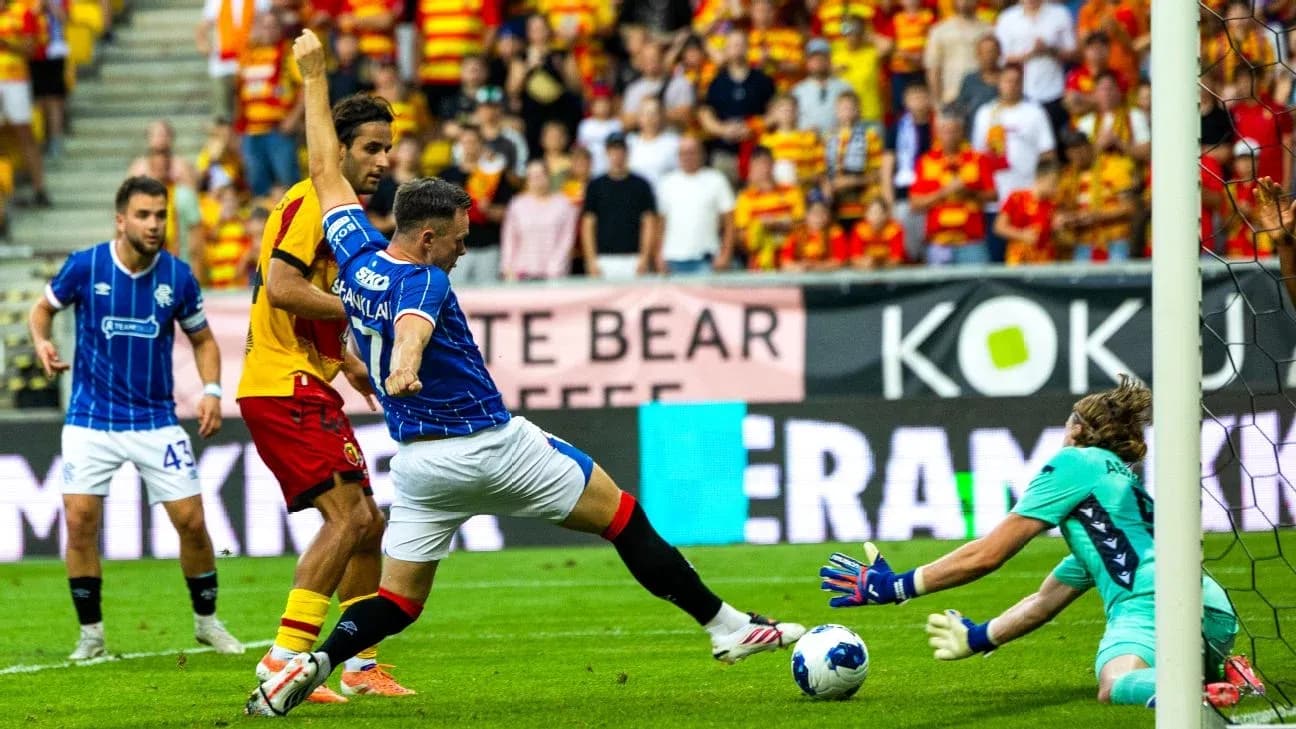
The goal sequence underlined these structural themes. An early own goal by G. Montoia, credited to Rangers, came from a defensive scramble rather than any sustained Rangers pattern; tactically it was an isolated error rather than a systemic flaw. Jagiellonia’s response was immediate and controlled. The own goal by E. Fernandez, credited to Jagiellonia, and then the composed finish by Szmyt at 21' both stemmed from the hosts’ ability to pin Rangers deep and force hurried clearances or misjudged defensive actions. Rangers’ back four struggled whenever Jagiellonia could combine in the left half-space, where Imaz and Szmyt repeatedly exploited the channel between full-back and centre-back.
Rangers’ 4-2-3-1 lacked vertical connection for long stretches. With Chermiti up front and D. Yokota, T. Aasgaard and M. Diomande working behind him, there was an on-paper platform to attack the spaces behind Jagiellonia’s advanced full-backs. In practice, the double pivot of Neil and Chukwuani (later replaced by N. Raskin and others) often received under pressure with their backs to goal. Without clean turns or third-man combinations, Rangers were forced into longer passes that Jagiellonia’s centre-backs could defend comfortably. The visitors’ 3 shots on goal and 5 corners indicate sporadic threat, mostly from wide deliveries and second balls rather than crafted central incursions.
The second-half substitution wave from Rangers at 46' was a clear tactical admission that the initial midfield balance was failing. C. Devlin for Chukwuani, Raskin for Neil and F. Curtis for Yokota were all designed to inject more energy and progression through the centre. Devlin and Raskin gave Rangers more bite and forward passing from the double pivot, and Curtis offered fresher legs between the lines. Yet Jagiellonia’s response was equally strategic: at 65', J. Agbonifo (IN) came on for R. Conceicao (OUT), and A. Klynge (IN) replaced Lozano (OUT), adding dynamism in midfield and fresh pressing energy on the flanks to preserve the central compactness.
Jagiellonia’s defensive line management was notable once they led 2-1. Rather than dropping to the edge of their own box, they held a medium block, with the back four around the 35–40 metre line and Romanczuk screening. This limited Rangers’ ability to pin them deep and kept the game in the middle third. The foul count (11 for Jagiellonia, 15 for Rangers) supports this: the hosts were not forced into constant last-ditch defending, while Rangers increasingly resorted to disruptive fouls as they tried to regain the ball after turnovers.
The late substitutions from both sides were about game state. At 76', V. Dragojevic (IN) for T. Aasgaard (OUT) aimed to freshen Rangers’ attacking midfield, and at 80' D. Drachal (IN) for Imaz (OUT) plus Y. Sylla (IN) for Prelec (OUT) allowed Jagiellonia to add legs in central areas and up front to chase and contest long clearances. At 85', L. Shankland (IN) for R. McCrorie (OUT) signalled a more direct, striker-heavy approach from Rangers, but by then Jagiellonia’s structure was entrenched and the game had tilted into a pattern of managed risk rather than open exchange.
Discipline also shaped the tactical tone. Rangers collected three yellow cards (Tuur Rommens 5', Tochi Chukwuani 34', Nicolas Raskin 90+2') to Jagiellonia’s single booking for Yuki Kobayashi at 88'. While no reasons were recorded, the distribution aligns with Rangers’ greater defensive strain and increased aggression in the chase phase, especially late on as they pushed numbers forward and left themselves exposed to transition fouls.
Statistically, Jagiellonia’s 7 shots on goal to Rangers’ 3, combined with a slight possession edge and fewer fouls, paints the picture of a side that controlled both territory and shot quality. Rangers’ 5 corners and 4 shots off goal show they did create moments, but mostly from wide play and without consistent central penetration. The absence of recorded goalkeeper saves and xG data prevents a deeper numerical dive, yet the available metrics align tightly with the visual tactical story: Jagiellonia’s 4-3-3 offered clearer attacking patterns and more stable defensive spacing, while Rangers’ 4-2-3-1 never fully solved the central overloads or found a reliable route through the home block.