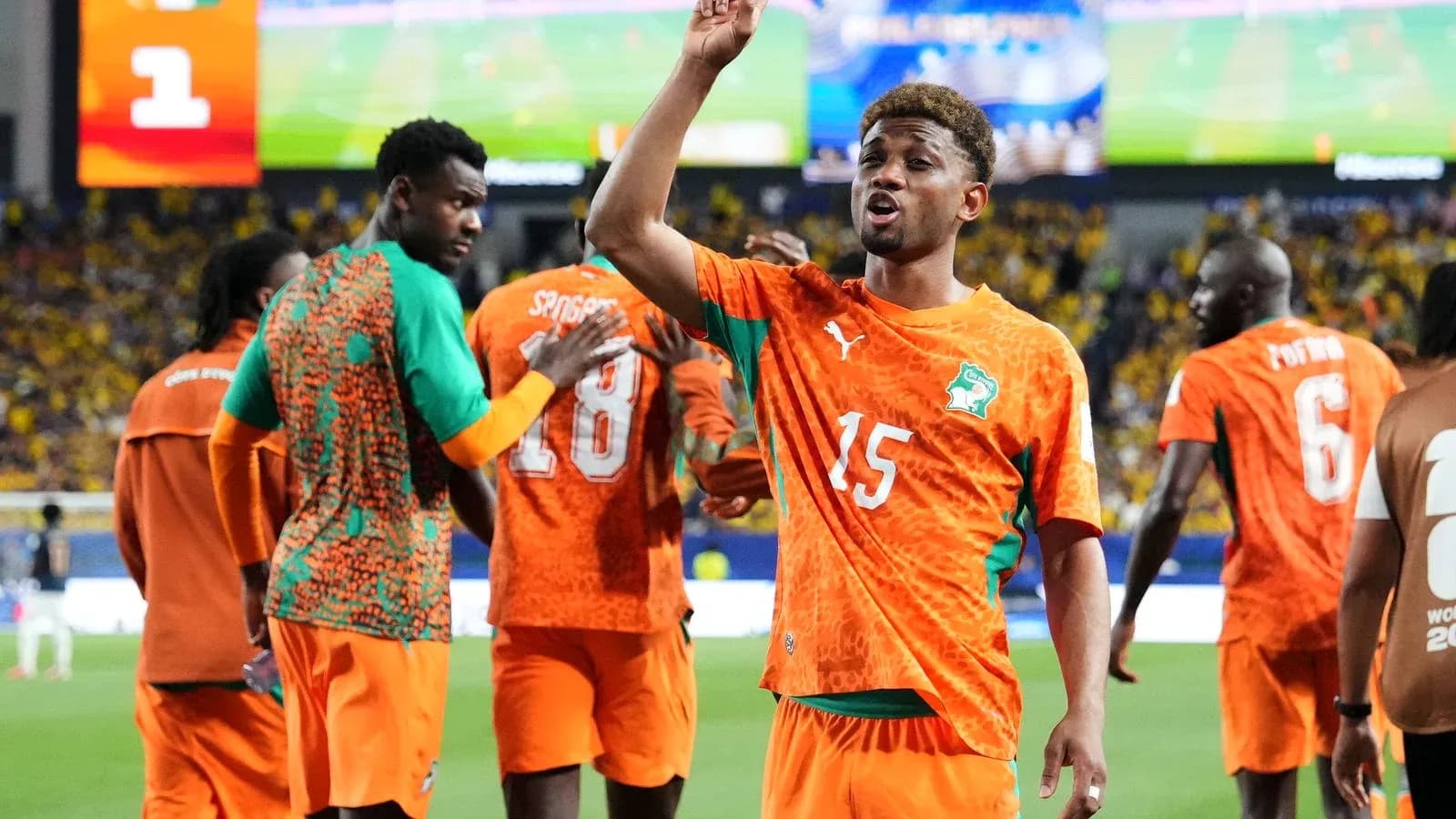
Ivory Coast's Tactical Edge in 1-0 Victory Over Ecuador
Ivory Coast’s 1-0 win over Ecuador at Lincoln Financial Field was a classic case of a team bending without breaking, then finding a late structural advantage. Both sides lined up in a 4-4-2, but the way they interpreted the shape produced very different tactical profiles over 90 minutes.
Ivory Coast, under Emerse Fae, used a compact, vertically oriented 4-4-2 built around central power and direct running. The double pivot of Franck Kessié and Seko Fofana sat slightly offset: Kessié more responsible for first-phase circulation, Fofana stepping higher to break lines with carries and passes. With 470 passes and 397 accurate (84%), Ivory Coast were not purely reactive; they accepted a marginal possession deficit (48%) but used the ball more purposefully in advanced zones, reflected in a higher shot volume (15 total, 4 on goal) and xG of 1.52.
The wide midfielders were key to the structure. Bazoumana Touré on the left and Yan Diomande on the right tucked infield without the ball, forming a narrow second line that protected the half-spaces in front of the back four. That allowed the full-backs, Ghislain Konan and Guéla Doué, to defend aggressively on the front foot against Ecuador’s wide threats. Wilfried Singo and Emmanuel Agbadou anchored the defensive line centrally, stepping into duels early to prevent Enner Valencia and Gonzalo Plata from receiving on the turn between the lines.
Ecuador, with Sebastian Beccacece’s 4-4-2, leaned more on structured possession and gradual progression. They finished with 52% of the ball, 492 passes and 419 accurate (85%), but generated slightly fewer shots (12 total, 1 on goal) and a lower xG of 1.01. Their midfield four of John Yeboah, Moisés Caicedo, Pedro Vite and Alan Minda aimed to create overloads around Caicedo as the central reference point. The idea was to pull Ivory Coast’s narrow block out of shape, then exploit the wide channels with diagonal switches.
However, Ivory Coast’s central compactness meant Ecuador’s possession often remained in front of the block. Shots were split between 5 inside the box and 7 from range, illustrating how rarely they were able to penetrate cleanly. The back four of Konan, Agbadou, Singo and Doué consistently held their line just outside the box, forcing Ecuador to settle for lower-quality attempts.
The goalkeeper dynamic underpinned this. Yahia Fofana (Ivory Coast) faced only 1 shot on goal and made 1 save, supported by a line that allowed 12 shots but kept most at manageable distances and angles. At the other end, Hernán Galíndez (Ecuador) made 3 saves from Ivory Coast’s 4 shots on target; Ecuador’s back line allowed 8 shots inside the box, a critical difference that left their goalkeeper more exposed in high-value zones.
Discipline and duels shaped the midfield battle. Ivory Coast committed 10 fouls and took 3 yellow cards, each reflective of their high-intensity, risk-accepting approach in central areas. Seko Fofana’s booking for “Roughing” at 28' highlighted his role as the aggressive presser stepping out of the double pivot. Franck Kessié’s “Tripping” yellow at 38' and Guéla Doué’s “Tripping” card at 40' both came as Ecuador tried to accelerate through the middle and right channels; Ivory Coast were willing to break rhythm with tactical fouls to protect their structure.
Ecuador, with 13 fouls and 1 yellow, were more often the team reacting to Ivory Coast’s direct surges once the Elephants broke the first line. Jackson Porozo’s “Holding” caution at 73' underlined a recurring issue: when Ivory Coast’s forwards or advanced midfielders received between the lines or running in behind, Ecuador’s defenders were occasionally forced into emergency defending rather than controlling the duel earlier.
The substitution pattern after the interval was decisive tactically. At 56', Beccacece replaced Alan Minda with Nilson Angulo, seeking more direct running from the left. Simultaneously, Fae made a double attacking adjustment: Ange-Yoan Bonny (IN) came on for Elye Wahi (OUT), and Amad Diallo (IN) came on for Bazoumana Touré (OUT). This shifted Ivory Coast’s front line profile. Bonny offered more back-to-goal presence, while Amad introduced a left-sided playmaker who could receive between the lines and combine.
Ecuador’s response at 62' — Ángelo Preciado (IN) for John Yeboah (OUT) and Jackson Porozo (IN) for Alan Franco (OUT) — subtly rebalanced their right flank. Preciado gave more thrust from full-back, while Porozo added aerial and physical presence in the defensive line. Yet this also meant Ecuador’s right side became more vertical and less intricate, making their attacks more predictable against Ivory Coast’s compact block.
At 77', Fae doubled down on control and fresh legs in midfield: Christ Inao Oulaï (IN) came on for Nicolas Pépé (OUT), and Ibrahim Sangaré (IN) came on for Seko Fofana (OUT). Ecuador, in turn, brought on Kevin Rodriguez (IN) for Enner Valencia (OUT), trading the captain’s penalty-box craft for more mobility and pressing from the front. Ivory Coast’s changes tilted the game: Sangaré’s presence as a more positionally disciplined midfielder helped lock down central spaces as Ecuador chased the game, while Amad and Bonny continued to threaten in transition.
The final Ivory Coast change at 89' — Odilon Kossounou (IN) for Guéla Doué (OUT) — was a clear defensive consolidation move, adding a natural centre-back profile to protect the lead and aerial space.
The winning goal at 90' crystallised these tactical trends. Amad Diallo, introduced as a left-sided attacker with license to drift, found the decisive moment, finishing after a contribution from Wilfried Singo, who had been encouraged all game to step up from the back line when space opened. It was the product of Ivory Coast’s superior occupation of advanced zones in the closing stages, as Ecuador’s structure stretched in search of a winner and left larger gaps for late runners.
Statistically, the match confirmed the eye test. Ivory Coast created more and better chances (15 shots, xG 1.52) despite having slightly less of the ball. Ecuador’s 52% possession and 492 passes suggested control, but their final-third play lacked the vertical incision to convert that into high-quality shots, finishing with only 1 effort on target and xG 1.01. Both sides blocked 3 shots, indicating committed defending in the box, but Ivory Coast’s ability to keep most Ecuadorian attempts from prime locations reduced the burden on Yahia Fofana (Ivory Coast).
In contrast, Galíndez (Ecuador) had to intervene more often as Ivory Coast managed 8 shots inside the box, reflecting the home side’s superior manipulation of Ecuador’s defensive line. The foul and card profile — Ivory Coast 10 fouls and 3 yellows, Ecuador 13 fouls and 1 yellow, total 4 cards — underlined a contest where Ivory Coast accepted disciplinary risk to protect their compactness, while Ecuador’s reactive fouling could not prevent a late structural breakdown. Overall, Ivory Coast’s 1-0 win was less about dominance in raw possession and more about superior spatial control, targeted substitutions, and sharper execution in the final third.