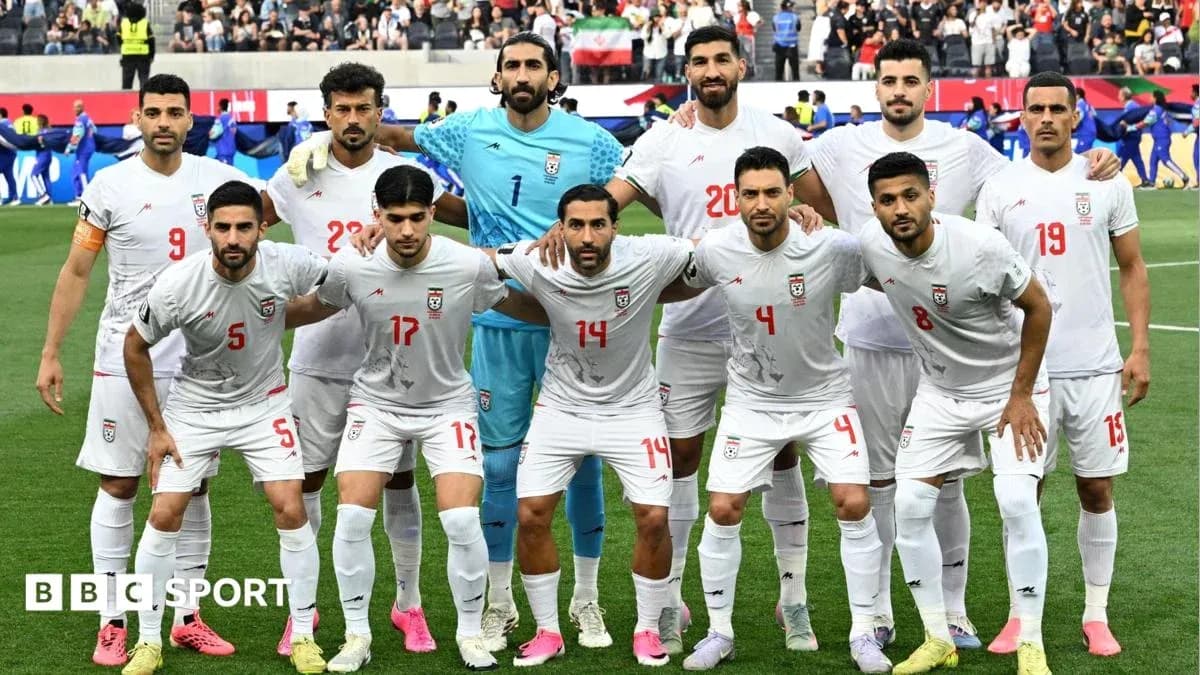
Iran Files Complaint to FIFA Over US Travel Restrictions for World Cup
Iran’s World Cup campaign is being fought on two fronts: on the pitch, and at the border.
The Football Federation of Iran (FFIRI) has announced it will file an official complaint to Fifa over strict US travel restrictions that it says leave the national team at a competitive disadvantage at the 2026 World Cup.
Under the conditions of their visas, Iran’s players and staff are only permitted to enter the United States — co-host of the tournament alongside Canada and Mexico — the day before each match and must leave the country on the same day the game is played.
For a team whose remaining group fixtures are both on US soil, that is no small detail. It shapes their entire tournament.
“Most oppressed” – Ghalenoei’s anger after New Zealand draw
The impact of those rules was felt immediately. Iran opened their World Cup with a 2-2 draw against New Zealand in Los Angeles, a result overshadowed by head coach Amir Ghalenoei’s stark assessment of their circumstances.
He described Iran as the “most oppressed” team at the tournament, pointing directly at the travel constraints and preparation time as key concerns.
The FFIRI backed that stance in a strongly worded statement, arguing that the visa conditions are “inconsistent with the principle of providing equal conditions for all participating teams and may negatively affect teams’ preparation processes”.
The federation confirmed it “will formally express its dissatisfaction and lodge an official complaint with Fifa through the appropriate channels”.
Base moved, staff blocked, tickets revoked
Iran’s very presence at this World Cup has been wrapped in uncertainty, tied to the war in the Middle East and the security and political tensions that have followed.
Originally due to be based in Arizona, Iran switched their World Cup camp to Tijuana in Mexico as the regional conflict escalated. That decision alone underlined how different their logistical reality is from most of their rivals.
The complications did not stop there. Multiple “integral” members of Iran’s backroom staff were denied US entry visas, cutting into the support structure around the squad. On top of that, the FFIRI says its ticket allocation was revoked on the eve of the tournament, prompting a public appeal for Fifa to “uphold the principles of neutrality, fairness, and established regulations”.
The friction was visible off the pitch as well. After the New Zealand match in Los Angeles, Fifa president Gianni Infantino went into Iran’s dressing room, a rare intervention that underlined the level of tension surrounding the team.
US response: “The team agreed to these terms”
American authorities insist the framework was clear from the outset.
“The Iranian national football team agreed to these terms,” a Department of Homeland Security spokesperson told the BBC when asked about Ghalenoei’s complaints.
Andrew Giuliani, executive director of the White House Fifa Task Force, reinforced that position in an interview with CBS News, spelling out exactly how Iran’s movements will be controlled.
“The team will be allowed to come in, match day minus one, so the day before the match,” Giuliani said. “They’ll be asked to leave the day that the match wraps up, so the evening of the match. And they’ll be able to do that again in Los Angeles.”
In other words: no extended stays, no extra adaptation time, no exceptions.
Iran say preparation “not approved”
From Iran’s perspective, that timetable is unworkable for elite competition.
The FFIRI said the national team “needed to arrive in each host city two days before every match and return to its base camp the day after the game in order to achieve optimal technical and physical preparation”.
That request, they say, “was not approved” for the opener against New Zealand. The federation argues that the consequences are sporting, not just administrative.
The same pattern has already repeated.
Looking ahead to their second group match against Belgium in Los Angeles on 21 June (20:00 BST), Iran asked to travel to the city two days before kick-off. The game is scheduled for 12:00 local time, a midday start that heightens the need, in their view, for acclimatisation and a full training session on site.
“The aim was to provide sufficient time for players to adapt to the match conditions, complete their final training session, and finalise preparations,” the FFIRI said.
“Despite the technical reasons presented by the federation, the request was once again denied.”
Politics, peace deals and a tight schedule
All of this plays out against a fraught diplomatic backdrop.
The presidents of the US and Iran have signed an initial peace deal aimed at ending the war in the Middle East, a development that might have suggested a thaw in relations. On the ground, for this World Cup, the reality is harsher.
Iran must shuttle between their base in Tijuana and US host cities on a 24–48-hour loop, preparing for Belgium in Los Angeles and Egypt in Seattle on 27 June (04:00 BST), while operating under visa rules that leave almost no margin for delay or disruption.
The football will go on. The question now is whether Iran can keep their World Cup alive while fighting a schedule and a border as fiercely as any opponent in their group.