Hannibal Mejbri: From La Banane to Tunisia's Football Frontier
The boy named for a general who terrified Rome now leads a nation trying to conquer its own football frontier.
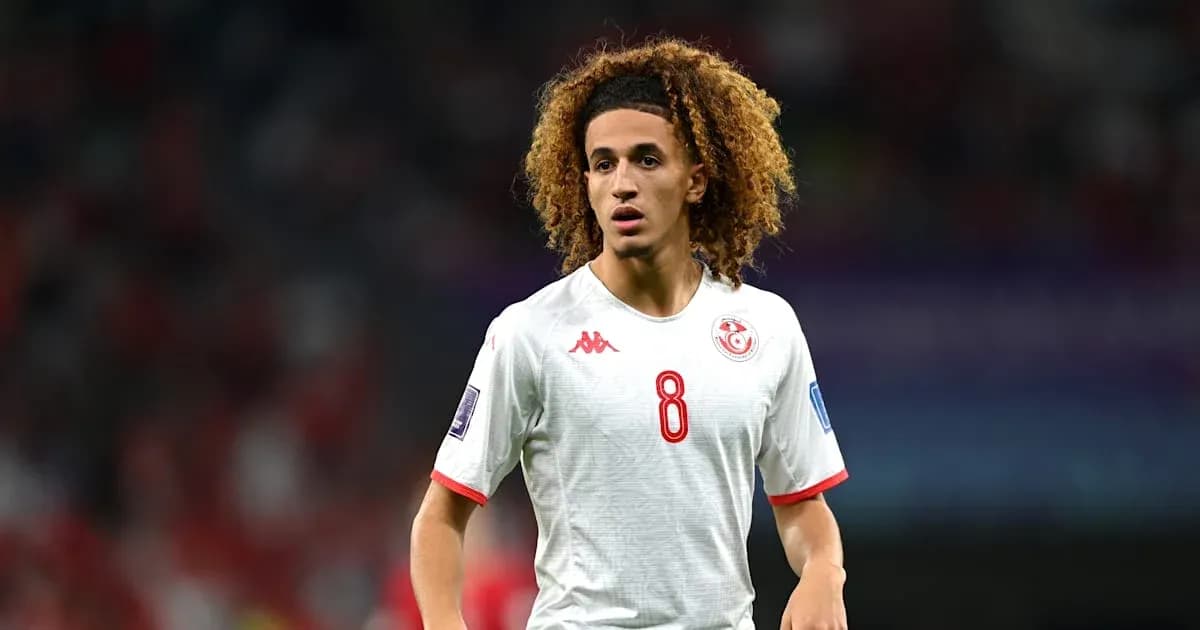
Hannibal Mejbri, 23, carries one of the great names in history and one of the great nicknames in sport. The Eagles of Carthage. Tunisia’s men’s team, a side forever straining at the limits of the group stage, now has a playmaker whose story stretches from a Paris tower block to the 2026 FIFA World Cup.
This time, the Hannibal in red is aiming to finish the journey.
From La Banane to the world
Mejbri was born in Paris to Tunisian parents and raised in the capital’s 20th arrondissement, a crowded, working-class district where the streets speak a dozen languages but football rules them all.
He remembers it simply. No grand plan. No academy roadmap pinned on a fridge.
"Instead of going straight up to my house, I used to stay out and play football until night fell," he recalls in the series World at Their Feet, which follows emerging talents on the road to the 2026 World Cup. "I was a normal boy, there was no master plan. I had my friends, I was focused on my life as a kid."
His patch of the city includes a curved block of flats nicknamed La Banane. Concrete, graffiti, tight spaces. For Mejbri, it became a training ground. A small world that demanded quick feet and quicker thinking.
Childhood friend Hubert Mbuyi remembers the silhouette before the skill.
"He had a unique style, with big hair, big blonde hair. So everyone knew him and had a lot of expectations for him," Mbuyi says. "Where you could find a pitch and a ball, you will find Hannibal."
The hair made him easy to spot. The talent made him impossible to ignore.
A million-euro teenager
Paris FC spotted him early. Mejbri joined their academy at six and stayed for most of the next seven years, learning the game in the shadow of the city’s bigger clubs. A short spell at Boulogne-Billancourt followed, then came the call that changes a teenager’s life.
In 2018, Monaco, serial producers of young talent, paid €1 million to bring the 15-year-old into their academy. For a boy from La Banane, the contrast was stark.
"I could feel the richness of Monaco," he says. "So yeah, it was a little bit of a shift, a little dream, and I learned a lot there."
The experience was not perfect. He did not settle as hoped, the fit never quite right. But the raw ability was obvious, and Europe’s elite kept watching. Bayern Munich, Paris Saint-Germain, Barcelona — the list of suitors read like a Champions League draw.
In August 2019, at 16, he chose Manchester United.
The decision dragged him into the unforgiving spotlight of Old Trafford, a place where patience is short and expectation is generational. He rose quickly through the ranks. By 2021, he had a Premier League debut. By September 2023, he had a first league goal.
It came in a 3–1 home defeat to Brighton. United were 3–0 down when Mejbri struck, a clean hit that at least cut through the gloom.
"I still get chills," he says. "I don't know why I started to celebrate when we were losing 3–0, and you can see in my celebration that I had a certain rage in me and that I let go of everything when I scored."
The scoreboard said consolation. His reaction said something else: a player unwilling to accept his role as background noise.
A flag, a choice, a heartbeat
On the international stage, Mejbri had options. He wore France’s colours at under-16 and under-17 level, a pathway that has taken many from the banlieues to the very top. Yet when the senior decision arrived in 2021, he turned towards his parents’ homeland.
"I joined Tunisia because I chose with my heart," he explains. "Even though I lived in France, it doesn't take away the love I have for France. But I find that the love I have for Tunisia is greater."
For Tunisia, it was a coup. For Mejbri, it was a declaration.
He is already deep into his international career, with 44 caps and two African Revelation of the Year awards at the Africa d'Or to his name. Every time he pulls on the red shirt, the journey from La Banane to Carthage feels complete — and yet only just beginning.
"When I represent my country, I also represent my neighbourhood," he says. "Because I know that I will represent them, and so all of that, it's a bit related to pride."
Mbuyi sees what that means on the ground.
"All Tunisians are proud of him," he says. "Because in the end, he's a kid from the neighbourhood. When he plays matches, everyone focuses on the match. We're all watching Hannibal's hair on the pitch. We try to spot him every time."
For the people of La Banane, the World Cup is no longer a distant spectacle. It has a face, a number, and that unmistakable head of hair.
Giving back to La Banane
Success has not loosened his connection to home. Every summer, Mejbri returns to the same streets, the same block, the same tight spaces where he learned to play. He organises a football tournament for the community, a small festival of the game that once kept him outside until dark.
Last year alone, he gave away around 100 shirts. Not just souvenirs, but symbols.
"You can just walk around here and find two or three people wearing his shirt," says Mbuyi.
In a neighbourhood where dreams can feel far away, the sight of a local boy on the world stage matters. It turns possibility into something you can touch, wear, and chase down a touchline.
"Hannibal is a great example of what the people look for in this area," Mbuyi says. "Because of him, the young kids can dream."
Now those dreams stretch all the way to the 2026 World Cup. Tunisia have never gone beyond the group stage. They have knocked on the door, rattled it, but never quite broken through.
Two thousand years after another Hannibal tried to cross his own mountains, this one stands at the foot of football’s version, the weight of a nickname, a neighbourhood, and a nation on his shoulders.
The question is no longer whether people can spot his hair on the pitch. It is whether the Eagles of Carthage, with Hannibal Mejbri at their heart, can finally fly over that ridge and into uncharted territory.