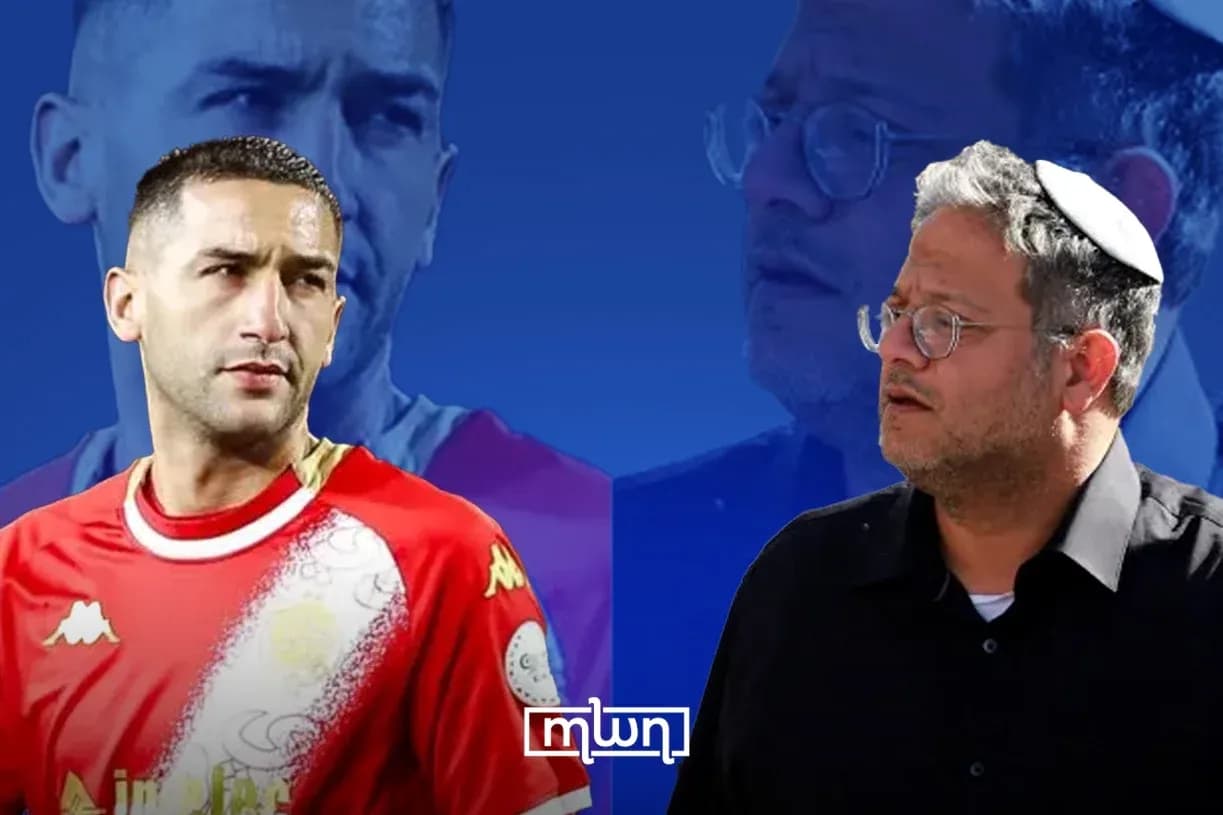
Hakim Ziyech's Bold Stance on Palestine Sparks Political Firestorm
Hakim Ziyech has never been a player who hides behind platitudes. On the pitch, his left foot speaks loudly enough. Off it, his stance on Palestine has now drawn him into a direct and incendiary confrontation with one of Israel’s most powerful politicians.
The Moroccan international, now with Wydad after high‑profile spells at Ajax, Chelsea, Galatasaray and Al‑Duhail, reacted sharply to Israel’s newly approved death penalty law targeting Palestinian prisoners. The law, passed in the Knesset on March 30 by a 62–48 vote, sets death by hanging as the default sentence for Palestinians convicted in military courts. It has been condemned by critics, including the UN human rights office, as discriminatory and corrosive to due process.
Ziyech did not respond with a long statement or interview. He posted an image.
On his Instagram story, he shared a picture of Israel’s National Security Minister Itamar Ben‑Gvir celebrating the vote in parliament, and questioned whether the move would once again be sold to the world as “self-defense.” It was a pointed, cutting line – the kind of message that travels quickly in a region where footballers are rarely just athletes.
Ben‑Gvir did not let it pass.
The minister fired back, labelling Ziyech “antisemitic” and dismissing any criticism of the law. In comments carried by Israeli and regional media, he escalated further, warning that “Ziyech and all other antisemites will not escape.” It was an extraordinary response, not just to a footballer, but to a social media story – and it dragged Ziyech squarely into an already raging political storm.
The backlash to Ben‑Gvir’s words has been sharpened by his own history. His record includes a past conviction for incitement against Arabs and links to an extremist movement banned in Israel. Against that backdrop, his attempt to brand a high‑profile Muslim footballer as antisemitic has only added fuel to an already volatile debate.
For those who have followed Ziyech closely, none of this came out of the blue.
The 32‑year‑old has been unwavering in his public support for Palestinians, especially since Israel’s devastating campaign on Gaza began on October 7, 2023. He has repeatedly used his social media platforms to highlight what he describes as bloody massacres carried out by Israeli Occupation Forces, sharing images, videos and commentary that cut against many mainstream narratives.
In October 2023, he posted one of his earliest messages in this latest phase of the conflict, pairing a pro‑Palestine stance with a quote about oppression and the way media frames violence. Months later, as footage from the occupied West Bank spread online, he weighed in again, condemning Israel’s actions and urging people not to let the pressure on governments and institutions fade. He went beyond the usual platitudes of “peace” and “dialogue,” openly criticising governments he believes have enabled the situation.
This is the pattern: Ziyech sees something, he speaks. Not as a diplomat, but as a man with a platform and a conviction.
That consistency has turned him into more than just a playmaker for club and country. For many fans across North Africa and the wider region, he has become a symbol of a generation of footballers unafraid to cross the white line that separates sport from politics. For his critics, he has stepped too far into a conflict where every word is weaponised.
Now his latest intervention has drawn a response from a figure who thrives on confrontation. A minister with a history of incendiary remarks has chosen a footballer as his latest target. The stakes are no longer confined to stadiums or social media feeds.
Ziyech will go back to training with Wydad, back to preparing for the next match, back to the rhythm of a professional season. But the echo of this exchange will linger far beyond the final whistle.