
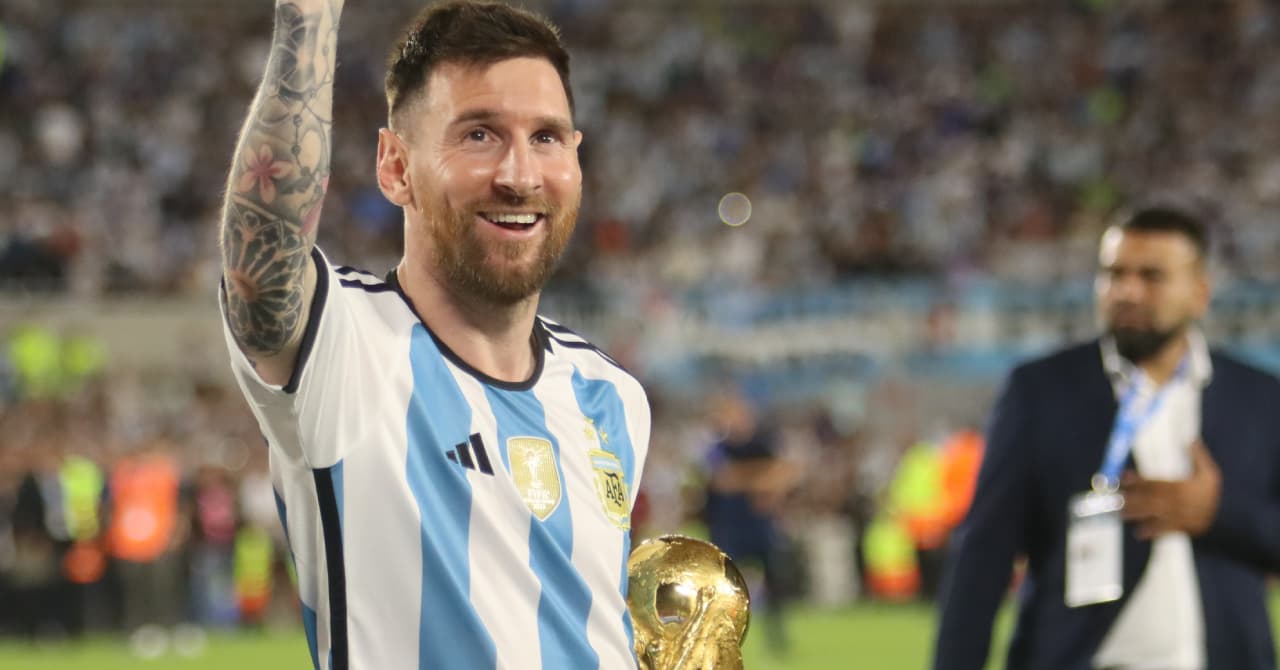
Group J: Messi’s Last Stand Against Algeria, Austria, and Jordan
There is no such thing as a gentle World Cup group when Lionel Messi is in town. Not anymore. Not after Saudi Arabia 2022, when Argentina walked into their opener as champions-elect and walked out stunned, beaten 2-1 after leading at half-time.
Anyone assuming Group J is a coronation parade for the holders would do well to remember that morning in Lusail.
Here, Argentina share the stage with an Algeria side finally back on the big show, an Austria team reborn under Ralf Rangnick and a Jordan squad making history just by turning up – and determined not to stop there.
This isn’t a group of passengers. It’s a group full of intent.
Algeria: Petkovic’s Pragmatists With Mahrez at the Helm
Algeria have waited eight years to feel this again. Two missed tournaments since they took Germany to extra time in 2014, when a young Riyad Mahrez was still learning what it meant to carry a nation’s hopes.
He carries them now.
At 35, Mahrez arrives as captain, chasing the eight goals he needs to become Algeria’s all-time leading scorer. His numbers for the national team remain remarkable: 38 goals, 43 assists, 113 caps, and a trophy cabinet that includes the 2019 AFCON title, Leicester City’s impossible Premier League triumph in 2016 and a treble with Manchester City in 2023. He remains the reference point, the man opponents still double up on.
Around him, Vladimir Petkovic has built a side with a distinctly European edge and a hard competitive shell. The Bosnian and Herzegovinian coach knows tournament football. He took Switzerland to the Nations League finals in 2018/19 and into the Euro 2020 quarter-finals, beating Turkiye and France before falling on penalties to Spain. He understands how to manage moments, how to drag a squad through a month of pressure.
Mohamed Amoura is his sharpest weapon. Ten goals in qualifying, seven more than anyone else in Algeria’s group, including a hat-trick against Mozambique. The Wolfsburg forward started his Bundesliga campaign with eight goals in 19 games before the goals dried up across his final 11 appearances. Even so, defenders in this group know exactly how quickly he can catch fire again.
This is a squad sprinkled with players who have lived the intensity of Europe’s top leagues. Houssem Aouar, once capped by France and schooled at Lyon and Roma, offers craft in midfield. Amine Gouiri, back from injury, signalled his readiness with two goals in a 7-0 friendly demolition of Guatemala in March. Nabil Bentaleb brings his Premier League scars and Lille experience into the middle of the pitch.
At the back, Luca Zidane arrives with a famous surname and his own story of resilience, having recovered from a broken jaw and chin with Granada just to make this tournament. Out wide, Anis Hadj Moussa storms in off a superb season at Feyenoord – 14 goals and seven assists, numbers that demand attention.
Rayan Ait-Nouri’s year tells a different tale: a bright start at Manchester City, then an ankle injury, AFCON duties and a slide to the fringes of Pep Guardiola’s plans, even as City lifted the FA Cup and EFL Cup. A run of starts in February and March hinted at trust, but the full-back arrives with something to prove.
Petkovic’s Algeria are not here to make up the numbers. The schedule helps them, too. Their final group game against Austria looks tailor-made as a straight shootout for automatic qualification, with both heavily favoured to beat Jordan and the safety net of eight third-placed teams advancing.
Les Fennecs have been here once before, in 2014. They look well-placed to do it again.
Argentina: The Champions, the Chase, and the Clock on Messi
No team has retained the World Cup since Brazil did it in 1962. Argentina land in North America with the trophy, the aura, and the burden of trying to change that.
Lionel Scaloni has already done what generations of predecessors could not. He delivered the Copa America in 2021, the World Cup in 2022 and another Copa America in 2024. No other Argentina coach has combined continental and global crowns. He ended a 36-year wait for a third star on the shirt and, in the process, reshaped his country’s relationship with its national team.
He does it with continuity. Emiliano Martinez remains in goal, the penalty-box showman and shootout specialist whose heroics in Qatar still feel fresh. In front of him, Cristian Romero and Lisandro Martinez form a snarling, uncompromising defensive core.
Midfield is where Scaloni’s side can smother games. Rodrigo De Paul’s engine, Alexis Mac Allister’s intelligence and Enzo Fernandez’s range form one of the most complete trios at the tournament. They can press, they can pass, they can kill the tempo or raise it at will.
Up front, there is variety and menace. Julian Alvarez, able to play wide, central or as a second striker, gives Scaloni tactical flexibility. Lautaro Martinez leads the line, a pure No 9 who thrives on service and chaos in the penalty area.
There are absences, of course. Angel Di Maria, one of the great symbols of the 2022 triumph, has stepped away from international football. Franco Mastantuono, the teenage Real Madrid midfielder who lit up qualification with his potential, did not make the final cut – a notable omission in a squad that otherwise leans heavily on experience.
And then there is Messi.
At 38, preparing for a record sixth World Cup, his presence in North America is more than a sporting event. It is a cultural moment. Nobody seriously expects a seventh. This is the last dance on this stage.
He arrives nursing a hamstring issue picked up with Inter Miami in May, a rare note of anxiety in an otherwise settled camp. Scaloni’s public line has been calm – the early reports are “not that bad” – and Messi is expected to be ready for the opener against Algeria in Kansas City.
He remains the axis around which everything turns. Top scorer in CONMEBOL qualifying with eight goals, still the player Argentina look to when the game tightens, still the one who bends the narrative to his will.
On paper, this is a group Argentina should handle. They are favourites to top it and move on. But they know better than anyone that the World Cup does not respect paper.
Austria: Rangnick’s Relentless Pressers Return to the World Stage
Austria have been away from the World Cup for 28 years. They do not return quietly.
Ralf Rangnick has dragged the national side into the modern game, imposing the pressing, vertical style that has defined so much of his club work. The result is a team that runs hard, bites into duels and refuses to let opponents breathe.
The progress has been clear. At Euro 2024, Austria reached the last 16 after finishing above France and the Netherlands in their group. World Cup qualification followed, and the squad boarding the plane to North America might be the strongest the country has produced since that third-place finish in 1954.
Look at the spine and the pattern emerges. Fourteen of the 26 players are based in the Bundesliga, a league that mirrors Rangnick’s demands for intensity and organisation. At RB Leipzig, Christoph Baumgartner, Xaver Schlager and Nicolas Seiwald form a midfield triumvirate steeped in the Red Bull school he helped design. They know the triggers, the pressing traps, the runs.
Baumgartner, in particular, arrives in full stride. Thirteen goals and ten assists in the Bundesliga this season mark him out as one of the most productive central midfielders in Germany. He times his runs through the lines, finishes in tight spaces and appears in the box when defenders least want to see him. In this group, he is a problem waiting to happen.
Experience comes from Marcel Sabitzer, now a senior figure at Borussia Dortmund with 95 caps to his name, and from Konrad Laimer, a relentless wide midfielder at Bayern Munich who sets the tone with his work-rate.
At the back, David Alaba captains at 33, the calm head and technical leader in defence. Ahead of him, the future is already nudging at the present. Carney Chukwuemeka has chosen Austria over England. Paul Wanner, 20 and on the books at PSV Eindhoven, is another who could announce himself to the world over the next month.
Then there is Marko Arnautovic. Vice-captain, 36 years old, 47 goals in 132 caps – the country’s all-time record scorer. He knows this could be his last major tournament. He will play like it.
Rangnick’s Austria are not just organised; they are awkward, aggressive and deeply committed to their identity. The opener against Jordan in Santa Clara offers a platform. Take three points there, and the path towards a top-two finish – and a decisive showdown with Algeria – opens up quickly.
Jordan: The Debutants Who Refuse to Be Tourists
Jordan arrive as World Cup rookies. They do not arrive as wide-eyed tourists.
Qualification alone was a statement. Second place in their AFC third-round group, behind South Korea but ahead of Iraq, Oman, Palestine and Kuwait, underlined that this is a team that knows how to navigate tight campaigns and pressure nights.
Coach Jamal Sellami brings his own sense of history. A Moroccan with a successful domestic coaching record and a title at the 2018 African Nations Championship with his country’s local-national team, he has spoken openly about wanting to follow the path Morocco carved in Qatar – a run to the semi-finals that reset expectations for Arab and African nations.
Jordan’s squad is built on familiarity. Thirteen of the 26 players are based in the domestic league, a core that trains and competes together week after week. At a tournament where many sides spend the first fortnight trying to find rhythm, that cohesion can be priceless.
There has been pain too. Striker Yazan Al-Naimat, a key attacking figure, misses out after suffering an ACL injury in December. His absence strips away one of their main outlets.
Defensively, captain Ehsan Haddad anchors the backline from Al-Hussein, while Yazan Al-Arab brings experience from FC Seoul, one of the few in the squad who live their club lives outside the Middle East.
The spotlight, though, belongs to Musa Al-Tamari.
The Rennes forward is the finest footballer Jordan has produced, the first to play in Ligue 1, and the man his country has dubbed the “Jordanian Messi”. The nickname is heavy, but the talent is real. He carries their hopes of an upset, the player who can turn a deep defensive shift into a counter-attack that stuns a bigger name.
Jordan’s path is clear. The opener against Austria in Santa Clara is their best shot at a result. A point there would reverberate across the group. Anything taken off Algeria would be historic.
And then comes Argentina in Dallas, under the lights at AT&T Stadium, in the final group game. Whatever the table looks like, that night will be the biggest in Jordanian football history.
The Shape of Group J
Strip away the romance and the storylines, and the hierarchy looks obvious. Argentina should top Group J. Austria, with Rangnick’s structure and Baumgartner’s form, are the most likely to chase them home. Algeria, armed with Mahrez and a coach who knows tournament football, have every chance of pushing into the last 16 again.
Jordan, on paper, are the outsiders.
But the World Cup does not run on paper. It runs on moments. On a Mahrez free-kick. On a Messi surge. On Baumgartner ghosting into the box. On Al-Tamari, somewhere in Texas or California, cutting inside and hitting a shot that changes everything.
Argentina come here trying to do what no one has done for more than six decades and to give Messi the send-off his career deserves. The others arrive determined to write their own chapters across his final World Cup.
Someone, in this group, is going to spoil a script. The only question is whose.



