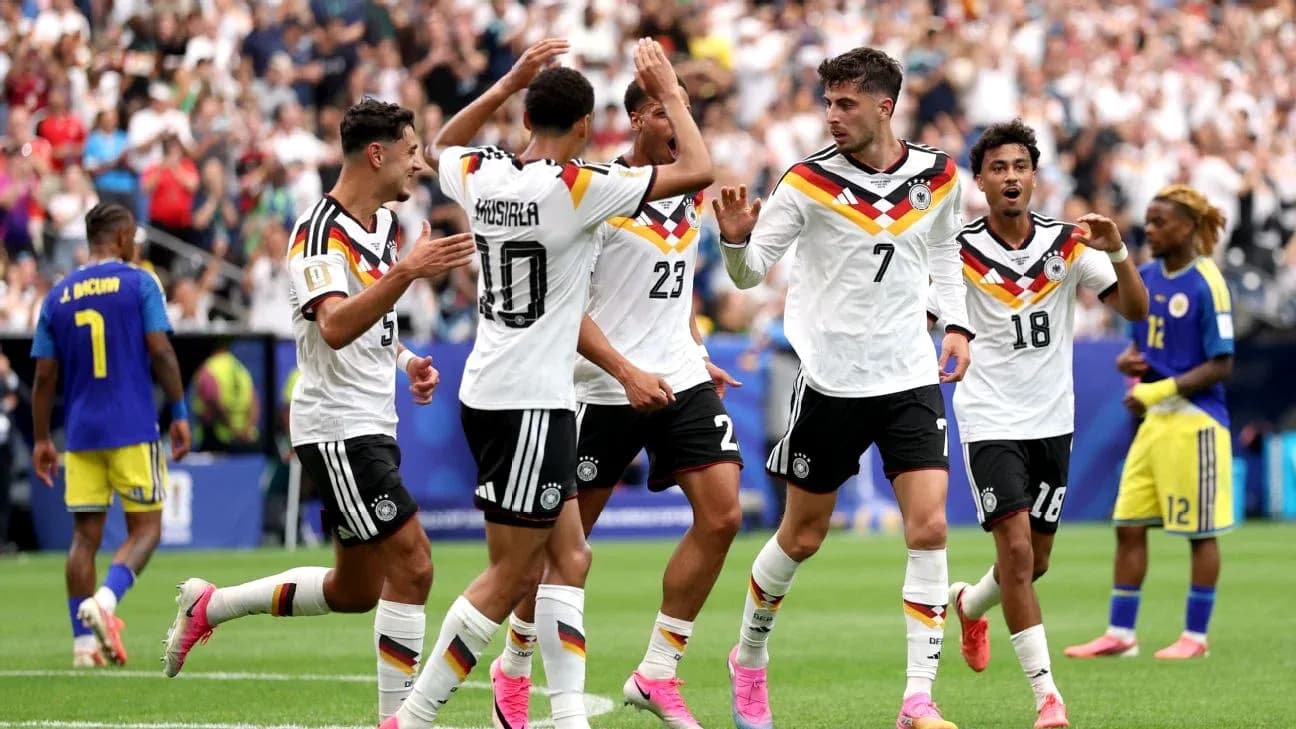
Germany's Dominance in World Cup Opener Against Curaçao
Under the Houston roof of NRG Stadium, Germany’s World Cup campaign began with a statement that echoed far beyond Group E. A 7-1 dismantling of Curaçao in their opening Group Stage - 1 fixture was not just a scoreline; it was a manifesto of what Julian Nagelsmann wants this side to be in 2026: aggressive, fluid, and ruthless.
Following this result, Germany sit 1st in Group E with 3 points and a goal difference of 6, their entire statistical profile distilled into one overwhelming night. Curaçao, by contrast, are 4th with 0 points and a goal difference of -6, their debut on this stage defined by the brutal education elite opposition can deliver.
I. The Big Picture – Structures and Identities
Nagelsmann stayed true to his preferred 4-2-3-1, and the shape looked tailor-made for tournament football. M. Neuer anchored from behind, but the real personality of this team emerged in the lines ahead of him. J. Kimmich at right-back and N. Brown on the left operated more like deep-lying playmakers from wide, compressing Curaçao and setting the tempo.
Germany’s season statistics are starkly simple so far: in total this campaign they have played 1 match, won 1, scoring 7 goals and conceding 1. At home they have also played 1, with 7.0 goals for on average and 1.0 against. There is no clean sheet yet, but there is a clear attacking identity: relentless pressure, high technical quality, and a front four that constantly rotates.
Curaçao lined up in a 4-3-1-2 under Dick Advocaat, a compact, narrow block designed to protect central areas. E. Room in goal, a back four led by R. Bazoer and A. Obispo, and a midfield triangle with L. Bacuna and J. Bacuna were tasked with absorbing waves of pressure and then springing T. Chong, J. Locadia, and S. Hansen on transition. On their travels they have played 1 match, scoring 1.0 goal on average and conceding 7.0, a brutal statistical summary of how exposed that plan became against elite opposition.
II. Tactical Voids and Discipline
There were no listed absentees for either side, so this was close to full-strength against full-strength. That made the tactical voids exposed on the night even more telling.
For Germany, the only “void” was structural rather than personnel-based: the double pivot of F. Nmecha and A. Pavlovic had to balance aggression with protection. At times, with both full-backs high, Germany risked isolation for J. Tah and N. Schlotterbeck. Curaçao’s lone goal is a warning that even in dominance, this side can be hit if the counter-press fails.
Curaçao’s void was more existential: their 4-3-1-2 lacked natural width. With S. Floranus and D. Fonville pinned deep by L. Sane and Brown, the midfield three were constantly outnumbered by Germany’s box of Nmecha, Pavlovic, J. Musiala, and F. Wirtz. There is no card data registered for either team in the season stats, suggesting that this was not a cynical or stop-start encounter; instead, Curaçao were simply overwhelmed, rather than rescued by tactical fouling or disruption.
III. Key Matchups – Hunter vs Shield, Engine Room Battles
The “Hunter vs Shield” duel was embodied by K. Havertz against Curaçao’s central defence. Havertz arrives from this match as one of the World Cup’s early headline forwards: in total this campaign he has scored 2 goals, with both of his 2 shots on target, and added a penalty conversion to underline Germany’s 100.00% record from the spot (1 penalty taken, 1 scored, 0 missed). His movement between the lines and into the channels made him impossible to mark in a strict sense; Bazoer and Obispo were repeatedly dragged into zones they did not want to defend.
Supporting him, J. Musiala and Wirtz acted as twin No.10s in practice. Musiala’s line reads like a modern attacking midfielder’s blueprint: 1 goal, 1 shot on target, 26 passes with 2 key passes, and 5 dribble attempts with 4 successful. Every time he received between the lines, Curaçao’s midfield three were forced to collapse centrally, opening the wide corridors for Kimmich and Brown.
On the flanks, the “Engine Room” duel was less about crunching tackles and more about control. Kimmich, listed as a defender but playing like a deep playmaker, attempted 73 passes with 5 key passes and an 89% accuracy. His delivery from the right side was the metronome of Germany’s dominance. Brown mirrored that on the left: 36 passes, 3 key passes, 1 goal, and 1 assist. For a defender to appear in both the top scorers and top assists lists after one match underlines how aggressively Germany use their full-backs.
Curaçao’s midfield, led by L. Bacuna and J. Bacuna, never found a stable grip. Their 4-3-1-2 offered some vertical threat through Chong as the advanced midfielder, but with no statistical attacking standout in the current dataset, the story is one of collective strain rather than individual resistance.
IV. Statistical Prognosis – What This Result Tells Us
Following this result, Germany’s overall averages are emphatic: 7.0 goals for and 1.0 against per match in total this campaign, with a winning streak of 1 and their biggest win already marked as 7-1. The lack of a clean sheet and the solitary goal conceded will give Nagelsmann something to tighten, but the offensive ceiling is obvious.
Curaçao, conversely, carry a total record of 1.0 goal for and 7.0 against per match, with a biggest loss of 7-1 and no clean sheets. Their current form of L and a goal difference of -6 place them at the foot of Group E, and the data suggests that their defensive structure, especially on their travels, must be recalibrated urgently if they are to remain competitive.
In narrative terms, this was a night that confirmed Germany as early contenders and framed Curaçao as brave but brutally outgunned. The numbers are extreme because the contest was extreme: a heavyweight flexing its muscles against a newcomer still learning the rhythms of the World Cup stage.