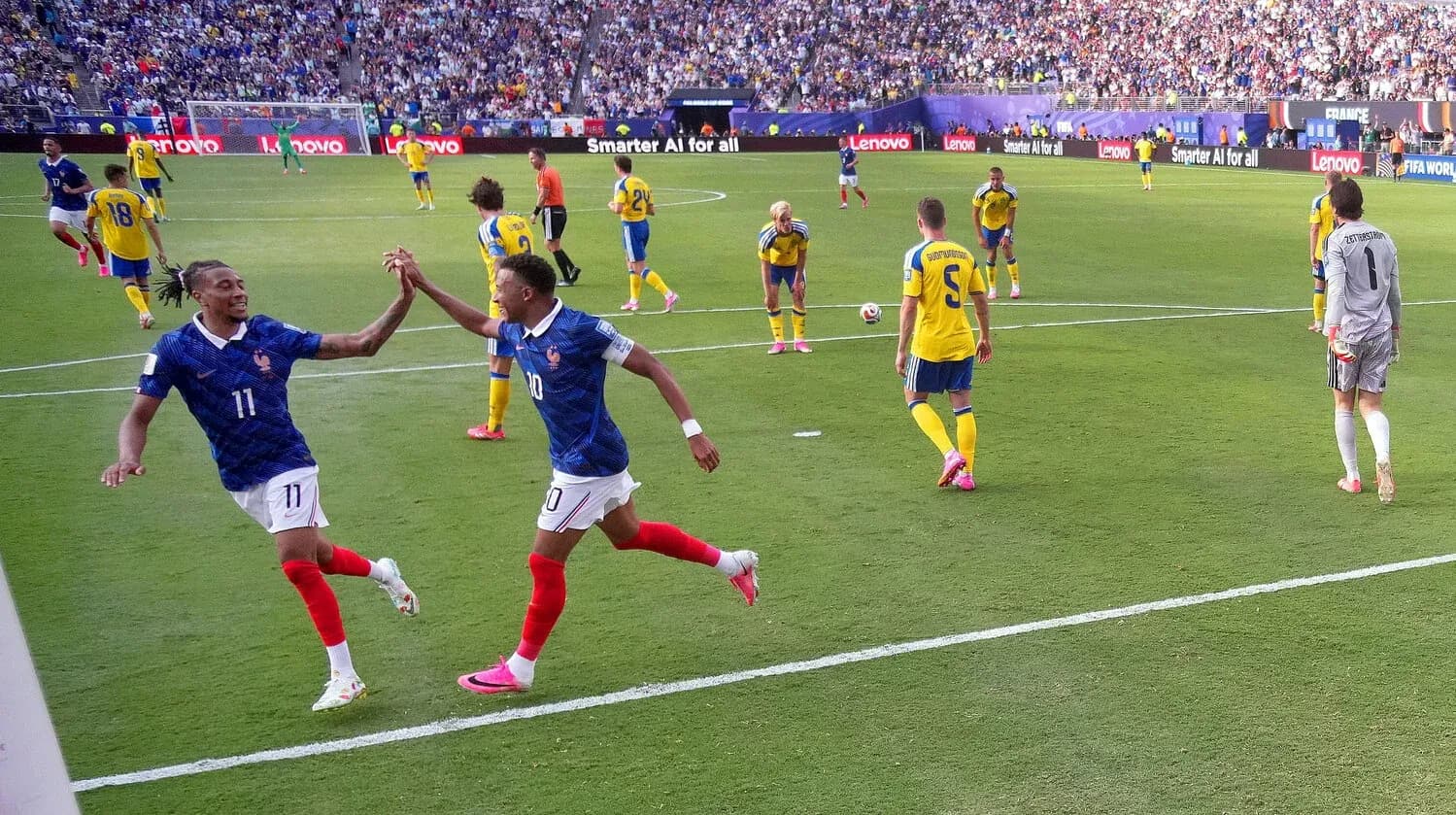
France Dominates Sweden 3–0 in World Cup Knockout Stage
MetLife Stadium in New-York staged a Round of 32 tie that felt less like a cautious first knockout step and more like a statement of intent. France, flawless in the group with 9 points and a goal difference of 8 from 3 matches, arrived as the World Cup’s form side. Sweden, second in their section with 4 points and a neutral goal difference overall in the group (7 scored, 7 conceded), came in as a dangerous underdog. By full time, the scoreboard read 3–0 to France, a reflection of a tactical contest where Didier Deschamps’ structure, star power and balance overwhelmed Graham Potter’s more fragile, evolving Sweden.
I. The Big Picture – France’s machine vs Sweden’s volatility
Heading into this game, France’s seasonal profile in this World Cup was that of a ruthless front-runner. Overall they had played 4 matches, winning all 4, with 13 goals scored in total and only 2 conceded. At home they had played 3 times, winning all 3, scoring 9 and conceding just 1; on their travels they had played once, scoring 4 and conceding 1. The averages underline the dominance: 3.0 goals per home game and 4.0 away, for an overall attacking average of 3.3. Defensively, they were conceding 0.3 at home and 1.0 away, 0.5 overall. Two clean sheets in total and no failures to score meant there were no obvious cracks to target.
Sweden’s profile was the opposite: volatile and high-risk. Overall they had played 4 matches, with 1 win, 1 draw and 2 defeats. At home they had played once, winning 5–1; on their travels they had played 3 times without a victory, drawing 1 and losing 2. That split is stark: 5.0 goals scored per home game but only 0.7 away, giving an overall attacking average of 1.8. Defensively, Sweden were conceding 1.0 at home but a punishing 3.0 on their travels, 2.5 overall. They had yet to keep a clean sheet and had failed to score once, a worrying sign against the tournament’s most efficient attack.
Deschamps leaned into continuity, rolling again with the 4-2-3-1 that had been used in all 4 matches. Potter, whose team had already shown three different systems this tournament (3-1-4-2, 3-4-3 and 4-4-2), opted for a back four and a front two here, hoping to balance defensive cover with the threat of Viktor Gyökeres and Alexander Isak.
II. Tactical Voids – Discipline and hidden weaknesses
Neither side had suspensions or confirmed absences in the data, so the “voids” were more structural than personnel-based.
For France, the only disciplinary note across the campaign was a single yellow card overall, shown between minutes 61–75, suggesting a side that rarely loses control of games or emotions. No red cards and no penalties taken or missed meant no self-inflicted chaos.
Sweden, by contrast, carried a more combustible edge. Their yellow cards were spread but with a clear late spike: 20% of cautions between 31–45, 20% between 46–60, 20% between 61–75, and 40% in the 76–90 window. Lucas Bergvall, who started here in midfield, already had 1 yellow in the tournament, with 7 fouls committed overall. That pattern hinted at a team that increasingly resorts to fouls as matches stretch, a critical vulnerability against France’s devastating late runners.
III. Key Matchups – Hunter vs Shield, and the Engine Room
Hunter vs Shield was always going to centre on Kylian Mbappé against Sweden’s back line. Mbappé entered the tie as the World Cup’s leading scorer with 6 goals and 2 assists in 4 appearances, backed by 19 shots (13 on target) and a sparkling rating of 8.65. His partnership with Ousmane Dembélé – 4 goals, 2 assists, 7 shots and 5 on target, rating 8.28 – gave France dual threats on the break and in tight spaces.
They were supplied by Michael Olise, the tournament’s top assist provider with 5, plus 9 key passes and 87% passing accuracy. His 34 duels and 8 successful dribbles showed a playmaker who doesn’t just float between lines but actively wins territory.
Sweden’s Shield was built around Victor Lindelöf and Gustaf Lagerbielke at centre-back, flanked by Gabriel Gudmundsson and Daniel Svensson. But the numbers were unforgiving: on their travels they had already conceded 9 goals in 3 matches, including a heaviest away defeat of 5–1. Their biggest away loss and an away defensive average of 3.0 goals conceded per game underlined just how brittle this unit could be under sustained pressure.
Up front, Sweden’s own Hunters had credentials. Isak, with 1 goal and 3 assists plus 7 shots (6 on target), and Gyökeres, with 1 goal and 2 assists from 9 shots (6 on target), formed a physically imposing, mobile pairing. Yet they were feeding into a French defence that had conceded just 2 goals in total across 4 matches, with Mike Maignan protected by a back four of Jules Koundé, Dayot Upamecano, William Saliba and Lucas Digne. France’s biggest wins – 3–0 at home and 4–1 away – showed they could open up while still maintaining control at the back.
In midfield, the Engine Room duel set Aurélien Tchouameni and Adrien Rabiot against Bergvall, Yasin Ayari and the energetic Anthony Elanga. Tchouameni and Rabiot’s remit was clear: shield central zones, control tempo, and give Olise the platform to receive between Swedish lines. Bergvall, already on the disciplinary radar, had to walk a tightrope: aggressive enough to disrupt, but careful enough not to leave Sweden a man down or constantly defending set pieces.
IV. Statistical Prognosis – Why 3–0 felt pre-written
When you align the numbers with the tactical shapes, France’s 3–0 win feels like the logical outcome of the trends heading into this game.
France’s overall attacking average of 3.3 goals per match met a Swedish defence conceding 2.5 overall and 3.0 on their travels. Sweden’s inability to keep a clean sheet, combined with France’s record of scoring in every match and never failing to score, tilted the xG narrative heavily towards Deschamps’ side even before kick-off.
At the other end, Sweden’s overall attacking average of 1.8, boosted by that single 5–1 home win, was always likely to regress against a France team conceding just 0.5 overall and keeping 2 clean sheets in total. With Maignan behind a settled back four and a double pivot designed to choke central progression, Gyökeres and Isak were facing their toughest defensive block of the tournament.
Add in Sweden’s late-game disciplinary spike – 40% of their yellows in the final quarter of normal time – and the pattern is clear: a team that tires and fouls more as space opens up, precisely when Mbappé, Dembélé and Bradley Barcola thrive in transition. France’s calm card profile and tactical continuity only reinforced their capacity to manage the game state once ahead.
Following this result, the scoreline simply confirmed what the data had been whispering: France are operating like a tournament machine, their 4-2-3-1 and attacking trident calibrated for knockout football, while Sweden’s adventurous front line is still shackled to a defence that cannot yet withstand elite pressure on the biggest stage.