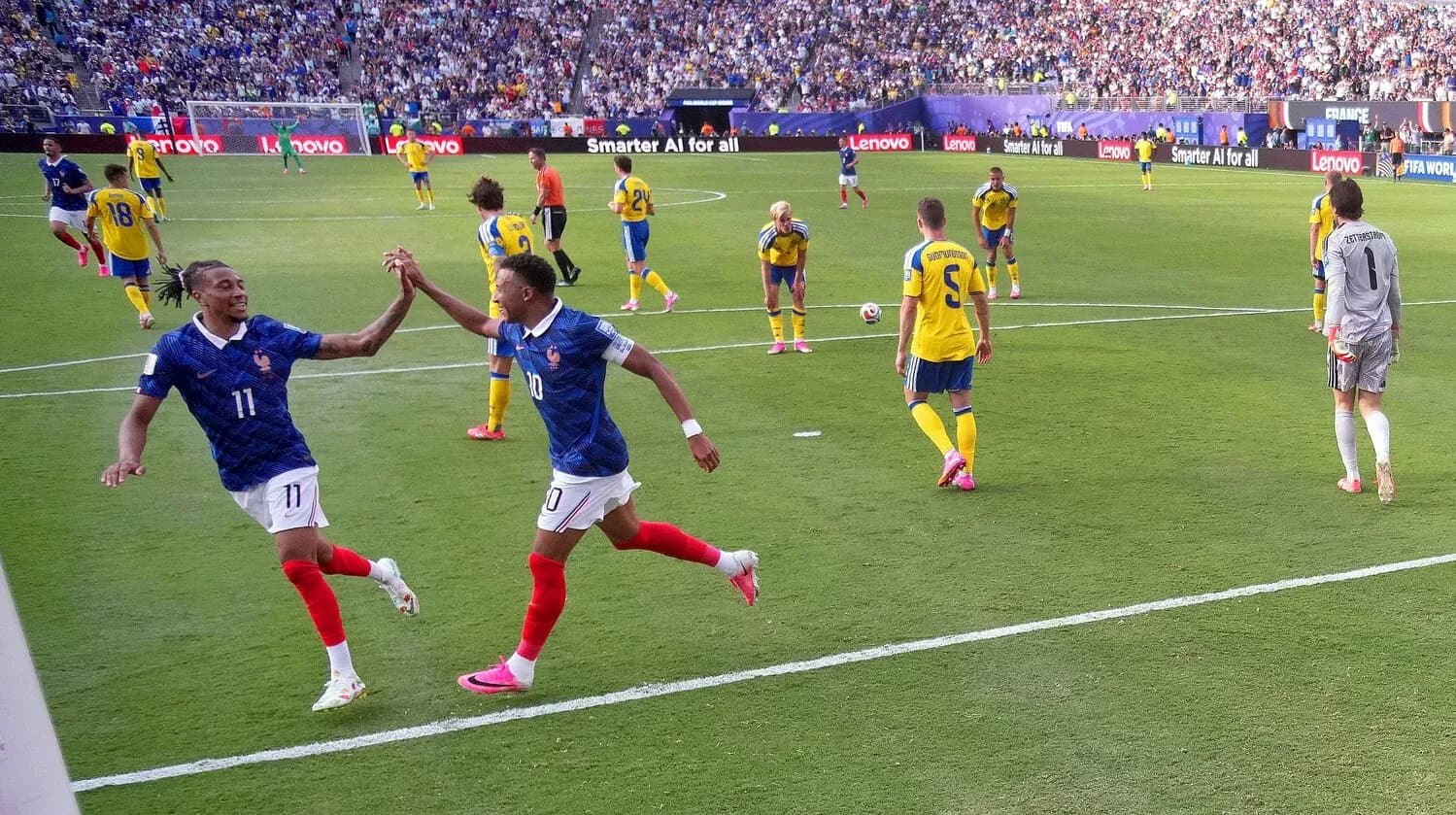
France Dominates Sweden 3-0: Tactical Analysis of the World Cup Match
France’s 3-0 win over Sweden at MetLife Stadium was a clinic in territorial control and structured attacking, built off Didier Deschamps’ 4-2-3-1 against Graham Potter’s 4-4-2. The World Cup Round of 32 tie quickly tilted towards France’s positional play: 61% possession, 551 passes at 88% accuracy and a 3.17 xG profile reflected sustained pressure rather than sporadic bursts. Sweden, with 39% possession and 0.65 xG, were largely forced into a low-to-mid block, trying to spring Viktor Gyökeres and Alexander Isak on limited transitions.
Out of possession, France’s shape was closer to a 4-4-2 press. Michael Olise stepped high from the No.10 line to join Kylian Mbappé in the first wave, while Ousmane Dembélé and Bradley Barcola dropped to form a flat midfield four when Sweden managed to connect passes. Aurélien Tchouaméni and Adrien Rabiot controlled the central corridor, screening passes into Lucas Bergvall and Yasin Ayari and forcing Sweden wide, where full-backs Jules Koundé and Lucas Digne could press aggressively knowing they had strong cover from Dayot Upamecano and William Saliba.
With the ball, France’s 4-2-3-1 morphed into a 2-3-5. Tchouaméni often held as the single pivot, Rabiot stepping slightly higher and wider on the left to link with Barcola and Digne. On the right, Dembélé’s width and 1v1 threat pinned Gabriel Gudmundsson back, while Koundé underlapped or held a more conservative line to secure rest defence against Elanga’s pace. Olise operated in the right half-space, constantly receiving between Sweden’s midfield and defence and acting as the main playmaker, which is reflected in his direct involvement in two goals.
The shot profile underlines how effectively France occupied the final third: 25 total shots, with 16 inside the box and 12 on target. This wasn’t speculative shooting; it was the product of layered attacks, with Mbappé, Barcola and Dembélé repeatedly attacking the channels between full-back and centre-back. Sweden blocked only 1 shot to France’s 4, further evidence that France were creating clearer looks rather than relying on low-percentage efforts from distance.
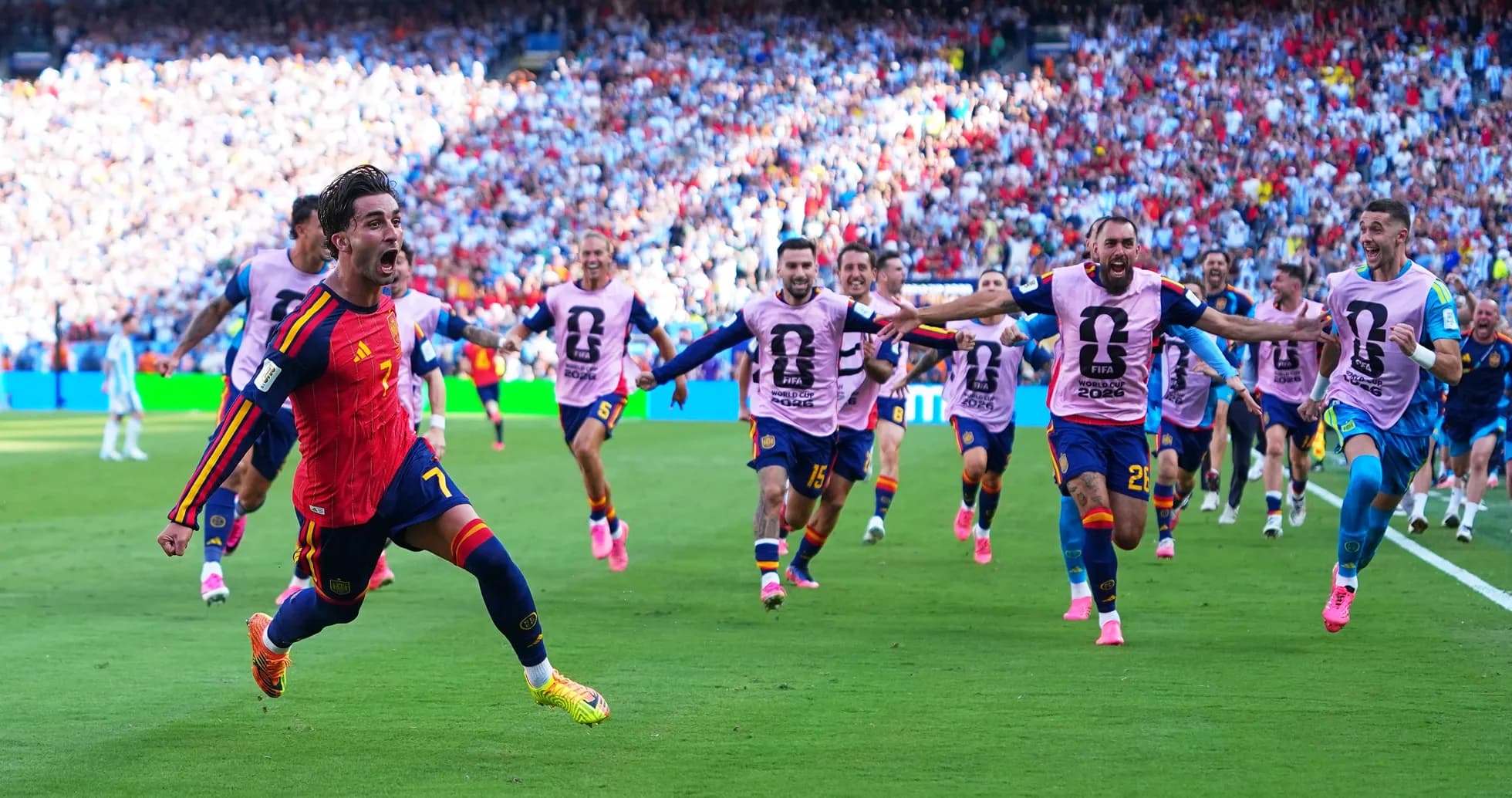
Mbappé’s opener on 45' from a Dembélé assist came at the end of exactly this pattern: wide isolation, a decisive action from the winger, and a ruthless finish from the central forward. The second goal at 53' showed the other side of France’s structure: Barcola arriving from the left, assisted by Olise, exploiting the weak-side space once Sweden had been shifted towards the ball. The third at 74', again Mbappé from an Olise assist, was the logical culmination of Sweden’s defensive fatigue and France’s ability to repeatedly find their star forward between and behind centre-backs.
Deschamps’ substitutions were designed to preserve intensity and defensive stability rather than to change the system. At 75', Malo Gusto (IN) came on for Jules Koundé (OUT), maintaining an attacking full-back profile on the right but with fresh legs for the final quarter-hour. Simultaneously, Désiré Doué (IN) replaced Ousmane Dembélé (OUT), keeping a direct dribbler on the flank to threaten Sweden’s tiring back line. At 78', Theo Hernández (IN) for Lucas Digne (OUT) added even more thrust from left-back, ensuring France could continue to pin Sweden deep.
Later, at 85', Jean-Philippe Mateta (IN) came on for Michael Olise (OUT), shifting France towards a more orthodox centre-forward profile to attack crosses and protect Mbappé’s workload. In the same minute, Rayan Cherki (IN) replaced Mbappé (OUT), giving France a more possession-oriented forward line to see out the game while still posing a threat between the lines. Crucially, none of these changes altered the fundamental 4-2-3-1/2-3-5 structure; they simply refreshed the roles within it.
Sweden’s changes were reactive and aimed at injecting energy and creativity into a struggling 4-4-2. At 66', Besfort Zeneli (IN) came on for Elliot Stroud (OUT), and Taha Abdi Ali (IN) replaced Lucas Bergvall (OUT), signalling an attempt to add more ball-carrying and attacking intent from midfield. At 82', Benjamin Nygren (IN) for Yasin Ayari (OUT) and Mattias Svanberg (IN) for Daniel Svensson (OUT) further tilted the side towards more progressive profiles, while at 89' Gustaf Nilsson (IN) replaced Alexander Isak (OUT) to provide a more physical reference up front. However, with only 352 passes at 80% accuracy and just 8 total shots (7 in the box, 3 on target), Sweden never established the sustained possession needed to make those adjustments count.
In goal, Mike Maignan (France) was largely protected by the structure in front of him, facing only 3 shots on target and making 3 saves. His goals prevented figure of 1.16 suggests that when Sweden did create, the chances were of reasonable quality, but France’s goalkeeper met the moments cleanly. At the other end, Jacob Widell Zetterström (Sweden) was under siege: France produced 12 shots on target, and he made 9 saves with 1.16 goals prevented, indicating he actually outperformed expectation in a heavy defeat. The 3-0 scoreline, in that sense, could have been even more emphatic.
Statistically, the game tracked closely with France’s attacking output. Their 3.17 xG aligned almost exactly with the three goals scored, underlining that this was not a smash-and-grab but a performance where process and outcome matched. Sweden’s 0.65 xG, by contrast, reflects their difficulty in progressing through France’s compact mid-block and the scarcity of truly dangerous moments.
The territorial dominance is further evidenced by set-piece and territorial metrics: France earned 9 corners to Sweden’s 1 and drew more offsides (3 to 1), consistent with a side playing higher up the pitch and repeatedly probing the last line. The foul count (14 for France, 10 for Sweden) shows that France were willing to break up the few Swedish counters at source, with tactical fouls in midfield preventing their 4-4-2 from ever fully transitioning into dangerous overloads.
Overall, France’s tactical structure – a controlled 4-2-3-1 with fluid attacking lanes – suffocated Sweden’s 4-4-2. Superior spacing, central control through Tchouaméni and Rabiot, and the creative axis of Olise, Dembélé, Barcola and Mbappé turned statistical superiority into a commanding and deserved 3-0 progression to the next round.