AC Milan and Juventus Battle to Tactical Stalemate in Serie A
AC Milan and Juventus played out a cagey 0–0 at Stadio Giuseppe Meazza in Serie A’s Regular Season Round 34, a match where structure and control consistently overrode risk. With no goals and only six shots on target combined, both sides leaned heavily on compact back threes and disciplined midfield lines. Juventus edged possession 53–47 and generated slightly fewer expected goals (0.52 to Milan’s 0.65), underlining a contest defined more by territorial jousting and defensive precision than penalty-box chaos. Ultimately, it was a tactical stalemate in which both coaches prioritized stability, and neither side found a convincing mechanism to unbalance the other’s block.
The scoring sequence is simple: there were no goals, and the only moment of attacking drama near the net that could have changed that was erased. In the 37th minute, Khéphren Thuram thought he had produced the breakthrough for Juventus, but VAR intervened and the goal was cancelled, leaving the halftime score 0–0 and unchanged through full time.
The disciplinary and event log, however, reveals the underlying tactical tensions. The first yellow card arrived on 20', when Andrea Cambiaso (Juventus) was booked for a foul, signaling early that Juventus’ wing‑back was being stretched defensively by Milan’s flank rotations. On 37', Thuram’s cancelled goal via VAR was a key psychological turning point: Juventus had exploited space but were denied the reward, reinforcing both teams’ caution thereafter.
At 38', Davide Bartesaghi (AC Milan) received a yellow card for a foul, reflecting Milan’s need to disrupt Juventus transitions down their left. That booking directly preceded Milan’s first adjustment: at 46', Pervis Estupiñán (IN) came on for D. Bartesaghi (OUT), a like-for-like switch that brought fresh legs and more assertive forward running down the flank.
The second half became a rolling chess match of substitutions. On 62', Niclas Füllkrug (IN) came on for C. Pulisic (OUT), giving Milan a more classic reference point up front. At 67', S. Ricci (IN) replaced Y. Fofana (OUT), tilting Milan’s midfield slightly more towards ball circulation and control rather than pure defensive coverage.
Juventus answered with a double change on 71': T. Koopmeiners (IN) came on for K. Thuram (OUT), and E. Holm (IN) replaced A. Cambiaso (OUT). This retooled the Bianconeri midfield, adding Koopmeiners’ passing range and Holm’s more conservative wing-back profile. On 72', Jeremie Boga (Juventus) was booked for a foul, illustrating how Juventus’ forwards were being forced into deeper defensive work as Milan tried to build from the back.
Milan’s own substitute Estupiñán picked up a yellow card for a foul on 75', an indication of his aggressive interpretation of the wing-back role and Juventus’ attempts to play into wide channels. On 80', Milan made a double attacking and structural change: C. Nkunku (IN) came on for R. Leão (OUT), and A. Jashari (IN) replaced L. Modric (OUT), injecting fresh creativity and energy between the lines.
Juventus mirrored with attacking reshuffles at 80': E. Zhegrova (IN) came on for F. Conceição (OUT), and K. Yildiz (IN) replaced J. Boga (OUT), effectively refreshing the two support roles behind Jonathan David. The last card came on 86', when Manuel Locatelli (Juventus) was booked for a foul, symptomatic of late-game tactical fouling to stifle Milan’s central progressions. Finally, at 88', D. Vlahovic (IN) came on for J. David (OUT), giving Juventus a more aerially dominant focal point for the closing minutes.
Tactical Overview
Tactically, AC Milan’s 3‑5‑2 was built around controlled possession phases and a solid back three. Mike Maignan, with 5 saves, was the busier goalkeeper but rarely exposed; Juventus’ 0.52 xG suggests that while they found shooting positions, they were mostly kept to modest-quality chances. The trio of Fikayo Tomori, Matteo Gabbia, and Strahinja Pavlović formed a compact, narrow defensive line, content to allow Juventus to circulate in front while protecting the central zone and the half-spaces.
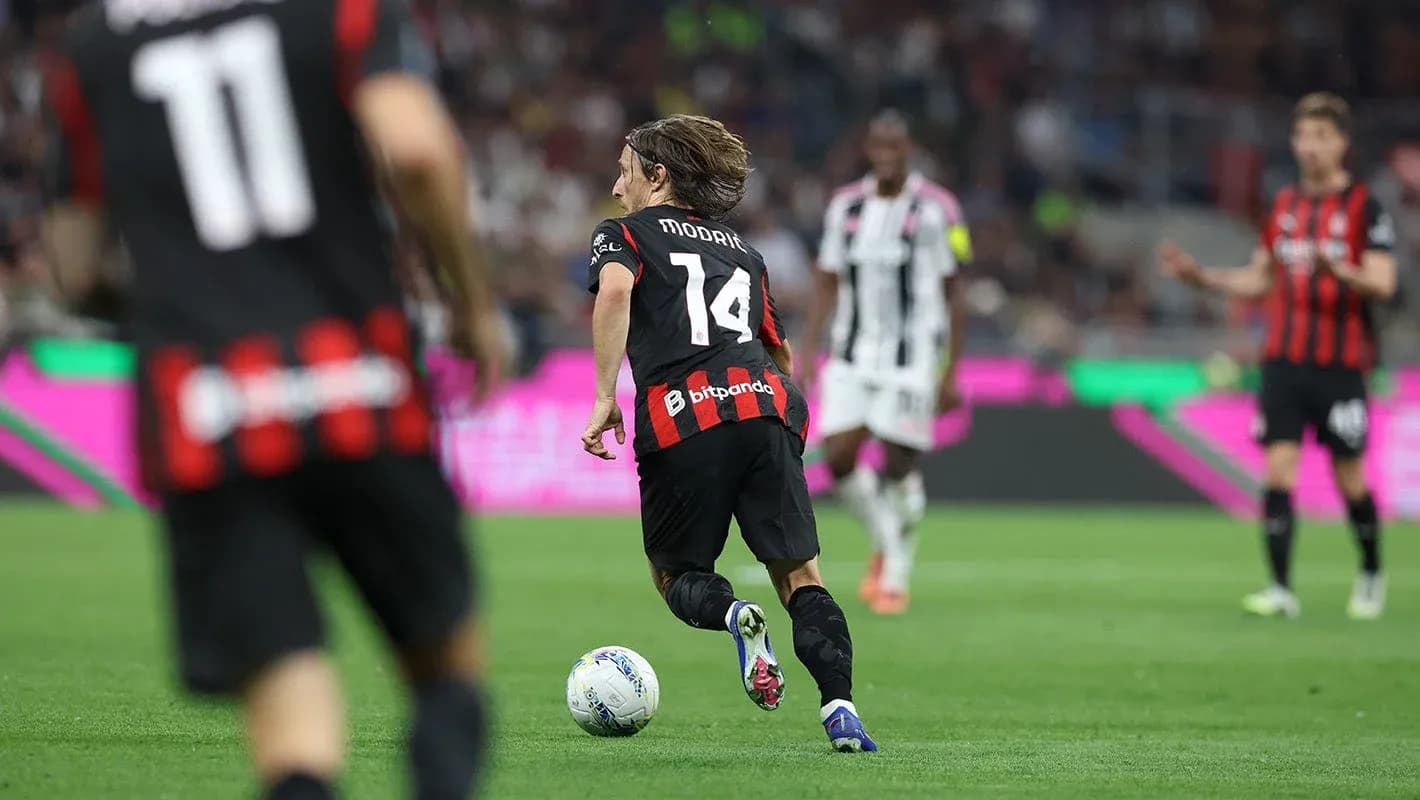
In midfield, Alexis Saelemaekers and Bartesaghi (then Estupiñán) provided width, while Youssouf Fofana and Adrien Rabiot worked as stabilizers around Luka Modrić. Milan’s 454 total passes at 86% accuracy show a team comfortable in structured buildup but somewhat lacking vertical incision. The shift from Pulisic and Leão to Füllkrug and Nkunku reoriented the attack: from dribbling and diagonal runs to a more direct target-man plus creative 10 dynamic. However, with only 1 shot on goal from 8 total shots and 0.65 xG, Milan’s possession did not translate into sustained penalty-box threat.
Juventus’ 3‑4‑2‑1 mirrored Milan’s structural principles but with a slightly more possession-oriented tilt. Michele Di Gregorio faced just 1 shot on target and made 1 save, underlining how effectively the back three of Pierre Kalulu, Bremer, and Lloyd Kelly protected the box. Juventus’ 503 passes at 92% accuracy and 53% possession paint a picture of calm circulation, anchored by Manuel Locatelli at the base and supported by Weston McKennie and Thuram (later Koopmeiners) as shuttlers.
The wing-backs, Cambiaso then Holm on one side and McKennie on the other, were crucial in stretching Milan’s midfield five, but Juventus often recycled rather than forcing risky entries. Ahead of them, Francisco Conceição and Jeremie Boga (later Zhegrova and Yildiz) floated between the lines, trying to drag Milan’s defenders out. Jonathan David, then Dušan Vlahović, offered depth and penalty-box presence, but the final ball rarely matched the movement.
Defensively, both sides’ Overall Form in this match leaned toward caution and risk management, while their Defensive Index—judged by shot suppression and box protection—was high. Milan committed 12 fouls and took 2 yellow cards; Juventus committed 8 fouls with 3 yellows, most explicitly for fouls rather than dissent or simulation, underscoring a physical but controlled contest.
Statistically, the verdict confirms the eye test of a finely balanced stalemate. Milan’s slight xG edge (0.65 vs 0.52), despite fewer shots on goal (1 vs 5), suggests their best chances were marginally clearer, but not decisive. Juventus’ superior passing accuracy and possession did not translate into overwhelming danger, in part because Milan’s back three and Maignan’s 5 saves neutralized most incursions. With no red cards, five yellows (two for Milan, three for Juventus), and both goalkeepers recording 0 goals prevented in the model, the match settled into a strategic deadlock rather than a chaotic shootout. In the context of the season, this was a point earned through structure and discipline more than ambition from either side.