Ferencvarosi TC vs Twente: Tactical Analysis of 2-2 Draw in UEFA Europa League
Ferencvarosi TC and Twente produced a tactically volatile 2-2 draw at Groupama Aréna in the UEFA Europa League 2nd Qualifying Round, a match defined more by structural shifts, game-state management and discipline than by measurable statistical dominance. With virtually all standard metrics (possession, shots, passes, xG) unavailable, the tactical picture must be drawn from lineups, events and substitutions alone. Ferencvarosi led 1-0 at half-time and 2-0 by the 50th minute despite going down to ten men before the break, only for Twente’s bench and late attacking reconfiguration to tilt the balance and salvage a draw.
Both sides started in a 4-3-3, but the systems evolved in very different ways once pressure and cards intervened.
Ferencvarosi TC's Tactical Setup
Ferencvarosi’s initial 4-3-3 under Balazs Borbely was an aggressive, front-foot structure. With D. Dibusz in goal, the back four of A. Osvath, M. Gomez, T. Raemaekers and Cadu had a clear split: Gomez and Raemaekers as the central pairing, Cadu and Osvath nominally listed as midfielders but functionally stepping into full-back and wide-half-space roles. Ahead of them, the central trio of P. Rommens, G. Kanichowsky and M. Corbu provided a staggered midfield, with Rommens the deeper distributor, Kanichowsky shuttling and Corbu often pushing to connect with the front three of K. Zachariassen, L. Joseph and C. O’Dowda.
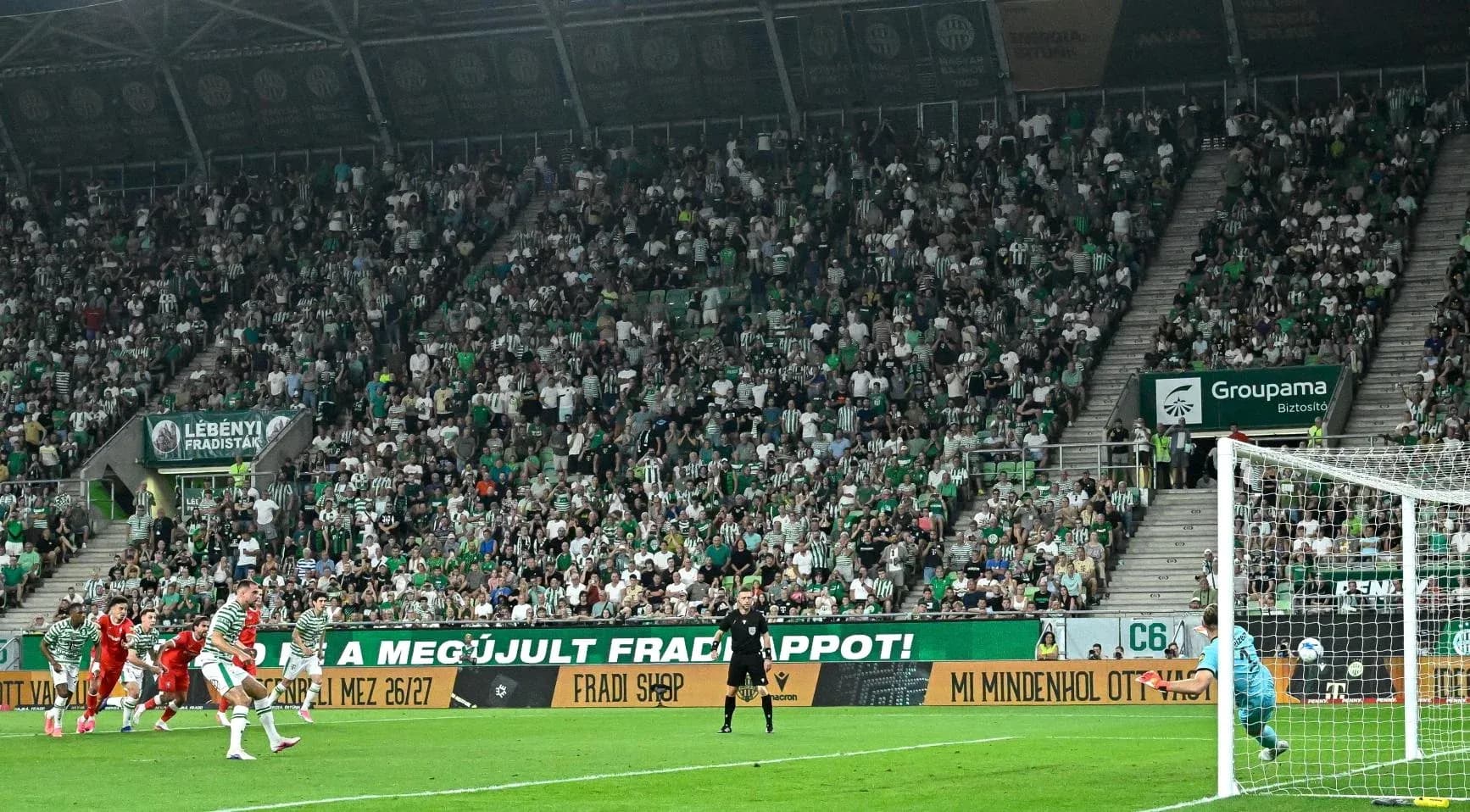
The early penalty at 22' converted by Raemaekers underlined Ferencvarosi’s intent to commit numbers into the box from wide and second-ball situations; a centre-back stepping up to take the spot-kick suggests he was a technical focal point in build-up as well. Up to that point, the 4-3-3 looked balanced: Zachariassen and O’Dowda narrowing inside to create lanes for Cadu and Osvath to advance, with Joseph pinning the Twente centre-backs.
The turning point came at 36', when Rommens received a straight red card for “Serious foul”. That single incident forced Borbely into a complete re-think of his structure. Reduced to ten, Ferencvarosi had two broad options: keep the front three and sacrifice midfield stability, or drop one forward to restore central control. The subsequent pattern of substitutions suggests Borbely initially trusted his starting block to ride out pressure, then later adjusted to protect legs and preserve transitional threat.
Despite the numerical disadvantage, Ferencvarosi struck again at 50' through Joseph for 2-0. Tactically, that goal speaks to a compact, low-block plus counter model: with one midfielder gone, Ferencvarosi likely collapsed into a 4-4-1 or 4-2-3, absorbing pressure and springing Joseph into space. The fact that Joseph scored before being withdrawn indicates he remained the primary outlet on the shoulder of Twente’s defence, exploiting the spaces left as the visitors pushed up.
From 56' onward, the home side’s game-state management became about survival. Cadu’s yellow card for “Unsportsmanlike conduct” at 56' hints at the increasing defensive strain on the back line and wide players. Substitutions at 73' and 78' were clearly tactical: Dele (IN) came on for O’Dowda (OUT), and N. Zohore (IN) came on for Joseph (OUT). Dele’s introduction for a wide midfielder suggests fresh legs to defend the flanks and carry counters, while Zohore replacing Joseph likely shifted the attacking reference point towards a more physically robust forward who could hold the ball and win fouls to relieve pressure. The 88' change, with J. Levi (IN) for Cadu (OUT), further underlined a tilt towards energy and defensive coverage in wide areas as Twente’s pressure peaked.
Twente's Tactical Adjustments
Twente’s 4-3-3 under John van den Brom began in a more orthodox shape: L. Unnerstall in goal behind a back four of B. van Rooij, S. Lemkin, R. Nijstad and A. Adelgaard; a midfield trio of R. Zerrouki, K. Hlynsson and T. van den Belt; and a front line of D. Rots, W. Weghorst and S. Orjasaeter. Early on, Twente struggled to turn structure into penetration, going 1-0 down and then facing a deep, compact block after the red card.
The second half was defined by Twente’s bench-driven tactical escalation. At 46', S. Lammers (IN) came on for Hlynsson (OUT) and D. Weidmann (IN) came on for Adelgaard (OUT). Those two changes simultaneously increased central attacking presence and removed a full-back, strongly suggesting a shift towards a more aggressive, possibly asymmetrical back three in possession or a 3-4-3/4-2-4 hybrid, with van Rooij and perhaps Rots or Orjasaeter stretching the width. Twente were now clearly willing to risk defensive exposure to exploit their numerical advantage.
The double yellow sequence at 56' – van den Belt and Cadu both booked for “Unsportsmanlike conduct” – reflected rising intensity in central zones, with van den Belt involved in confrontational or cynical actions as Twente tried to quicken tempo. Lemkin’s yellow at 61', also for “Unsportsmanlike conduct”, further underlined the emotional edge as Twente pressed high and defended transitions aggressively.
Van den Brom continued to lean on his bench. At 63', Y. Taha (IN) replaced van den Belt (OUT), adding fresh running and verticality from midfield. Then at 72', M. Pjaca (IN) came on for Rots (OUT) and L. Vennegoor of Hesselink (IN) for Orjasaeter (OUT). Those twin changes were decisive: Twente moved towards a more striker-heavy configuration, with Weghorst and Vennegoor of Hesselink both on the pitch, supported by Lammers and Pjaca. This likely resembled a 4-2-4 or even a 2-4-4 in sustained attacks, with full-backs high and Zerrouki plus Weidmann anchoring.
The payoff came late. At 82', Weghorst pulled one back for 2-1, capitalising on the aerial and positional overloads Twente had created in and around the box. At 86', Vennegoor of Hesselink completed the comeback to 2-2, again consistent with a strategy of flooding the penalty area with multiple targets and second-ball threats. Taha’s yellow card at 88' for “Foul” showed Twente continuing to play on the edge, even after restoring parity.
In goal, D. Dibusz (Ferencvarosi TC) and L. Unnerstall (Twente) both completed the match, but with “Goalkeeper Saves” and “goals prevented” unavailable, their impact can only be inferred from the scoreline and game state. Dibusz faced sustained pressure for much of the second half behind a tiring, numerically reduced block, while Unnerstall conceded twice – one from the spot and one in open play – before Twente’s territorial dominance limited Ferencvarosi’s attacking forays.
With all core statistical fields (possession, shots, passes, xG, goals prevented) missing, the verdict rests on structural and disciplinary evidence. Ferencvarosi’s 2-0 lead with ten men speaks to efficient exploitation of moments and a well-drilled defensive shape, but the late collapse to 2-2 reveals the physical and spatial costs of playing an hour a man down. Twente’s three yellow cards to Ferencvarosi’s one yellow and one red (Ferencvarosi TC: 1 yellow, 1 red; Twente: 3 yellows; total cards: 5) underline how aggressively the visitors chased the game.
From a tactical standpoint, Twente’s in-game coaching and bench depth were decisive: the chain of substitutions from 46' to 72' steadily increased attacking density and variety, eventually overwhelming Ferencvarosi’s reduced midfield and back line. Conversely, Borbely’s changes were largely reactive, oriented towards maintaining compactness and energy rather than reasserting control. Over two legs, this match will be remembered as a case study in how numerical superiority, proactive substitutions and structural risk-taking can overturn even a seemingly secure 2-0 deficit.