England's Tactical Masterclass: 2-1 Comeback Against Congo DR
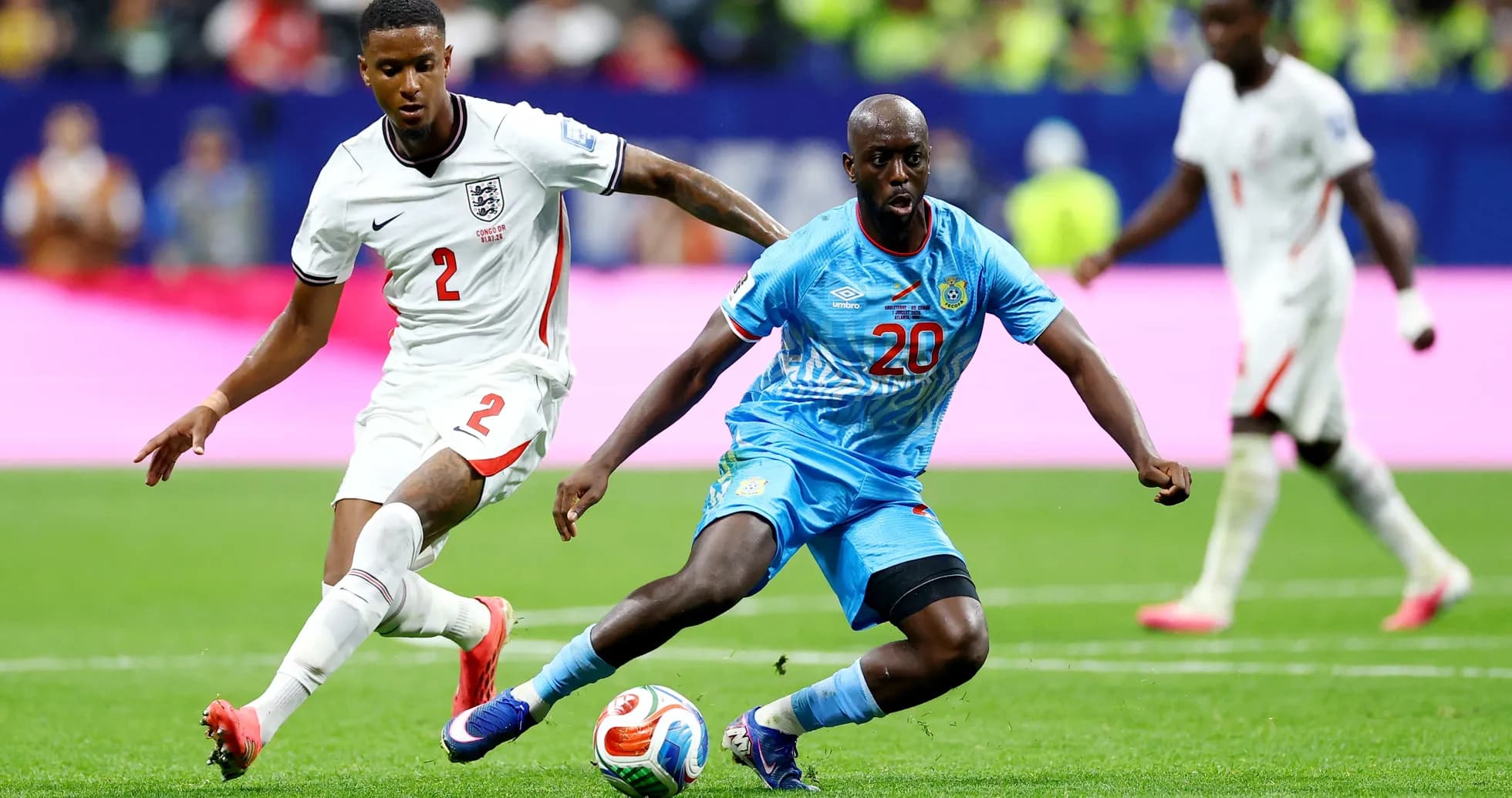
England’s 2-1 comeback win over Congo DR at Mercedes-Benz Stadium was defined by structural control versus vertical punch. Thomas Tuchel’s England, in a 4-2-3-1, used the ball and territory to slowly suffocate Congo DR’s 4-3-3, eventually turning a 0-1 deficit into a deserved Round of 32 victory built on sustained pressure and a late execution surge from Harry Kane.
Congo DR struck first through Brian Cipenga, capitalising on an early phase where Sebastien Desabre’s side were able to spring their front three quickly. The front line of Nathanaël Mbuku, Yoane Wissa and Cipenga worked off direct balls and early diagonals into the channels, trying to isolate England’s full-backs. The 4-3-3 without the ball became a compact mid-block, with Ngal’ayel Mukau and Samuel Moutoussamy initially screening central lanes to Kane and Jude Bellingham.
England’s 4-2-3-1 had a clear double pivot in Declan Rice and Elliot Anderson, tasked with both protecting transitions and feeding the advanced line of Noni Madueke, Bellingham and Marcus Rashford behind Kane. The structure produced dominance of the ball – 60% possession and 517 passes – but the first half showed a familiar pattern: England circulating in front of Congo DR’s block without enough penetration, while the Africans threatened in short, sharp counters. The VAR “Penalty cancelled” incident involving Kane at 44' underlined England’s territorial superiority but also their reliance on penalty-box incidents rather than cleanly created chances before the break.
Second Half Adjustments
After half-time, Tuchel’s adjustments were personnel-driven and aggressive. On 60', Bukayo Saka (IN) came on for Noni Madueke (OUT), and Anthony Gordon (IN) replaced Marcus Rashford (OUT). Functionally, this shifted the dynamic of the wide areas. Saka’s natural tendency to hold width and attack on the outside stretched Aaron Wan-Bissaka, while Gordon’s direct running from the opposite flank forced Congo DR’s back line deeper, breaking the compactness of their block.
This had two key tactical effects. First, it created more space between Congo DR’s midfield and defence for Bellingham to receive and turn. Second, it increased the volume and quality of cut-backs and low crosses into the box. England’s shot profile reflects this: 13 of their 16 attempts came from inside the box, and they finished with 7 shots on goal. The 4-2-3-1 became far more vertical, with Rice anchoring transitions and Anderson pushing higher to support Bellingham.
Desabre responded at 64' with Meschak Elia (IN) for Mbuku (OUT), looking for more pace and direct threat in behind, then at 76' with Théo Bongonda (IN) for Cipenga (OUT) and Edo Kayembe (IN) for Ngal’ayel Mukau (OUT). These moves were aimed at refreshing the front line and adding ball-carrying from deeper zones. However, by then England’s territorial lock was almost complete: Congo DR were reduced to 7 total shots, only 2 on target, and just 2 attempts inside the box. Their attacks increasingly began from deeper, with longer distances to goal and fewer support runners.
Decisive Phase
The decisive phase arrived between 75' and 86'. England’s pressure finally translated into scoreboard impact as Kane exploited the improved service. His first goal at 75', assisted by Anthony Gordon, came in the context of sustained England possession and repeated entries into the area. Congo DR’s back four, stretched horizontally by Saka and Gordon, left gaps between centre-backs and full-backs that Kane and Bellingham could attack. The second, again from Kane at 86' and again assisted by Gordon, underlined how England’s wide rotations and cut-backs had broken Congo DR’s defensive organisation.
Tuchel’s late substitution of John Stones (IN) for Rice (OUT) at 90' signalled a shift to protect the lead, adding an extra natural defender to close down aerial and direct balls as Congo DR threw on Fiston Mayele (IN) for Moutoussamy (OUT) and Joris Kayembe (IN) for Arthur Masuaku (OUT) at 89'. Congo DR’s shape in the final minutes resembled a 4-2-4, but with limited possession and only 3 corner kicks all match, they lacked the sustained platform to test England’s reshaped back line.
Goalkeeping Performance
In goal, Jordan Pickford (England) had a relatively quiet but high-stakes evening, officially making 1 save. England’s defensive structure, with Ezri Konsa and Marc Guéhi central and Djed Spence plus Nico O’Reilly wide, largely kept Congo DR’s threat to low-volume, low-xG efforts; Congo DR’s xG was just 0.8. At the other end, Lionel Mpasi Nzau (Congo DR) was far busier, registering 5 saves as England piled up 7 shots on target and 2.04 xG. The negative “goals prevented” value for both goalkeepers (−0.04 each) suggests that finishing marginally exceeded the underlying shot quality on both sides, but England’s sheer shot volume and box occupation tilted the match.
Discipline and Passing Quality
Discipline and duels also tell a tactical story. England committed 10 Fouls to Congo DR’s 12, with one yellow card each: Jude Bellingham (Foul) at 19' and Noah Sadiki (Foul) at 27'. The relatively low card count, despite England’s late siege, reflects controlled aggression rather than chaos. England’s pressing and counter-pressing were structured enough to avoid repeated tactical fouls, while Congo DR’s attempts to break up transitions did not descend into persistent infringement.
Passing quality underpinned England’s dominance. They completed 468 of 517 passes (91%), using circulation to move Congo DR’s 4-3-3 block side to side and create overloads in the half-spaces. Congo DR, with 365 passes and 299 accurate (82%), were more direct and vertical, but as the game wore on and they dropped deeper, their ability to connect through midfield diminished.
Statistically, the 2-1 scoreline aligns closely with underlying metrics. England’s 2.04 xG versus Congo DR’s 0.8, combined with a 16–7 shot advantage and 60–40 possession split, supports the view that Tuchel’s side controlled both territory and chance quality. Congo DR’s early goal and compact 4-3-3 gave them a platform, but once England’s wide substitutions took effect and Kane began receiving higher-quality service in the box, the tactical balance shifted decisively toward the eventual winners.