England vs Norway: World Cup Quarterfinal Showdown
Miami will be unforgiving on Saturday night. Thick air, 33 degrees, humidity clinging to every sprint. Into that furnace walk England and Norway, one a serial quarterfinalist, the other a resurgent outsider riding the high of a generation.
This is a World Cup quarterfinal with layers. A golden-boot shootout, a tactical puzzle around Erling Haaland, a midfield duel forged in North London, and a question as old as tournament football: who copes best when the legs start to feel like lead?
Haaland vs Kane: Golden Boot, golden stakes
For the first time at this World Cup, two of the leading contenders for the Golden Boot share the same pitch.
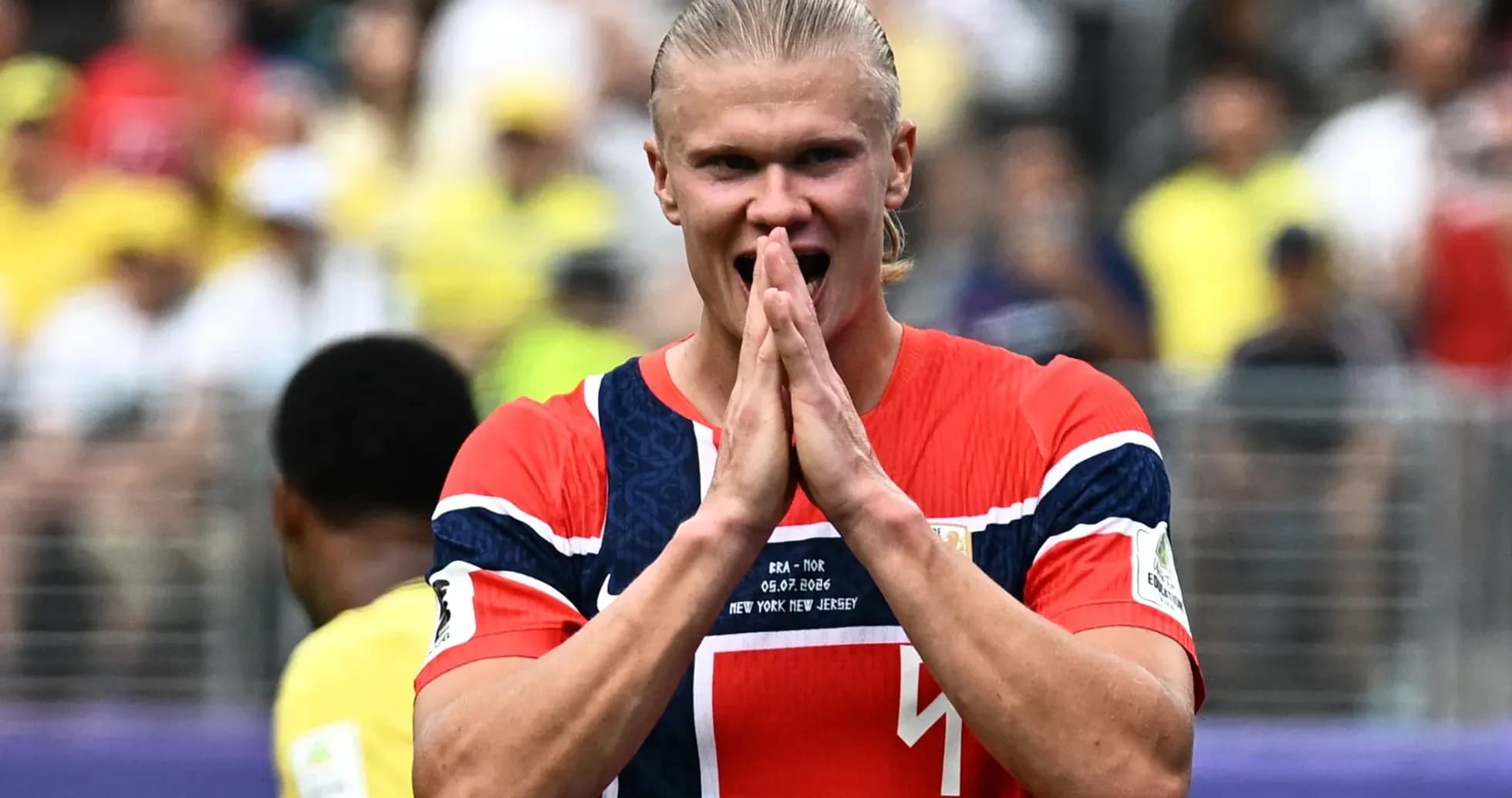
Erling Haaland has arrived in the knockouts like a wrecking ball. Rested against France in the group stage once Norway were already through, he has spent the last two rounds making up for lost minutes: the winner against Ivory Coast, both goals in the 2-1 upset of Brazil. Seven goals in four appearances, 14 consecutive Norway games with at least one strike, 27 in that run alone. His international record now stands at 62 in 54 caps. Absurd numbers.
He trails Kylian Mbappe and Lionel Messi by one in the scoring charts. He leads Harry Kane by the same margin.
Kane, at 32, is crafting a different kind of masterpiece. He opened with two against Croatia, added another in the win over Panama that sealed top spot in the group, then dragged England through the Round of 32 with both goals in the late comeback against DR Congo. Against Mexico, his penalty proved decisive in a wild 3-2 contest that ended with England down to 10 men and clinging on.
They are bound by a shared language of goals. Three Premier League Golden Boots apiece. Both having thrived in Germany. Yet they have rarely stood on the same grass: just two meetings in 2022/23, when Kane’s Tottenham and Haaland’s Manchester City traded wins and the strikers traded goals.
This time the stage is bigger, the margins thinner. One of them could walk out of Miami with a semifinal place and a stranglehold on the “best striker in the world” argument. The other goes home with numbers, but no trophy.
The Dan Burn question: England’s unlikely Haaland antidote
How do you stop a striker who scores every 73 minutes in international football?
England’s most intriguing answer might be a 6’7” defender who has barely featured for his country.
Dan Burn’s inclusion in Thomas Tuchel’s squad raised eyebrows. He made his England debut just before his 33rd birthday in March 2025 and arrived at this tournament with only a handful of caps, his starts confined to qualifiers against Andorra and Albania. On paper, not the profile of a man you throw at Haaland in a World Cup quarterfinal.
Yet against Mexico, when England were reduced to 10 men and forced to defend deep for the final 15 minutes plus 12 added on, Burn transformed the closing stages. He headed away everything, threw himself in front of crosses and shots, and turned England’s box into a no-go zone.
The matchup with Haaland is not hypothetical. It is built on hours of direct combat in English football. Since Haaland joined Manchester City in 2022, he has faced Burn eight times across the Premier League, FA Cup and League Cup. Across more than 10 hours on the pitch together, Haaland has scored once – in their very first meeting in August 2022.
For a forward who devours chances at club and international level, that record stands out.
Burn is not alone in frustrating him. Ezri Konsa has faced Haaland across five matches and 406 minutes and conceded just one goal, again in their first encounter back in September 2022. That sits against the wider reality: Haaland has 112 goals in 132 Premier League games over four seasons, with three Golden Boots to show for it.
The contrast is stark. Against Marc Guehi, before the Crystal Palace defender became his club teammate at City, Haaland scored seven times in five meetings. Against John Stones, he has never played as an opponent at all.
Tuchel will not ignore those numbers. He cannot match Haaland for speed or age, but he can throw height, experience and familiarity at him. Burn and Konsa, if paired or rotated, offer something very few centre-backs can claim: a proven record of making Haaland’s life awkward.
In a game this tight, awkward might be enough.
Odegaard vs Rice: Arsenal’s heartbeat splits in two
If Haaland is the headline, the game’s rhythm may be dictated a few yards behind him.
Martin Odegaard was majestic against Brazil. The Norway captain carried the ball forward 61 times, completed 101 of his 109 passes, and orchestrated a performance that restricted the five-time champions to just 33.6 percent possession – their lowest ever share in a World Cup match.
Norway smothered Brazil with the ball, then punished them without it. Odegaard was at the centre of both.
England know that script. On Sunday in Mexico City, they had even less of the ball than Brazil did against Norway. Reduced to 10 men, they spent the final half-hour in their own penalty area, repelling waves of pressure. It was their lowest share of possession since records began.
To reach a first World Cup semifinal since 2018 – and only a third since 1966 – they need to change that pattern. That means cutting Odegaard’s supply lines, not just reacting to the damage.
No one is better placed to understand the task than Declan Rice. The pair have shared the Arsenal midfield 117 times in three seasons, guiding the club to a long-awaited Premier League title and a run to the Champions League final. They know each other’s habits, strengths, tells.
Rice, though, is not at full tilt. Neural pain affecting his lower back and hamstring has shadowed him for months. Odegaard will know that too. Rice still logged 3,094 Premier League minutes this season; his England midfield partner Elliot Anderson played even more. Odegaard’s league load, by contrast, sat at 1,369 minutes.
Fresh legs, tired muscles. Fine margins again.
If Rice cannot close spaces as quickly, Odegaard will find them. If he can, if he can drag his body through one more punishing night, England’s chances of controlling the ball and the tempo rise sharply.
Miami’s furnace: who melts, who endures?
There is a cruel irony in a quarterfinal between England and Norway being decided in tropical heat.
Neither nation is built for 33C and 58 percent humidity, yet one of them has been living in it more consistently over the past few weeks.
Norway’s route has been heavy on outdoor heat. They opened in Boston against Iraq, then moved to New York/New Jersey for the win over Senegal. They went back to Boston for the defeat to France, when Stale Solbakken rotated heavily and changed 10 players, before briefly escaping into enclosed conditions for the victory over Ivory Coast in Dallas. The win over Brazil came back in the humidity of New York/New Jersey.
England’s path has been gentler. They began under the roof in Dallas against Croatia, then played in Boston and New York/New Jersey against Ghana and Panama, both matches affected by rain. Their Round of 32 win over DR Congo came in the air-conditioned comfort of Atlanta. Even the Mexico game in Mexico City, disrupted by a thunderstorm and a one-hour delay, was played in relatively cool conditions.
Miami has been different. The two hottest group games were staged here: Uruguay’s 2-2 draw with Cape Verde and 1-1 with Saudi Arabia. Saturday’s 5pm local kickoff drops England and Norway straight into that same intensity, with thunderstorms again lurking in the forecast.
This is not just about hydration breaks and ice towels. It is about who can maintain their press in the 70th minute, who can still sprint to track a runner in the 88th, who makes the right decision when the brain is fogged by heat.
The side that handles that best may not just win; they may arrive in the semifinal on Wednesday with something left in the tank.
Norway’s left vs England’s right: a fault line in the heat
There is a clear pressure point in this match, and it sits down England’s right flank.
Reece James, the only natural right-back in Tuchel’s squad after Tino Livramento’s calf injury ruled him out before the tournament, has missed the last three games with a hamstring problem. In his absence, England have patched and improvised. Djed Spence, Ezri Konsa, John Stones and Jarell Quansah have all taken turns on that side. At one point against DR Congo, even Declan Rice was pushed back there.
Quansah’s red card against Mexico has removed one option for Miami. James is pushing to return, a potentially huge boost, but if he is not passed fit, Konsa is the likeliest to start after impressing in the backs-to-the-wall effort last time out.
Whoever gets the nod walks into a storm.
On Norway’s left, Antonio Nusa brings pace, direct running and a wicked right foot. His signature moment so far came against Ivory Coast in the Round of 32, cutting in to curl a superb strike into the top corner. He has flickered in other games, always threatening to break open a contest with one run.
Yet it was his replacement against Brazil, Andreas Schjelderup, who truly shifted a knockout tie.
Introduced at half-time in New York/New Jersey, the 22-year-old Benfica winger delivered his best performance of the tournament. His cross found Haaland for the opening goal. Later, he teed up the same teammate to hammer in a second from the edge of the box, sealing Norway’s place in Miami.
That left flank – whether with Nusa running at his man or Schjelderup drifting into clever pockets and whipping balls into the area – will be a constant examination of England’s patched-up right side. One mistimed step, one lapse in concentration in the heat, and Haaland will be waiting between the posts.
So it comes to this: Haaland’s hunger, Kane’s craft, Odegaard’s control, Rice’s resilience, the furnace of Miami, and a handful of individual duels that could tilt a World Cup.
Norway are chasing the greatest chapter in their footballing history. England are trying to turn decades of near-misses into something more permanent.
By Saturday night, one of them will have run out of time. The other will be 90 minutes from a World Cup final.