Egypt Advances Over Australia in Tactical Round of 32
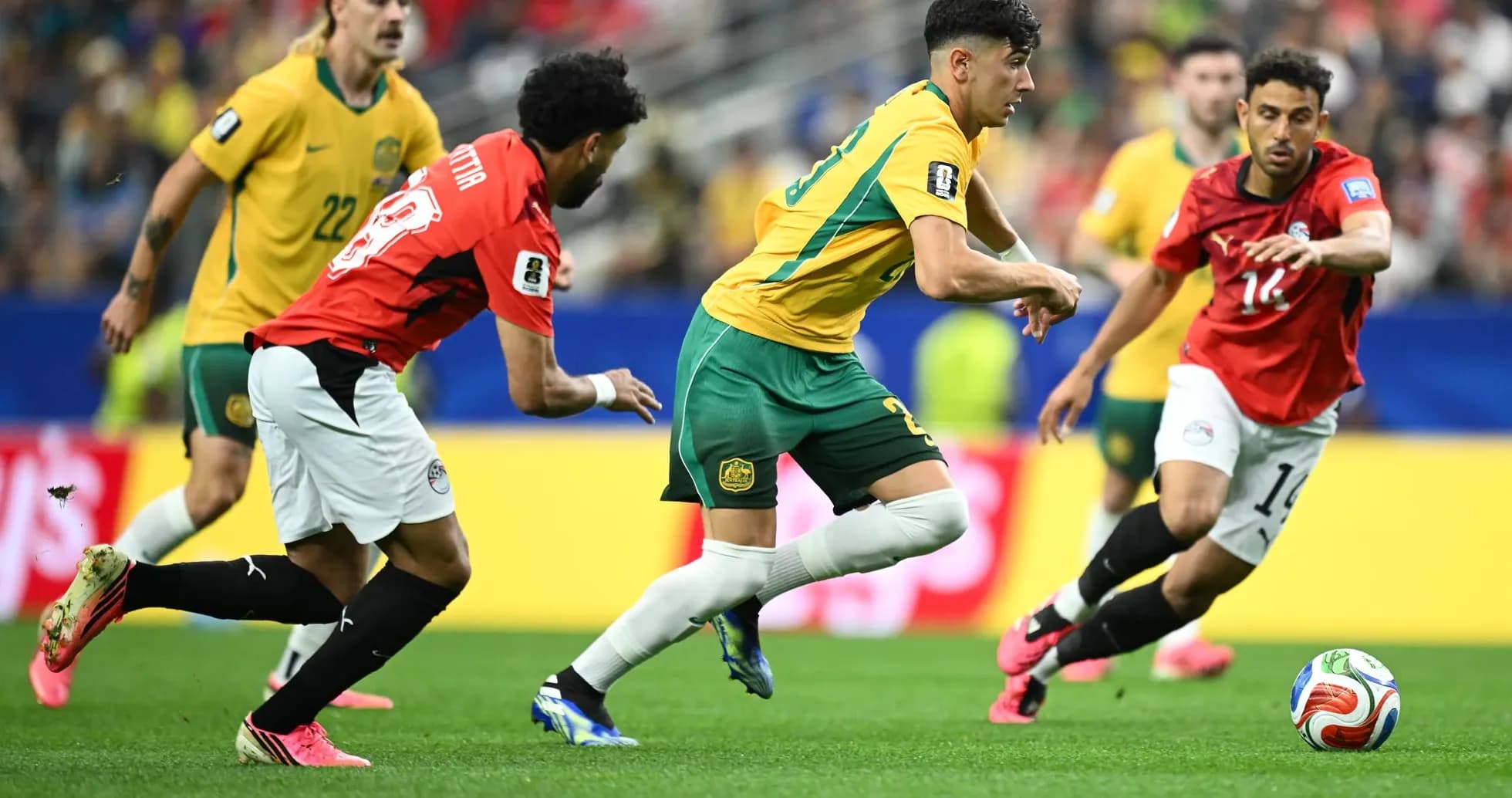
Australia and Egypt produced a tactically tight Round of 32 tie at AT&T Stadium, with Egypt advancing 4-2 on penalties after a 1-1 draw over 120 minutes. The pattern of the match was defined by Egypt’s territorial control against Australia’s back‑five defensive scheme and transition threat, with key structural shifts after half-time and deep into extra time.
Egypt’s 4-4-2 out of possession and flexible 4-2-3-1/4-2-4 in possession allowed them to dominate the ball: 58% possession, 723 passes with 614 accurate (85%). The double pivot of Hamdy Fathy and Marwan Attia (before Fathy’s withdrawal) gave a stable base, while Emam Ashour and Omar Marmoush (starting nominally as wide midfielders) stepped inside to overload central areas around Jackson Irvine and Aiden O’Neill. This structure underpinned Egypt’s shot profile: 14 total shots, 8 from inside the box, and a higher xG of 1.36.
Australia’s 3-4-2-1, coached by Tony Popovic, was clearly designed to absorb and break. The back three of Alessandro Circati, Harry Souttar and Lucas Herrington stayed narrow, with wing‑backs Jordan Bos and Aziz Behich tasked with tracking Egypt’s wide threats while also providing the outlet in transition. In possession, the shape often morphed into a 3-2-4-1, with Irvine stepping higher alongside Connor Metcalfe and Cristian Volpato between the lines, and Nestory Irankunda as the advanced focal point. Despite creating 16 total shots and 10 inside the box, Australia managed only 1 shot on goal, reflecting a structural issue in converting final-third occupation into true chances; their xG of 0.87 underscores how many efforts were low-quality or heavily contested (9 blocked shots).
Opening Goal
The opening goal at 13' encapsulated Egypt’s superiority in early phases. Emam Ashour’s strike, assisted by left‑back Karim Hafez, came from Egypt’s ability to advance their full-backs and pin Australia’s wing‑backs deep. Hafez’s high starting position stretched Australia’s right side, forcing the back three to shift and leaving Ashour free to attack the half-space. This exploited the inherent risk of Australia’s 3-4-2-1: when both wing‑backs are forced into a back five, the midfield two can be overloaded by Egypt’s narrow wide midfielders and forwards.
Australia’s response was more about energy and verticality than structural change before the break, but Popovic moved quickly at half-time. At 46', Kai Trewin (IN) came on for Jordan Bos (OUT), effectively giving Australia a more conservative right side and a sturdier back line to handle Egypt’s rotations. This helped stabilize the defensive block and set the stage for their equaliser.
The 55' own goal by Mohamed Hany, credited to Australia, was the product of sustained pressure rather than a crafted pattern, but it reflected a tactical shift: Australia began to push their wing‑backs and half‑spaces higher, forcing Egypt’s full‑backs deeper and asking more questions of the central defenders. With Volpato and Metcalfe operating closer to Irankunda, Australia finally pinned Egypt back, increasing the volume of crosses and box entries that led to defensive errors.
In-Game Management
Hossam Hassan’s in-game management tried to restore control. At 67', Hossam Abdelmaguid (IN) came on for Hamdy Fathy (OUT), and Haissem Hassan (IN) replaced Mostafa Ziko (OUT). The first substitution freshened the back line and slightly altered Egypt’s build-up angles, while the second introduced a more mobile forward to attack space behind Australia’s high wing‑backs. At 80', Mahmoud Trézéguet (IN) replaced Karim Hafez (OUT), a clear attacking tilt on the left, with Trézéguet stepping higher than a traditional full-back and effectively turning Egypt into a back three in some possession phases as Mohamed Hany stayed deeper on the right.
Australia’s response in the final quarter of normal time was to add more direct running and creativity. At 74', Mohamed Touré (IN) came on for Nestory Irankunda (OUT), and Ajdin Hrustić (IN) replaced Cristian Volpato (OUT), injecting a more traditional striker profile and a left‑footed playmaker capable of switching play and delivering from deeper zones. This rebalanced Australia’s attack towards more crosses and second‑ball pressure, which contributed to their 4 corner kicks and kept Egypt pinned for spells, but they still struggled to generate clear, on‑target chances.
Deep into added time of normal play, Popovic doubled down on attacking width and energy: at 91', Awer Mabil (IN) came on for Connor Metcalfe (OUT), and Paul Okon-Engstler (IN) replaced Aiden O’Neill (OUT). These changes aimed to maintain pressing intensity and offer fresh legs between the lines, but they also slightly reduced Australia’s central defensive cover in transition.
Discipline
Discipline played a subtle tactical role. Egypt collected 2 yellow cards, Australia none. The disciplinary log, in order:
- 105' Haissem Hassan (Egypt) — Foul
- 120' Yasser Ibrahim (Egypt) — Foul
The first caution at 105' underlined Egypt’s increasing need to break up Australian transitions as legs tired. The second, at 120', reflected the strain on Egypt’s central defence as Australia pushed for late set-piece opportunities.
Extra Time
Extra time saw further strategic tweaks. At 106', Hamza Abdelkarim (IN) came on for Omar Marmoush (OUT), refreshing Egypt’s left side and preserving pressing capacity. At 120', Mahmoud Saber (IN) replaced Marwan Attia (OUT), shoring up central midfield ahead of the penalty shootout and adding a fresh passer to help Egypt keep the ball in the closing moments.
The goalkeeper narrative is defined more by volume than spectacular interventions. Australia registered 3 goalkeeper saves; Egypt only 1. Given the starting line-ups, Patrick Beach (Australia) began in goal, with Mathew Ryan and Paul Izzo among the substitutes. However, at 119', Mathew Ryan (IN) came on for Patrick Beach (OUT), a clear penalty‑shootout tactic to introduce a specialist. For Egypt, Mostafa Shobeir started, with Mohamed El-Shenawy, Mohamed Alaa and Mahdi Soliman on the bench. Egypt’s 4 shots on goal against Australia’s 1 underline that, across 120 minutes, Shobeir was largely protected by a compact block and effective first‑line pressing, while Australia’s keeper unit had to deal with more direct pressure and a higher xG load.
Statistical Overview
Statistically, Egypt’s control is clear: more possession (58% to 42%), more accurate passing (614 to 404), better passing efficiency (85% to 80%), and a higher xG (1.36 to 0.87). Australia, however, outshot them (16 to 14) and produced more blocked efforts (9 to 6), a sign of territorial pressure and Egypt’s last‑ditch defending around the box. Fouls were relatively balanced (Egypt 14, Australia 12), supporting the picture of a physically even contest despite Egypt’s technical edge.
In tactical terms, Egypt’s structure and ball circulation were superior, but Australia’s back‑five organisation and set‑piece pressure dragged the tie into a stalemate over 120 minutes. The penalty shootout, which Egypt won 4-2 after a 1-1 draw, ultimately separated a match where strategic adjustments, defensive organisation and game management were more decisive than open‑play chance creation.