
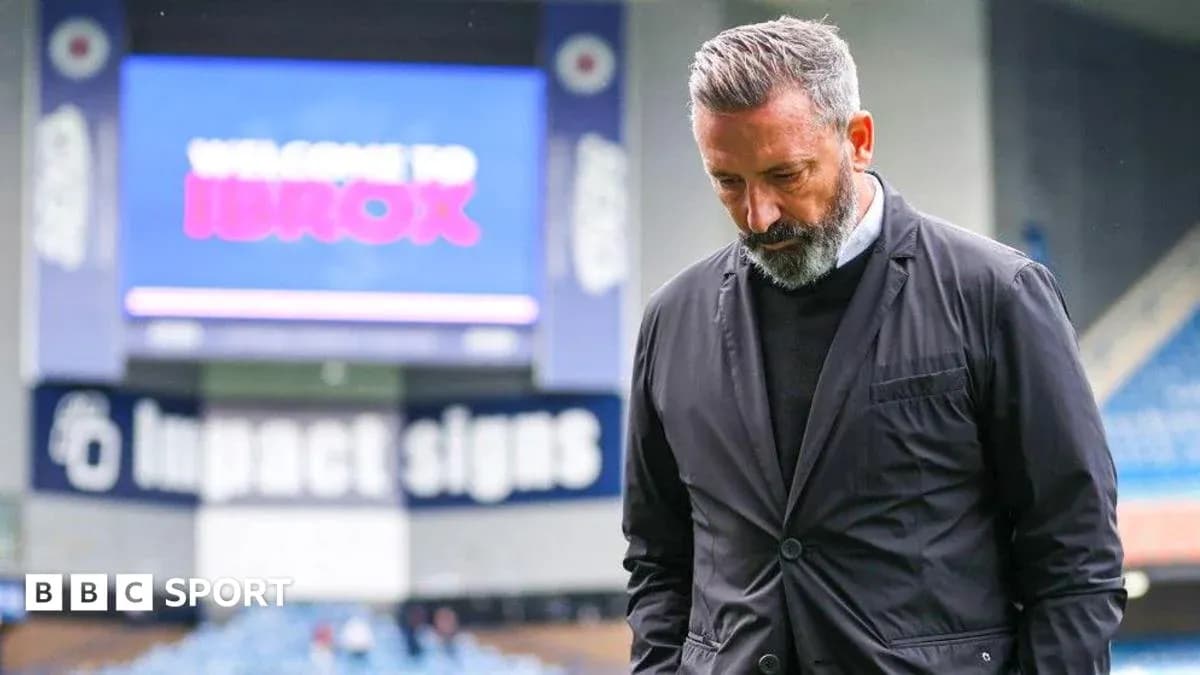
Derek McInnes: From Hearts to Rangers—A Manager's Journey
When Derek McInnes walked through the doors at Tynecastle last May, he spoke like a man who had finally come home. This, he said, was the job he should have had years ago. “Everything I wanted,” he called it.
Thirteen months later, he’s gone. Not to England, not abroad, but to the one club everybody always suspected would prise him away: Rangers.
Once Rangers made their move, the outcome felt inevitable. It wasn’t a courtship, it was a countdown. When, not if.
Hearts’ nearly man, Rangers’ chosen one
You could forgive Hearts fans for fury, for feeling jilted. The reality is more complicated. There is annoyance, yes, but not an uprising. McInnes did a fine job in Edinburgh, an outstanding one at times, yet he never truly felt like a Hearts man.
He came within three minutes of delivering the impossible, the Scottish Premiership title, and that brush with history will live with the club for years. Records fell all season, Tynecastle roared, and for a while it looked like the axis of Scottish football might actually shift.
But even in the delirium, everyone knew the subtext. McInnes was always a Rangers man. Always would be. The Ibrox job has hovered around his career for years, like a recurring subplot. With every surge in form, every cup run, his name floated back into the conversation.
Hearts, for all the emotion and noise, always felt like a staging post. A big one, a successful one, but a stepping stone all the same.
Control, data and a clash of worlds
McInnes adapted quickly to life in Gorgie, but he never fully settled into the club’s modern structure. Hearts’ model, with Jamestown Analytics heavily embedded in recruitment and squad planning, demands compromise from the head coach.
McInnes is not a natural compromiser.
He is a manager who wants control: over signings, over selection, over the direction of the football department. At Kilmarnock and especially at Aberdeen, he was the central figure, the man at the top of the football tree. At Hearts, the power was more diluted, the data team more influential, the lines of authority less clear.
He could live with it for a season. He was never likely to live with it for the long term.
At Rangers, the landscape changes. He walks into Ibrox with the promise of something far closer to the old-fashioned manager’s remit. His train set, his tracks. He will have strong authority over recruitment and, crucially, far more money to spend than at any point in his managerial career.
No more arguments over why he isn’t playing a particular “data win”. No more targets binned because they don’t tick enough boxes on an analytics dashboard. No more being handed players whose numbers impress a model but don’t fit his eye.
For a coach who almost won a title on a shoestring, that is a powerful lure.
The weight of Ibrox
The Rangers owners have already burned through serious money in little more than a year and are ready to go again this summer. McInnes arrives not as a firefighter, but from a position of relative strength, with a squad that will be reshaped around his ideas.
The flip side is brutal. The demand is singular and non-negotiable: win the Premiership.
Danny Rohl tried and fell short. Third place brought him no sympathy. Philippe Clement finished second and still the fans could not wait to move on. At Ibrox, explanations don’t travel far. Rationalisation doesn’t land. Only trophies count.
McInnes knows this better than most. He knows the club, the city, the scrutiny. He knows that at Rangers, words are cheap and time is shorter still.
There is an angry edge to the support now, a tiredness at watching Celtic streak away. That impatience will sit on his shoulder from day one.
Proven, but not yet complete
On paper, he is an obvious appointment. He understands the league as well as anyone. He communicates clearly, handles pressure, and his tactical work last season left the Rangers hierarchy nursing bruises. His Hearts side exposed their weaknesses, out-thought them, out-fought them.
He is also a big enough personality to fill the space. Rangers demands presence as much as it demands points. McInnes has that. He’s never lacked self-belief, never shied away from confrontation, never been afraid to put his name on a performance.
His record in big games, though, tells a more nuanced story.
At Aberdeen, he made Hampden feel like a familiar venue: League Cup finals in 2013-14, 2016-17, 2018-19, a Scottish Cup final in 2016-17. He ran into Celtic time and again, and nobody could reasonably hammer him for losing to a juggernaut.
Yet the list of cup exits to the rest – Dundee United, Hibs, St Johnstone, Dundee, Hearts, Motherwell, Hearts again, St Mirren, Motherwell again, United again – lingers. While he has waited for another major trophy, St Johnstone, Inverness, Hibs, St Johnstone again and Aberdeen have all lifted the Scottish Cup. Ross County, St Johnstone and St Mirren have taken the League Cup.
Outside the Old Firm, a generation of managers have got their hands on silverware: Tommy Wright, John Hughes, Alan Stubbs, Callum Davidson (twice), Jimmy Thelin, Jim McIntyre, Stephen Robinson.
McInnes, for all his consistency and longevity, still carries that label: nearly man.
The final test
That is what makes this move so fascinating. At Rangers, there is no room for “nearly”. No credit for close calls. No comfort in “we pushed them all the way”.
His duels with Celtic’s manager and with whoever succeeds him at Tynecastle will shape the next phase of Scottish football. The narrative is ready-made: the boyhood Rangers man, the almost-champion with Hearts, now tasked with breaking Celtic’s grip and justifying years of “what if?” whispers.
For Hearts, he turned out to be the right man at the right time, but not the forever man. The job he wanted then, not the job he has always wanted.
Now he has that one. The one that has hovered over his career. The one that offers him power, resources, and the chance to finally step out of the nearly-man’s shadow.
At Ibrox, there will be no hiding place if he doesn’t.



