Canada's 4-4-2 vs Morocco's 4-2-3-1: Tactical Analysis
Canada’s 4-4-2 against Morocco’s 4-2-3-1 at NRG Stadium produced a tactical story of control versus directness, with Morocco’s structure and efficiency overwhelming Canada despite a relatively balanced shot profile and xG (0.86 for Canada, 0.78 for Morocco). The 3-0 scoreline reflected Morocco’s superior management of key phases rather than sheer volume of chances.
Canada set up in a classic 4-4-2 with Maxime Crépeau in goal behind a back four of Richie Laryea, Luc De Fougerolles, Moise Bombito and Alistair Johnston. The midfield band of four — Ali Ahmed left, Stephen Eustaquio and Niko Sigur centrally, Tajon Buchanan right — supported a front two of Jonathan David and Tani Oluwaseyi. The idea was clear: use wide midfielders to stretch Morocco’s full-backs and create crossing situations, then rely on David’s movement and Oluwaseyi’s presence between centre-backs. Eleven corner kicks and seven shots inside the box show that Canada did reach advanced zones, but the final action lacked clarity.
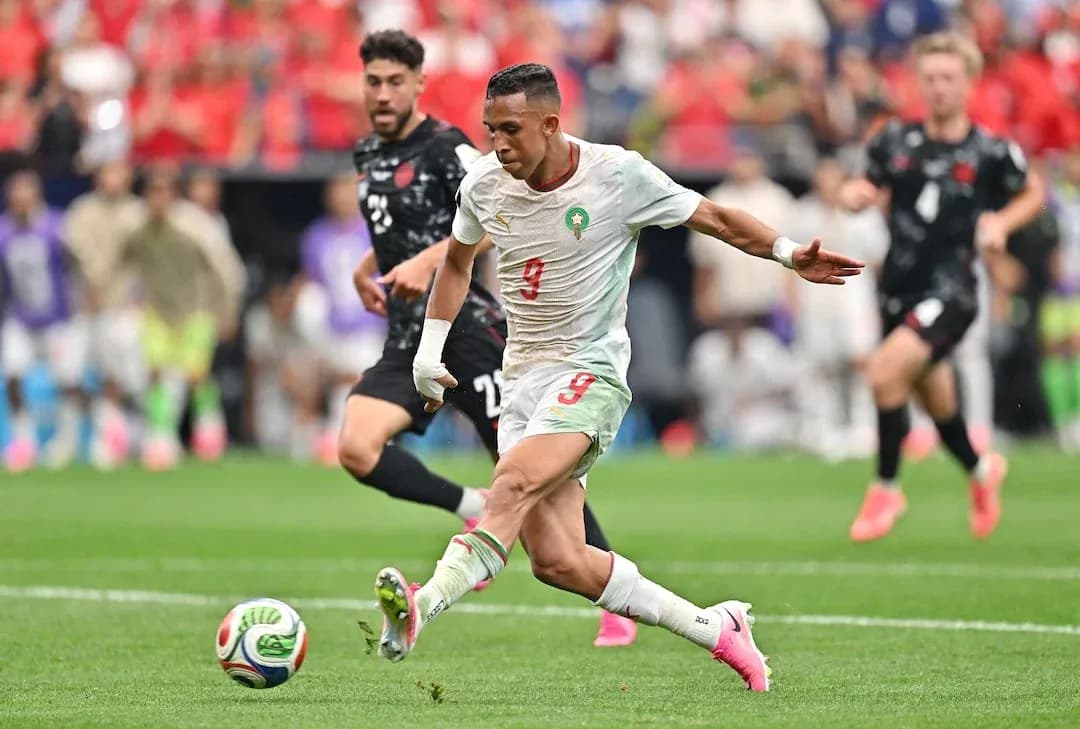
Morocco’s 4-2-3-1 was more layered. Yassine Bounou in goal was protected by a back four of Noussair Mazraoui, Redouane Halhal, Issa Diop and Achraf Hakimi. The double pivot of Ayyoub Bouaddi and Neil El Aynaoui sat underneath an attacking line of Bilal El Khannouss (left), Azzedine Ounahi (central), Brahim Díaz (right), with Ismael Saibari as the lone striker. Out of possession, this often resembled a compact 4-4-1-1, with Díaz and El Khannouss dropping alongside the pivots, closing central lanes and forcing Canada wide. In possession, Ounahi and Díaz became the main connectors, drifting into half-spaces and exploiting Canada’s relatively flat midfield four.
First Half
The first half was attritional and card-heavy, underscoring the intensity of duels. Canada committed 24 fouls to Morocco’s 14, and the card distribution reflects where the game was fought. Achraf Hakimi and Redouane Halhal were both booked for Morocco on the right side, indicating how often Canada tried to attack that channel. On the Canadian side, bookings for Laryea, David and De Fougerolles show strain across the right flank and central defence as they reacted late to Moroccan rotations. Morocco, with 55% possession and 472 passes at 82% accuracy, were more patient in circulation, using Bouaddi and El Aynaoui to recycle the ball and wait for gaps.
Second Half
The match pivoted immediately after the break. At 50', Morocco’s first goal came from exactly the pattern they had been trying to establish: Hakimi advanced from right-back and delivered for Ounahi, who arrived from his central attacking midfield role to finish. This sequence punished Canada’s 4-4-2 spacing — the wide midfielder had to choose between tracking Hakimi or tucking in, and the central pair were drawn backward, leaving Ounahi free to attack the box. It was a direct illustration of how Morocco’s asymmetry on the right overloaded Canada’s left side.
Jesse Marsch’s response was to alter the front line. At 63', Cyle Larin (IN) came on for Tani Oluwaseyi (OUT), keeping the 4-4-2 but adding a more penalty-box oriented striker. This was paired with later changes — Jacob Shaffelburg (IN) for Richie Laryea (OUT) and Promise David (IN) for Ali Ahmed (OUT) at 78', followed by Jayden Nelson (IN) for Tajon Buchanan (OUT) and Jonathan Osorio (IN) for Niko Sigur (OUT) at 87'. Collectively, these moves tilted Canada towards a more aggressive, winger-heavy shape, seeking direct service into Larin and David. The 11 corners and three shots on target suggest some success in territorial terms, but Morocco’s box defence, anchored by Diop and later Marwane Saadane (IN) for Issa Diop (OUT) at 87', remained composed.
Morocco’s in-game management was equally decisive. Early on, Soufiane Rahimi (IN) replaced Ismael Saibari (OUT) at 22', subtly reshaping the front line. Later, at 63', Sofyan Amrabat (IN) came on for Ayyoub Bouaddi (OUT), and Chemsdine Talbi (IN) replaced Bilal El Khannouss (OUT). These substitutions reinforced the spine and added fresh running between the lines just as Canada were chasing the game. At 87', Samir El Mourabet (IN) for Azzedine Ounahi (OUT) and Marwane Saadane (IN) for Issa Diop (OUT) further locked down central areas and aerial presence, preparing Morocco to absorb pressure and counter.
Goals
The second and third goals showcased Morocco’s superior exploitation of transitions and half-spaces. At 82', Ounahi again appeared in a dangerous central pocket, this time finishing from a Brahim Díaz assist. Díaz’s role was crucial: operating from the right but drifting infield, he repeatedly found the seam between Canada’s full-back and centre-back, drawing markers and releasing runners. The 90+8' goal by Rahimi, again assisted by Díaz, underlined how Morocco’s attacking midfield line continued to find space even deep into added time. Canada’s late attacking substitutions left their structure stretched, and Morocco punished the gaps ruthlessly.
In goal, Maxime Crépeau (Canada) was statistically quiet, credited with one save and 0.66 goals prevented. That combination indicates Morocco’s chances were few but of high quality; when they broke Canada’s last line, they tended to finish. Yassine Bounou (Morocco), with three saves and the same 0.66 goals prevented, was more involved, particularly dealing with Canada’s seven shots inside the box and frequent set-pieces. His command of the area on crosses was a key, if less visible, factor in neutralising Canada’s aerial strategy.
The statistical profile reinforces the tactical reading. Canada’s 45% possession, 357 passes at 76% accuracy and 11 total shots (three on target, three blocked) reflect a side that reached the final third but lacked precision and composure, especially under Morocco’s compact mid-block. Morocco, with only five shots but four on target and no blocked attempts, were far more selective and efficient, converting control of territory and tempo into high-yield situations. The xG balance — 0.86 to 0.78 — shows the game was not a barrage from Morocco, but rather a masterclass in chance quality, timing of runs, and in-game adjustments. In the Round of 16 context, Morocco’s 3-0 win was less about volume and more about superior structure, half-space exploitation, and clinical finishing around Ounahi and Díaz.