Burnley vs Wolves Tactical Analysis: A 1-1 Draw
Burnley’s 1-1 draw with Wolves at Turf Moor was a clash of contrasting game models: Mike Jackson’s high-possession, structure-heavy 4-2-3-1 against Rob Edwards’ compact, transition-oriented 3-4-2-1. Over 90 minutes, Burnley’s 70% share of the ball and territorial control met Wolves’ ruthless early punch and resilient low block, with the tactical story defined by how each side tried—and only partially managed—to bend the game to its preferred rhythm.
Wolves' Early Advantage
Wolves’ plan was evident from the opening minutes. Out of possession, the 3-4-2-1 narrowed into a 5-4-1, with wing-backs dropping alongside the back three and the two attacking midfielders screening Burnley’s double pivot. That compactness paid off immediately: an early VAR check at 4' confirmed a penalty for Wolves, and A. Armstrong converted at 5' to give the visitors a 0-1 platform perfectly aligned with their counter-attacking blueprint.
Burnley's Territorial Siege
From there, Burnley’s 4-2-3-1 became a territorial siege. Florentino and L. Ugochukwu formed a stable double pivot, offering constant outlets to recycle possession and pin Wolves deep. The full-backs, K. Walker and Lucas Pires, pushed high and wide, stretching Wolves’ back five and allowing the three attacking midfielders—L. Tchaouna, Hannibal Mejbri and J. Anthony—to occupy the half-spaces and pockets between the lines. With 558 passes to Wolves’ 223 and an 87% completion rate, Burnley built patiently, using circulation rather than chaos to create pressure.
Tactical Tension
Yet the shot profile underlined a key tactical tension. Burnley produced 16 total shots, but only 7 inside the box and 8 on target. Their xG of 1.06 reflects a lot of territorial dominance without consistently carving out premium chances. Wolves’ back three of Yerson Mosquera, S. Bueno and L. Krejci (before his substitution) were content to defend the width of the box, allowing crosses and long-range efforts while fiercely contesting central spaces. The visitors’ 7 blocked shots highlight how often Burnley’s attempts were met by a well-positioned defensive line rather than the goalkeeper.
Wolves' Direct Approach
In contrast, Wolves were far more direct but more dangerous per attack. With only 30% possession and the same 16 total shots, they generated a significantly higher xG of 2.05. That disparity points to a counter-focused approach: when Wolves broke through Burnley’s structure, they reached better zones, with 10 of their 16 shots coming from inside the box. The front three—Hwang Hee-Chan and M. Mane operating off Armstrong—looked to attack the channels behind Burnley’s advanced full-backs, often using quick vertical passes from Andre and A. Gomes in central midfield to spring transitions.
Burnley's Equalizer
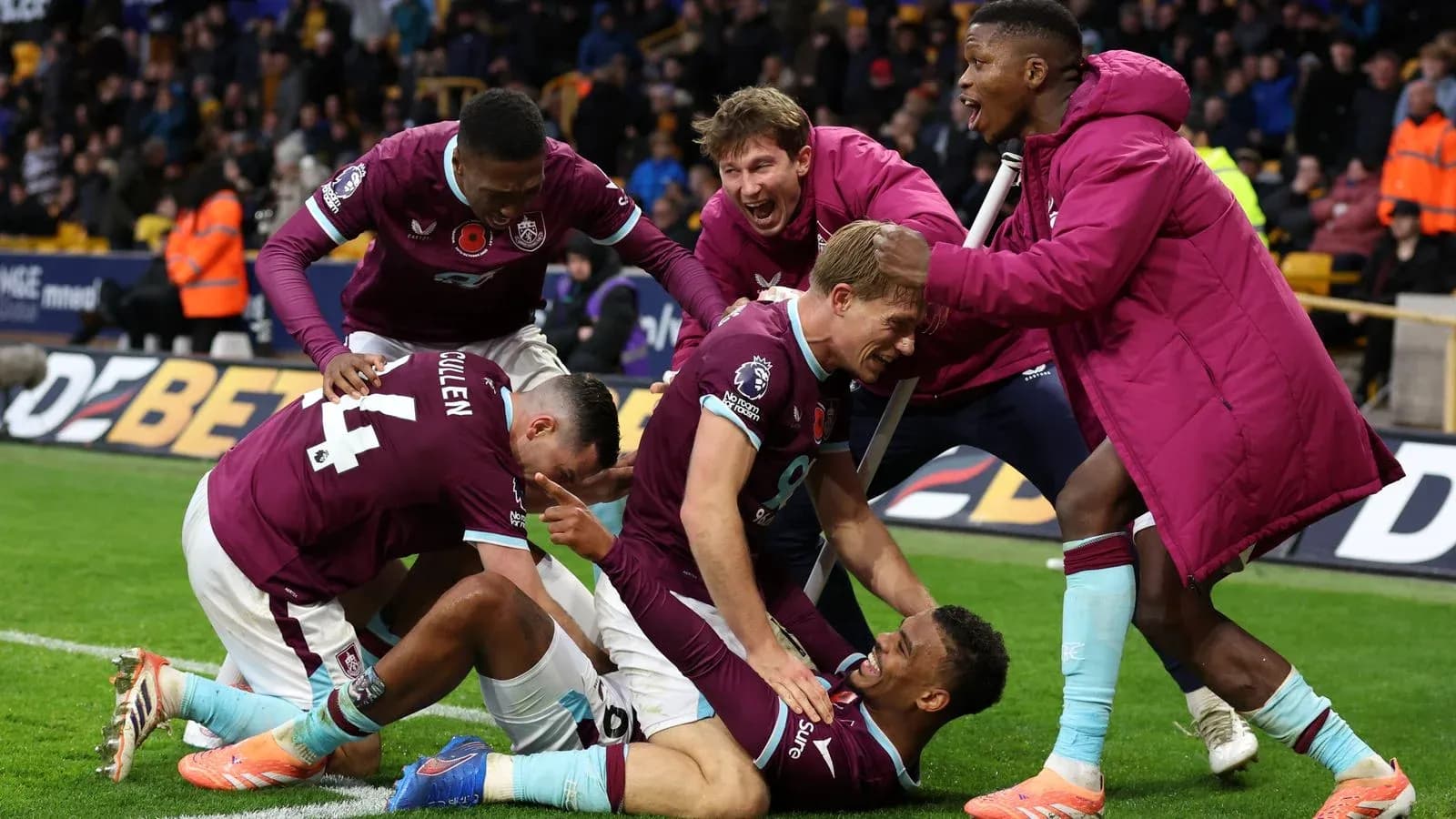
The goal Burnley did score at 47' encapsulated Jackson’s positional play ideals finally paying off. L. Tchaouna, working between the lines, found space to turn and feed Z. Flemming, whose timing and movement as the lone forward were rewarded with a “Normal Goal” that levelled the match at 1-1. It was a classic 4-2-3-1 pattern: overload in midfield, release a creative 10-type in the half-space, and exploit the gap between Wolves’ outside centre-back and wing-back.
Goalkeeping and Defensive Discipline
From a goalkeeping and defensive-structure standpoint, both sides executed their plans with discipline. M. Weiss (Burnley) made 3 saves, aligning with Wolves’ 4 shots on goal and underlining that the real danger came from the quality of chances rather than volume. His goals prevented value of 0.29 indicates he added a modest but tangible layer of overperformance relative to the xG he faced. At the other end, J. Sa (Wolves) was busier, making 7 saves against Burnley’s 8 shots on target. His identical goals prevented figure of 0.29 suggests that, like Weiss, he slightly outperformed expectation, crucial in protecting a point for a side under sustained pressure.
Discipline and Emotional Temperature
The discipline and emotional temperature of the game also mirrored the tactical battle. Hwang Hee-chan’s yellow card at 41' for an “Off the ball foul” reflected Wolves’ readiness to disrupt Burnley’s rhythm even away from immediate danger. Hannibal Mejbri’s booking for “Argument” at 45+9' came at the end of a frustrating half in which Burnley trailed 0-1 despite dominance of the ball. Late on, tempers flared again: Ashley Barnes (Burnley) was cautioned at 90+4' for “Argument”, quickly followed by Yerson Mosquera (Wolves) with the same reason at 90+4'. Those incidents underline how fine the margins felt as both teams chased a decisive moment.
Substitutions
Substitutions were used primarily to refresh energy and slightly tweak the attacking profiles rather than to overhaul shapes. For Burnley, Z. Amdouni (IN) came on for H. Mejbri (OUT) at 66', adding a more penalty-box-oriented threat from midfield. Later, J. Ward-Prowse (IN) for L. Ugochukwu (OUT) at 75' introduced a deeper playmaker with superior distribution, aiming to sharpen delivery against a deep block. M. Edwards (IN) for L. Tchaouna (OUT) at 75' and Ashley Barnes (IN) for Z. Flemming (OUT) at 84' shifted Burnley towards a more direct, crossing-heavy endgame, with J. Bruun Larsen (IN) for J. Anthony (OUT) at 84' adding fresh wide dribbling and crossing.
Wolves’ changes were more about preserving legs in a physically demanding defensive scheme. T. Arokodare (IN) came on for A. Gomes (OUT) at 66' to provide a more vertical outlet. Toti (IN) for L. Krejci (OUT) at 66' maintained the back-three structure while renewing defensive intensity. H. Bueno (IN) for D. M. Wolfe (OUT) at 74', J. Abbey (IN) for A. Armstrong (OUT) at 74' and Pedro Lima (IN) for R. Gomes (OUT) at 82' kept the wing-back and forward lines fresh enough to continue contesting transitions and wide duels.
Match Verdict
Statistically, the verdict is of a match where process and outcome diverged for both sides. Burnley’s overall form in this game—measured by possession control, pass accuracy and sustained pressure—was strong, but their attacking efficiency lagged behind their structure. Wolves’ defensive index was robust, with high blocks and a goalkeeper performing slightly above expectation, but their inability to convert a superior xG into a second goal left them vulnerable. In the end, 1-1 felt like a tactical compromise: Burnley imposed the game’s shape, Wolves dictated the danger zones, and neither quite did enough in the final third to turn their respective strengths into a decisive victory.