Benfica Dominates FC ST. Gallen 5-0 in UEFA Europa League
Benfica’s 5-0 dismantling of FC ST. Gallen at Estádio da Luz in the UEFA Europa League 2nd Qualifying Round was a textbook demonstration of how a clear structural superiority can be converted into territorial dominance and repeated high-quality chances, even without full statistical detail. The hosts controlled the game through a well-drilled 4-2-3-1, repeatedly overloading the half-spaces and wide channels, while FC ST. Gallen’s 3-5-2 collapsed under sustained pressure, especially after going down to ten men.
Executive Summary
Benfica lined up in a 4-2-3-1 under Marco Silva, with V. Pavlidis as the lone striker, supported by an attacking midfield trio of Rafa Silva, G. Sudakov and J. Kaminski. Against that, Enrico Maassen’s FC ST. Gallen opted for a 3-5-2 that, in practice, often resembled a 5-3-2 under pressure, with wing-backs C. Okoroji and M. Stevanovic pinned deep. The final 5-0 scoreline, with Benfica already 1-0 up at half-time, accurately reflects how one side’s structure consistently produced free men between the lines while the other struggled to progress the ball or protect its back line.
Scoring Sequence & Disciplinary Log
Goals (chronological, home score first):
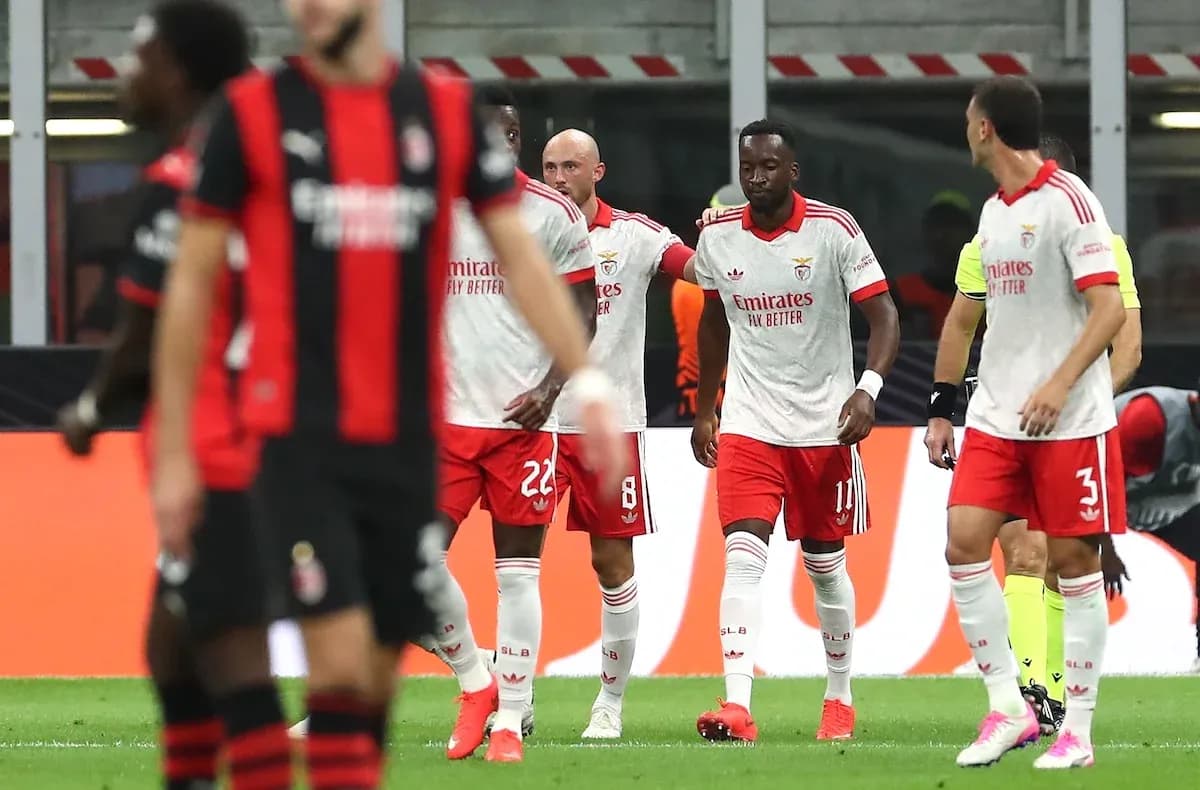
- 11' V. Pavlidis (Benfica) — assisted by Rafa Silva → 1-0 Benfica exploited the early structural mismatch: Pavlidis received after a vertical combination through the right half-space and finished to give the hosts control and the ideal platform for their positional game.
- 55' V. Pavlidis (Benfica) — assisted by J. Kaminski → 2-0 With Benfica circulating the ball comfortably, Kaminski found Pavlidis again attacking the central channel. The second goal crystallised Benfica’s superiority and forced FC ST. Gallen to defend even deeper.
- 65' V. Pavlidis (Benfica) — assisted by A. Bah → 3-0 A. Bah’s advanced positioning from right-back was rewarded as he supplied Pavlidis for his hat-trick. The move underlined how Benfica’s full-backs were allowed to push high, confident in the control exerted by the double pivot.
- 74' V. Pavlidis (Benfica) — Penalty, no assist → 4-0 The penalty converted by Pavlidis for his fourth of the night came in a phase where Benfica were camped in the final third, with FC ST. Gallen’s reduced side unable to defend the width or the box.
- 82' C. Lenglet (Benfica) — assisted by D. Lukebakio → 5-0 C. Lenglet’s goal from a D. Lukebakio assist completed the rout, symbolising Benfica’s freedom to commit even central defenders into advanced areas against a demoralised and stretched opponent.
Cards (chronological, with reasons):
- 21' J. Stanic (FC ST. Gallen) — Roughing
- 50' C. Okoroji (FC ST. Gallen) — Holding
- 57' J. Stanic (FC ST. Gallen) — Tripping (Yellow Card)
- 57' J. Stanic (FC ST. Gallen) — Tripping (Red Card)
Card totals: Benfica: 0, FC ST. Gallen: 3 yellow cards, 1 red card, Total: 4 cards. Stanic’s disciplinary sequence at 57' was decisive: the quick succession of a second yellow and the resulting red for “Tripping” left FC ST. Gallen with ten men just as Benfica were accelerating the tempo.
Tactical Breakdown & Personnel
Benfica’s 4-2-3-1 was built on a solid rest-defence and intelligent occupation of the interior lanes. The back four of A. Bah, A. Silva, C. Lenglet and S. Dahl played relatively high, with Bah particularly aggressive in his forward runs. In front of them, the double pivot of L. Barreiro and E. Barrenechea provided both circulation and cover; one routinely dropped to form a temporary back three in build-up, allowing the full-backs to push on and pin FC ST. Gallen’s wide men.
Between the lines, Rafa Silva and G. Sudakov constantly rotated with Kaminski, creating three-player triangles on either flank. This fluidity made it difficult for FC ST. Gallen’s midfield three (L. Gortler, L. Daschner, C. Boukhalfa) to decide whether to track runners or hold their zones. Pavlidis was the reference point who tied it all together: he alternated between dropping short to link play and attacking the space behind the central defenders, which is how he repeatedly found shooting positions for his four goals.
Out of possession, Benfica pressed selectively rather than relentlessly, but the structure was compact. The first line curved its press to force FC ST. Gallen wide, where the wing-backs received under pressure and with few short options. Once the visitors went down to ten men, Benfica could afford to compress the pitch further, defending almost on the halfway line and keeping FC ST. Gallen locked in their own third.
FC ST. Gallen’s 3-5-2, on paper, should have offered central stability, but in practice they were constantly outnumbered between the lines. The back three of T. Gaal, J. Stanic and C. Okoroji were forced to defend large horizontal spaces, especially once wing-backs dropped deep to form a back five. The midfield struggled to get tight to Benfica’s attacking midfielders, and the forwards A. Balde and C. Witzig were often isolated, with few opportunities to run in behind.
The key turning point was the red card to J. Stanic. Already trailing 2-0, FC ST. Gallen’s defensive line lost its left-sided central defender, forcing emergency reshuffles through substitutions (J. Ruiz, A. Hunziker, L. Frokaj, C. Konietzke) that were more about damage limitation than a coherent comeback plan. From that moment, Benfica’s superiority in wide overloads and second balls became overwhelming.
Benfica’s substitutions were tactically coherent: R. Rios for L. Barreiro maintained the double pivot’s balance; D. Lukebakio and A. Schjelderup for Rafa Silva and Kaminski refreshed the wide and half-space threats without altering the structure; J. Duran replacing Pavlidis and A. Dedic for A. Bah allowed Marco Silva to protect key starters while keeping the same positional framework that had dismantled FC ST. Gallen.
The Statistical Verdict
Many granular metrics (possession, shots, passing data, xG, goals prevented, saves) are not specified, but the available indicators combined with the event timeline paint a clear picture. Benfica scored five times without conceding, with all goals coming from structured attacks rather than isolated moments. The absence of any yellow or red cards for Benfica, against three yellows and one red for FC ST. Gallen, underscores the hosts’ control of tempo and duels: Benfica could dictate play without resorting to desperate defending, while FC ST. Gallen’s back line, particularly J. Stanic and C. Okoroji, resorted to “Roughing”, “Holding” and “Tripping” as they were repeatedly exposed.
The 1-0 half-time score suggests that FC ST. Gallen initially managed to keep the game somewhat within reach, but the second-half pattern—four further goals, a red card, and a flurry of defensive substitutions—confirms that Benfica’s structural and qualitative edge grew as legs and concentration faded in the visiting side. Even without exact shot counts or xG, the combination of a hat-trick plus penalty from Pavlidis, a centre-back goal from Lenglet, and the disciplinary collapse of FC ST. Gallen strongly indicates that the 5-0 was an accurate, perhaps even conservative, reflection of Benfica’s tactical dominance at Estádio da Luz.