Benfica Dominates Aarhus with Tactical Masterclass
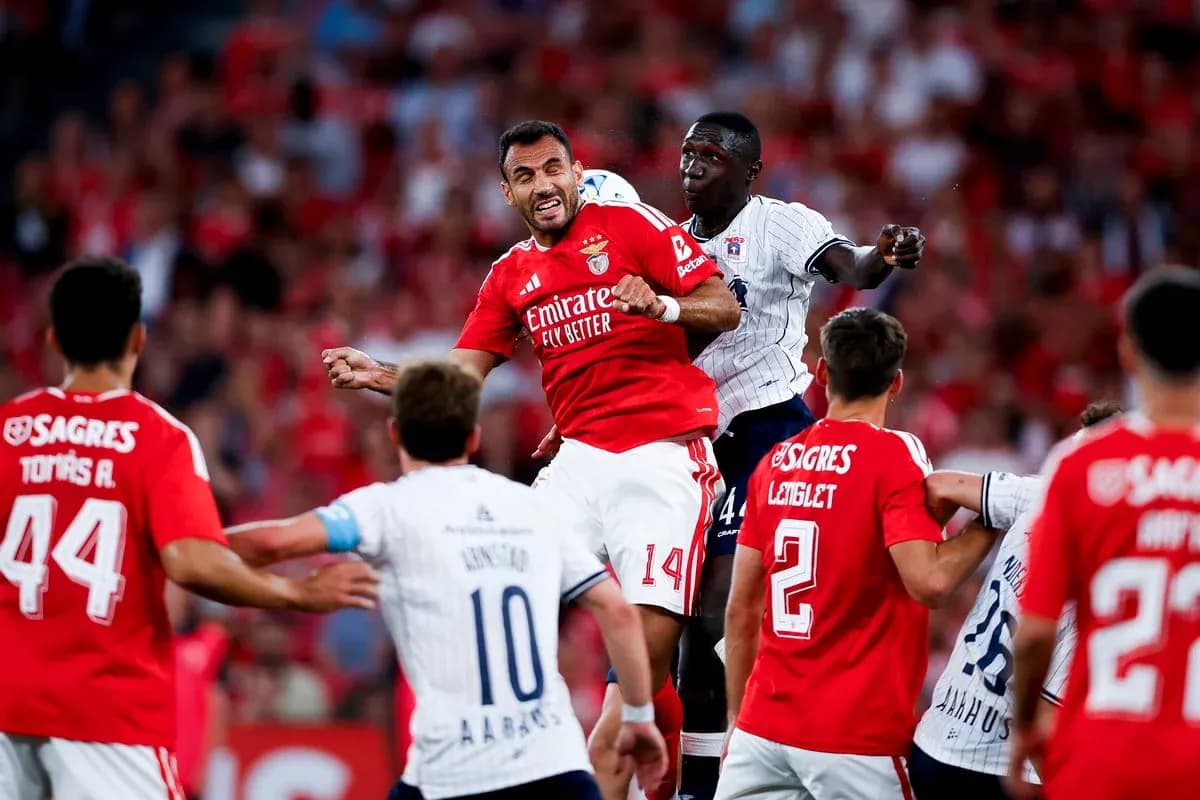
Benfica’s 3-1 win over Aarhus at Estádio da Luz was a tactical demonstration of how a dominant structure, high technical level and relentless territorial pressure can decide a European tie early. With 71% possession, 13 shots on goal and 11 corner kicks, Marco Silva’s side turned their 4-1-3-2 into a suffocating attacking platform, racing to a 3-1 lead by half-time and then managing the game with control rather than risk. Aarhus, in a 3-5-2 under Jakob Poulsen, were pinned deep for long stretches, managing just 1 shot on goal and 1 corner, their threat limited to isolated transitions and the one well-worked move that produced S. Jorgensen’s goal.
Benfica's Tactical Setup
Structurally, Benfica’s 4-1-3-2 was built to dominate the central lane and half-spaces. Leandro Barreiro sat as the single pivot in front of a back four of A. Bah, C. Lenglet, Tomás Araújo and S. Dahl, giving the hosts a clear rest-defense platform against Aarhus’s two forwards. Ahead of him, G. Sudakov, E. Barrenechea and G. Prestianni formed a fluid line of three behind the front pair of V. Pavlidis and Rafa Silva. In practice, this often resembled a 2-3-5 in possession: both full-backs pushed high, Barreiro anchored the middle, and the three attacking midfielders squeezed into the half-spaces and central pockets, with Pavlidis and Rafa constantly pinning the Aarhus back line.
The statistical dominance explains why Aarhus struggled to progress the ball. With only 29% possession and just 1 blocked shot, their 3-5-2 – C. Rosler, M. Camara and E. Kahl as the back three, wing-backs J. Andersen and M. Knudsen – was almost permanently in a low block. The wing-backs were forced deep by Benfica’s wide occupation from Bah and Dahl, which meant Aarhus rarely had the natural outlets to spring into counter-attacks. When they did escape, it was usually through S. Jorgensen’s timing from midfield or J. Andersen’s runs from the right, as seen in the move for the 36th-minute goal.
First Half Performance
Benfica’s early opener from Rafa Silva at 2' set the tone. It came from exactly the pattern Silva’s side wanted: high regain, quick verticality, and multiple runners between the lines. With Aarhus’s central midfield outnumbered by Benfica’s box of Barreiro plus three advanced midfielders, second balls consistently fell to the hosts, allowing wave after wave of attacks and contributing to the 13 shots on goal and 11 blocked shots. The sheer volume of blocked efforts underlined how deep Aarhus were defending – often with all three centre-backs plus both wing-backs inside their own box.
Barreiro’s role was pivotal both tactically and symbolically. His yellow card at 9' did not change his aggression in counter-pressing, and his 31' goal illustrated Benfica’s ability to overload the edge of the area. With Aarhus collapsing towards their six-yard box, the second line – Barreiro and the advanced midfielders – had space to arrive and shoot from zone 14. That spatial dynamic, Benfica’s five-man front line against a back five pinned on the edge of the box, is exactly what produced the high shot volume and forced Aarhus into 17 fouls.
Tomás Araújo’s booking at 24' came from one of the few moments where Aarhus managed to stretch Benfica’s rest defense, but overall the home back line were rarely under sustained pressure. The single Aarhus shot on goal – converted by S. Jorgensen from a J. Andersen assist – was the exception rather than the rule. It highlighted Aarhus’s best attacking idea: using the right side to attack the space behind Dahl when Benfica’s full-backs were high. Yet with so little possession and so few entries into the final third, this pattern never became a consistent route back into the game.
Second Half Adjustments
The turning point in terms of game state management was the sequence around half-time. VAR confirmed a penalty for Benfica at 45+1' for Vangelis Pavlidis, and he converted from the spot at 45', restoring a two-goal cushion at 3-1. From a tactical perspective, this allowed Marco Silva to shift the focus from relentless attacking to controlled possession. The second half became more about circulation and risk management than chasing further goals, which partially explains why Benfica did not add to their tally despite their territorial dominance.
Poulsen’s adjustments after the break – double changes at 57' with R. Carstensen (IN) for C. Rosler (OUT) and S. Tchamche (IN) for S. Jorgensen (OUT), followed by further substitutions at 73' and 81' – were aimed at adding energy and direct running. Moving away from the starting personnel, Aarhus tried to get fresher legs into the wide and forward zones. However, with only 1 corner kick and almost no sustained pressure, these changes altered the names but not the underlying dynamic: Aarhus remained largely reactive, chasing shadows in midfield and unable to string together passing sequences.
Bench Management
Marco Silva’s bench management was more about preserving key players and balancing minutes with the tie already in a strong position. At 66', R. Rios (IN) came on for L. Barreiro (OUT), slightly reconfiguring the pivot role but maintaining the same 4-1-3-2 shape. Later, at 72', J. Duran (IN) replaced V. Pavlidis (OUT) and A. Schjelderup (IN) replaced G. Prestianni (OUT), refreshing the front line without compromising the pressing structure. Finally, at 84', F. Aursnes (IN) came on for G. Sudakov (OUT) and J. Kaminski (IN) for Rafa Silva (OUT), adding work-rate and fresh legs to see out the game.
Discipline-wise, the card profile mirrored the tactical flow. Benfica, despite their dominance, still picked up two early yellow cards, both from central players (Barreiro and Araújo) involved in controlling transitions. Aarhus’s single yellow, to Stefen Tchamche at 83', reflected a late, frustrated challenge from a substitute forward in a game his side were chasing. With 10 fouls for Benfica and 17 for Aarhus, the visitors were forced into more last-ditch interventions, especially as they tried to disrupt Benfica’s rhythm in midfield.
Conclusion
Without explicit data on saves, xG or passing, the statistical verdict must rest on the shot, possession and fouls profile. Benfica’s 71% possession, 13 shots on goal, 11 blocked shots and 11 corners are consistent with a high-possession, high-pressure game plan that was executed effectively in the first half and then managed professionally. Aarhus’s 1 shot on goal and 1 corner underline how rarely they were able to threaten in volume, even if their single clear chance was taken clinically. In the context of a UEFA Europa League Play-offs tie, this performance positions Benfica as a side capable of imposing their structure and tempo at home, while Aarhus will need a radically different territorial and pressing approach in the return leg to overturn the deficit.