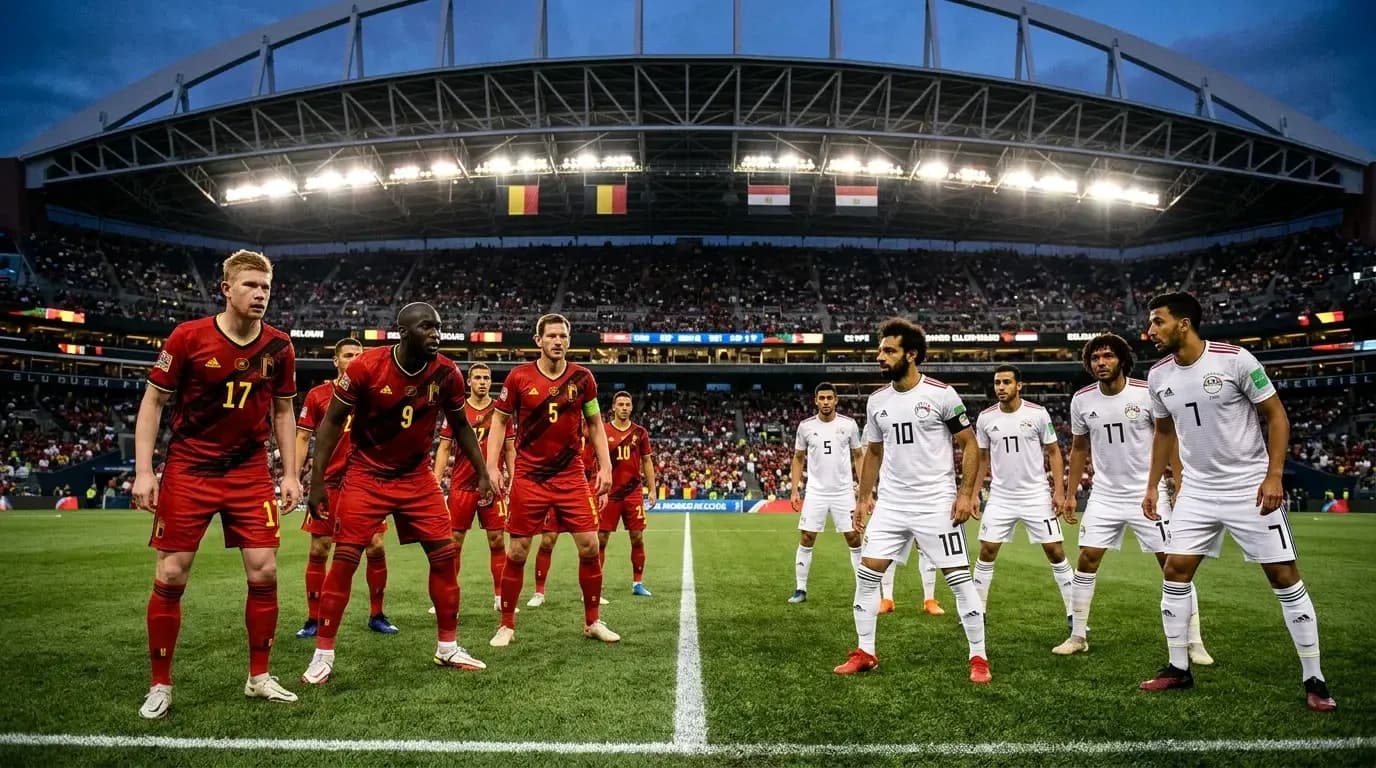
Belgium and Egypt Draw in World Cup Group Stage Match
Belgium and Egypt opened their World Cup Group Stage campaign at Lumen Field with a 1-1 draw that felt tactically balanced but stylistically contrasting. Belgium edged possession at 54% and finished slightly ahead on xG (1.32 to Egypt’s 1.07), yet needed a 66th-minute own goal to cancel out Emam Ashour’s first-half strike. Egypt, more vertical and compact, leveraged Mohamed Salah between the lines and direct runs from Omar Marmoush to threaten primarily in transition. Belgium, under Rudi Garcia, relied on patient circulation through Kevin De Bruyne and Youri Tielemans, but struggled to consistently break Egypt’s crowded central block despite a territorial advantage.
First Half
Emam Ashour’s 19' opener for Egypt, assisted by Mohamed Salah, encapsulated Hossam Hassan’s plan: win duels in midfield, find Salah early, and exploit Belgium’s defensive line before it could settle. With 10 shots inside the box to Belgium’s 9, Egypt actually generated more penalty-area volume despite less possession, underlining their efficiency at turning turnovers into quick entries around Thibaut Courtois’s area. Belgium’s equaliser, an own goal by Mohamed Hany at 66', was the product of sustained pressure and deliveries into dangerous zones rather than a cleanly constructed final action, reflecting both their persistence and their relative lack of incision in open play.
Belgium's Structure
Structurally, Belgium’s starting shape functioned like a flexible back four with Timothy Castagne and Thomas Meunier as full-backs, Nathan Ngoy and Brandon Mechele in central roles, and a midfield axis of Amadou Onana and Tielemans behind a fluid line of Leandro Trossard, De Bruyne, and Jérémy Doku supporting Charles De Ketelaere. The 452 total passes (388 accurate, 86%) show a clear intent to build methodically. De Bruyne often dropped alongside Tielemans to escape Egypt’s first line, creating 3v2 situations against Marwan Attia and Mohanad Lasheen. However, Egypt’s narrow midfield compactness forced Belgium wide, where crosses and cut-backs had to navigate a penalty area well protected by Yasser Ibrahim and Hamdy Fathy.
Egypt's Out-of-Possession Structure
Egypt’s out-of-possession structure was conservative but coherent. With 397 passes (322 accurate, 81%) and 46% possession, they accepted long spells without the ball, focusing on verticality once possession was regained. Salah’s nominal midfield listing belied his true role as a high, right-sided playmaker, receiving diagonals and then combining with Ashour and Marmoush. The fact that Egypt matched Belgium in shots on goal (3-3) despite less ball suggests their attacking sequences were shorter but more direct, often ending with efforts from central channels rather than speculative long-range attempts.
Blocked Shots Data
The blocked shots data is revealing: Egypt recorded 8 blocked efforts to Belgium’s 5. That indicates a more sacrificial, penalty-box defending posture from Hassan’s side, with centre-backs and midfielders dropping deep to contest shooting lanes. Belgium’s 15 total shots, with 9 inside the box, show they eventually managed to reach advantageous zones, but Egypt’s last-ditch interventions repeatedly diluted shot quality. Conversely, Belgium’s back line allowed 10 Egyptian shots inside the box from 14 total, a slightly higher proportion, pointing to occasional issues in controlling depth when Egypt broke through the first press.
Discipline and Tactics
Discipline was evenly matched and tactically relevant. Both teams committed 15 fouls and took 2 yellow cards each, but the timing matters. Marwan Attia (Egypt) was booked at 13' for “Foul”, quickly followed by Castagne (Belgium) at 14' for “Foul”, signalling an early physical contest in midfield corridors. Ahmed Fatouh’s yellow at 34' for “Foul” highlighted Egypt’s willingness to break Belgium’s rhythm on the flanks, especially as Doku and Trossard started to receive more progressive passes. Maxim De Cuyper’s 75' caution for “Foul” came after his introduction, reflecting Belgium’s increased risk-taking down the left and the need to stop Egypt’s counters after turnovers high up.
Substitutions and Tactical Dynamics
Substitutions shifted the tactical dynamics. On 56', Maxim De Cuyper (IN) came on for Amadou Onana (OUT), and Nicolas Raskin (IN) came on for Timothy Castagne (OUT), moves that rebalanced Belgium’s structure. Removing Onana reduced pure ball-winning but added more technical security and forward passing from deeper positions; De Cuyper’s presence gave Belgium a more aggressive left-back profile, overlapping to stretch Egypt’s block. The immediate effect was more sustained pressure, culminating in the 66' own goal: with Belgium camped higher, Egypt’s back line was forced into more hurried defensive actions inside their own box.
Simultaneously, Charles De Ketelaere (OUT) made way for Romelu Lukaku (IN) at 66', adding a classic penalty-box reference point. This altered Belgium’s attacking pattern from fluid rotations to more direct service into a target striker, with De Bruyne and Trossard playing more vertically. Even though Lukaku did not appear on the scoresheet, his presence helped pin Egypt’s centre-backs, creating the type of chaos that led to Hany’s own goal. Later, at 86', Hans Vanaken (IN) for De Bruyne (OUT) and Matías Fernández-Pardo (IN) for Doku (OUT) signalled a final attempt to maintain central creativity while adding fresh legs on the flank, but Egypt’s defensive shell held.
Egypt's Substitutions
Egypt’s substitutions were more about consolidating and managing energy. At 71', Rami Rabia (IN) came on for Emam Ashour (OUT), effectively trading an advanced midfielder for a more defensive profile to help protect the lead, which at that moment stood at 1-0. Later, Hamza Abdelkarim (IN) for Salah (OUT) and Zizo (IN) for Mostafa Ziko (OUT) at 76' refreshed the front line, but also reduced Egypt’s ability to retain the ball under pressure, as no replacement could replicate Salah’s gravity. In the closing stages, Ibrahim Adel (IN) for Hamdy Fathy (OUT) and Karim Hafez (IN) for Ahmed Fatouh (OUT) at 89' were late-game adjustments aimed at preserving intensity on the flanks and dealing with Belgian width.
Goalkeeping Performances
In goal, Thibaut Courtois (Belgium) made 2 saves, while Mostafa Shobeir (Egypt) produced 3. The saves tally, combined with the xG figures, suggests that both defences succeeded in limiting truly clear-cut chances; many of the 3 shots on goal per side were either from moderate angles or under pressure. The identical goals prevented values (-0.42 for both teams) indicate that neither goalkeeper significantly overperformed or underperformed relative to the quality of shots faced, reinforcing the impression of a tactically tight contest rather than a goalkeeping exhibition.
Set Pieces Contrast
Set pieces formed another clear contrast. Egypt earned 7 corner kicks to Belgium’s 2, an unusual pattern given Belgium’s possession advantage. This points to Egypt’s attacks often ending with forced defensive interventions near goal, while Belgium’s more patient approach produced fewer last-touch deflections over the byline. However, Belgium’s superior pass completion and territorial control allowed them to dictate the overall rhythm, even if they could not convert that control into a second goal.
Conclusion
In summary, Belgium delivered a possession-dominant but somewhat blunt performance, relying on structural superiority and circulation rather than repeated high-quality breakthroughs. Egypt executed a disciplined, counter-oriented plan, maximising their 10 shots inside the box and leaning on compact defending and shot blocking. The 1-1 scoreline and near-parity in shots on goal and xG accurately reflect a match where neither tactical approach clearly overwhelmed the other, and where the decisive moments came from transitional sharpness and defensive pressure rather than sustained creative superiority.