Bayern München Defeats Real Madrid 2–1 in UEFA Champions League
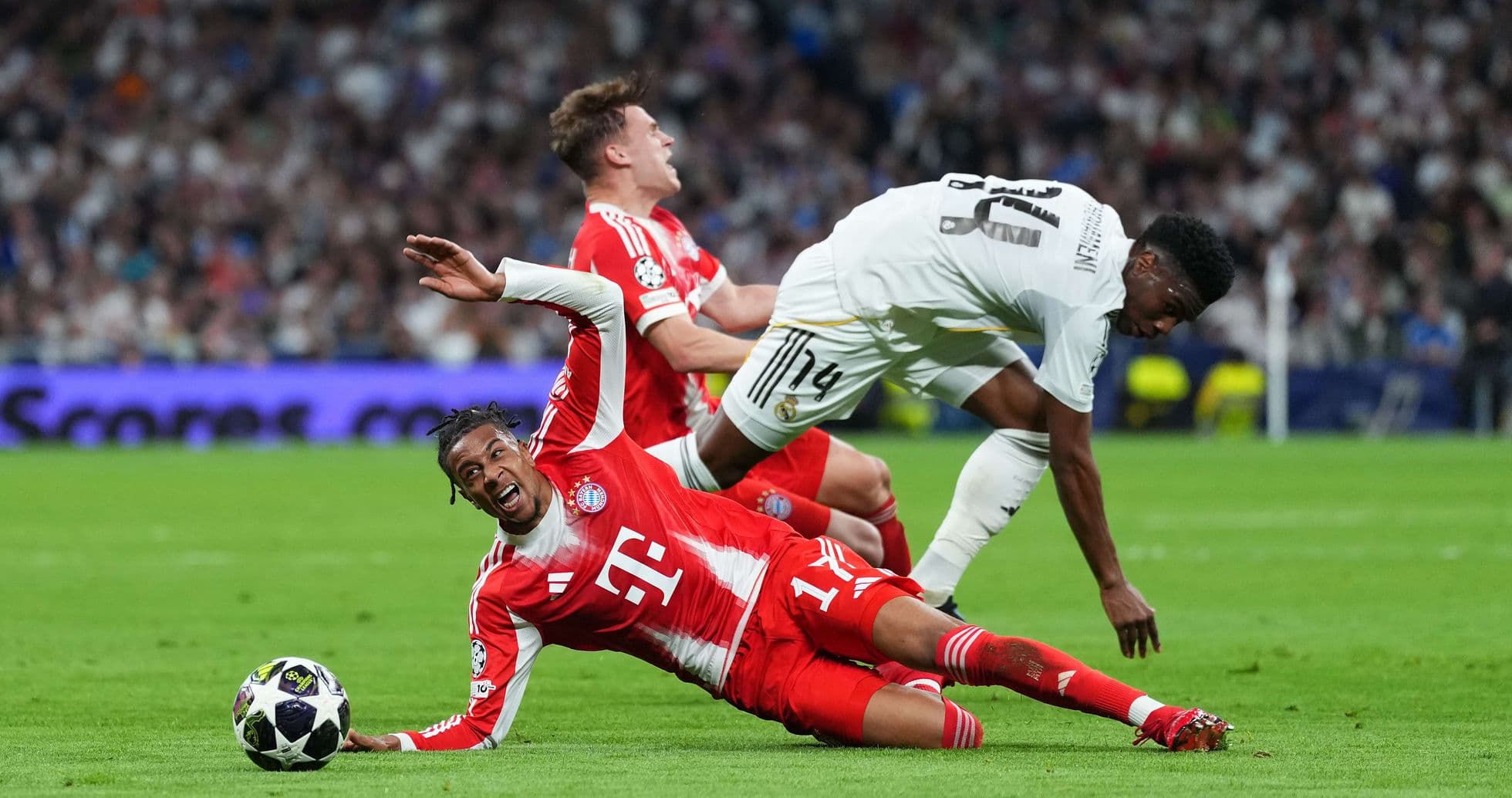
At the Bernabéu in this UEFA Champions League quarter-final, Bayern München edged Real Madrid 2–1 in a match defined by Bayern’s superior control in key phases and ruthless exploitation of transitional moments. Despite near-parity in total shots (20–20), Bayern’s slightly higher possession (52%) and sharper shot quality (2.92 xG vs Madrid’s 2.2) underpinned their win. Real Madrid’s 4-4-2, built around Kylian Mbappé and Vinicius Júnior, generated volume and nine shots on target, but Manuel Neuer’s nine saves and Bayern’s compact 4-2-3-1 defensive structure proved decisive. Andriy Lunin’s five saves and a goals-prevented figure of 1 kept Madrid in it, yet Bayern’s vertical use of Luis Díaz and Harry Kane carried the tie.
Scoring Sequence & Disciplinary Log
The card and goal sequence shaped the tactical rhythm. The first disciplinary incident arrived on 37', when Aurélien Tchouaméni received a yellow card for a foul, an important early marker that constrained Madrid’s primary screening midfielder for the remainder of the match.
Bayern struck first on 41'. Luis Díaz, starting from the left of the 4-2-3-1 line of three, finished a move assisted by Serge Gnabry. The pattern reflected Bayern’s plan: exploit Madrid’s full-back zones, with Gnabry attacking the half-space and releasing Díaz into the box. Bayern led 1–0 at the break.
Immediately after half-time, on 46', Harry Kane doubled Bayern’s advantage. Michael Olise provided the assist, operating between the lines and feeding Kane, whose movement detached from the centre-backs in the inside-right channel. At 0–2, Bayern could drop their block a few metres and play more selectively in transition.
Real Madrid’s response was reshaped by substitutions. On 62', Éder Militão (IN) came on for Dean Huijsen (OUT), adding aggression and recovery speed to the back line. Simultaneously, Jude Bellingham (IN) replaced Thiago Pitarch (OUT), changing the midfield from a more balanced four to a more vertical, line-breaking presence.
Bayern reacted on 69'. Alphonso Davies (IN) came on for Konrad Laimer (OUT), shifting Bayern’s left side into a more natural full-back-winger dynamic, and Jamal Musiala (IN) replaced Serge Gnabry (OUT), injecting ball-carrying and press resistance between the lines.
On 70', Jonathan Tah was booked for a foul, underlining the growing stress on Bayern’s central defence as Madrid increased tempo. Two minutes later, on 71', Brahim Díaz (IN) replaced Arda Güler (OUT), adding 1v1 threat and interior dribbling from the right.
Madrid’s breakthrough came on 74'. Kylian Mbappé scored, assisted by Trent Alexander-Arnold. The right-back advanced high from the 4-4-2 line, delivering from the flank into Mbappé’s run, exploiting space between full-back and centre-back. That made it 1–2 and tilted momentum.
Bayern’s discipline was tested heavily in the closing phase. Luis Díaz received a yellow card for a foul on 77', reflecting his defensive workload tracking Madrid’s right side. On 82', Manuel Neuer was booked for time wasting, a direct consequence of Bayern trying to manage the lead under sustained pressure. On 86', Jamal Musiala collected another yellow for a foul, as Bayern’s midfield increasingly resorted to tactical infringements to disrupt Madrid’s rhythm.
In added time, Bayern used late substitutions to manage legs and tempo. At 90+3', Leon Goretzka (IN) came on for Aleksandar Pavlović (OUT), reinforcing physicality in midfield. Simultaneously, Tom Bischof (IN) replaced Luis Díaz (OUT), adding fresh energy to help defend wide spaces and press passing lanes.
Tactical Breakdown & Personnel
Real Madrid’s 4-4-2 featured Andriy Lunin in goal behind a back four of Trent Alexander-Arnold, Antonio Rüdiger, Dean Huijsen, and Álvaro Carreras. The midfield four—Federico Valverde, Thiago Pitarch, Aurélien Tchouaméni, and Arda Güler—supported a front two of Kylian Mbappé and Vinicius Júnior. The structure aimed to combine width from the full-backs with central ball progression through Tchouaméni and Pitarch, and direct verticality into the front pair.
Statistically, Madrid created 20 shots, with nine on target and 12 from inside the box, reflecting decent penetration. Their 48% possession and 454 passes at 85% accuracy show they were comfortable without monopolising the ball, instead leaning on transitions and early balls into Mbappé and Vinicius. However, Bayern blocked three of their efforts, often through compactness around the box led by Tah and Dayot Upamecano.
Bayern’s 4-2-3-1, with Manuel Neuer in goal, a back four of Josip Stanišić, Upamecano, Jonathan Tah, and Konrad Laimer, double pivot of Aleksandar Pavlović and Joshua Kimmich, and an attacking trio of Michael Olise, Serge Gnabry, Luis Díaz behind Harry Kane, was built for controlled possession and explosive wide transitions. Their 52% possession, 493 passes at 89% accuracy, and 20 shots (eight on target) show a side comfortable both building and countering.
The blocked-shot profile was telling: Bayern recorded six blocked shots to Madrid’s three. That disparity illustrates Bayern’s deeper, more compact defensive phases once ahead, often defending the edge of their box and sacrificing some territorial height to protect central lanes.
Goalkeeper impact was decisive. Lunin made five saves and, combined with a team goals-prevented figure of 1, kept the scoreline respectable given Bayern’s 2.92 xG. Neuer, by contrast, delivered nine saves, mirroring Madrid’s nine shots on target, and Bayern’s goals-prevented figure of 1 indicates his interventions were directly tied to preserving the lead. There was no symmetry: Neuer simply faced more on-target volume and answered almost everything.
The substitutions sharpened these tactical dynamics. Militão’s introduction allowed Madrid to defend higher and more aggressively, enabling Alexander-Arnold to push on and deliver the assist for Mbappé. Bellingham’s arrival for Pitarch shifted Madrid towards a 4-3-3/4-2-3-1 hybrid in possession, with Bellingham attacking the half-spaces and connecting with Mbappé and Vinicius. Brahim Díaz, replacing Güler, increased dribbling and unpredictability on the right, contributing to the wave of pressure that forced Bayern deeper.
On Bayern’s side, Davies for Laimer restored a natural left-back and freed Luis Díaz to stay higher, until his late withdrawal. Musiala added ball retention and fouling threat between the lines, as evidenced by his late yellow on 86'. Goretzka’s late cameo for Pavlović injected aerial presence and second-ball security as Bayern defended their box.
The Statistical Verdict
From a data perspective, Bayern’s 2–1 win is broadly aligned with the underlying numbers but with a clear goalkeeping and defensive-structure story. Bayern’s 2.92 xG versus Madrid’s 2.2 suggests the visitors generated slightly better chances, especially via Kane and Díaz. Both teams posted a goals-prevented figure of 1 at team level, but the distribution of saves—Neuer’s nine versus Lunin’s five—highlights how often Madrid tested the Bayern goalkeeper.
Possession (52–48 in Bayern’s favour) and passing accuracy (89% vs 85%) underline Bayern’s marginal superiority in control and circulation, particularly through Kimmich and Pavlović. Corners (11 for Bayern, eight for Madrid) and identical foul counts (12–12) show a high-intensity, territorially contested match rather than one-sided dominance.
Disciplinary data is unambiguous: Madrid collected one yellow (Tchouaméni 37'), while Bayern accumulated four (Tah 70', Luis Díaz 77', Neuer 82', Musiala 86'). That imbalance reflects Bayern’s increasing reliance on tactical fouls and game management as Madrid chased the game. In the end, Bayern’s compact block, superior blocking numbers (six vs three), and Neuer’s shot-stopping combined with efficient finishing from Díaz and Kane to carry them through this quarter-final first leg at the Bernabéu.