Australia's World Cup Rise: From Underdogs to Contenders
Mike Grella wanted a lay-up. He might have handed Australia a sledgehammer instead.
Days out from a World Cup group clash that suddenly feels loaded with edge, the former US international has become the lightning rod for a Socceroos side that refuses to accept its allotted place in the global pecking order.
“They have no shot of doing anything at the World Cup,” Grella declared on CBS Sports Golazo before a ball was kicked. “They are the weakest team in the group… There’s no shot Australia can compete with the US.”
That clip has aged fast. Brutally fast.
From punchline to problem
Australia walked into Vancouver on Sunday with most of the world expecting a polite cameo. They walked out with a 2-0 win over Turkiye, a shaken seed, and a World Cup narrative that suddenly has a green-and-gold tint.
Nestory Irankunda, the 20-year-old Watford winger with a backstory that grips you before he even touches the ball, lit the fuse. Connor Metcalfe detonated it after the break with a thunderous strike. In between and around them, Patrick Beach, a goalkeeper barely known to his own country a week ago, played like he’d been auditioning for this stage his entire life.
Beach’s World Cup debut was the kind that turns a squad number into a cult hero overnight. Full-stretch saves, big hands at big moments, command in the chaos. Australia needed him. He answered.
The rest of the world took notice.
Irankunda, the story within the story
In England, Irankunda’s rise has cut through the usual noise. He already had a natural following thanks to his time at Bayern Munich and his breakout season with Watford in the Championship. Now he has something else: a World Cup moment.
The BBC’s Chris McKenna framed it as the latest step in “an incredible journey” for a former refugee who, just a year ago, was learning from Harry Kane in Bavaria. The Sun splashed him and the Socceroos across their website with the line: “Watford star born in refugee camp scores historic World Cup goal.”
FourFourTwo pushed it further, asking the question that guarantees attention: “The new Michael Owen?” The comparison came from the way Irankunda’s goal evoked Owen’s famous 1998 strike against Argentina – the pace, the directness, the sheer audacity of it.
This wasn’t just a tidy finish. It was a statement that Australia’s attack looks nothing like the grind-it-out days of Tim Cahill and Harry Kewell. This is speed, space, and a willingness to hit on the break with venom.
Ange’s verdict from the studio
Back in the UK, there was a distinctly Australian voice leading the praise. Ange Postecoglou, sitting on ITV’s panel, watched Irankunda tear through Turkiye and saw something every coach craves: raw, uncoachable pace used with purpose.
“It doesn’t matter what level of football you play at, in the park or World Cup, that is fantastic speed,” Postecoglou said. He called it “a massive moment,” the sort that can flip a young player’s world in “a good couple of weeks.”
His hope? That this is only the beginning for Irankunda. The same could be said for Tony Popovic’s entire squad.
Because while the pre-tournament projections had Australia as a footnote, the numbers are shifting. The Athletic now gives the Socceroos an 85 per cent chance of getting out of the group. For a team Grella dismissed as a “lay up,” that’s a sharp swing in probability.
Grella’s words, America’s nerves
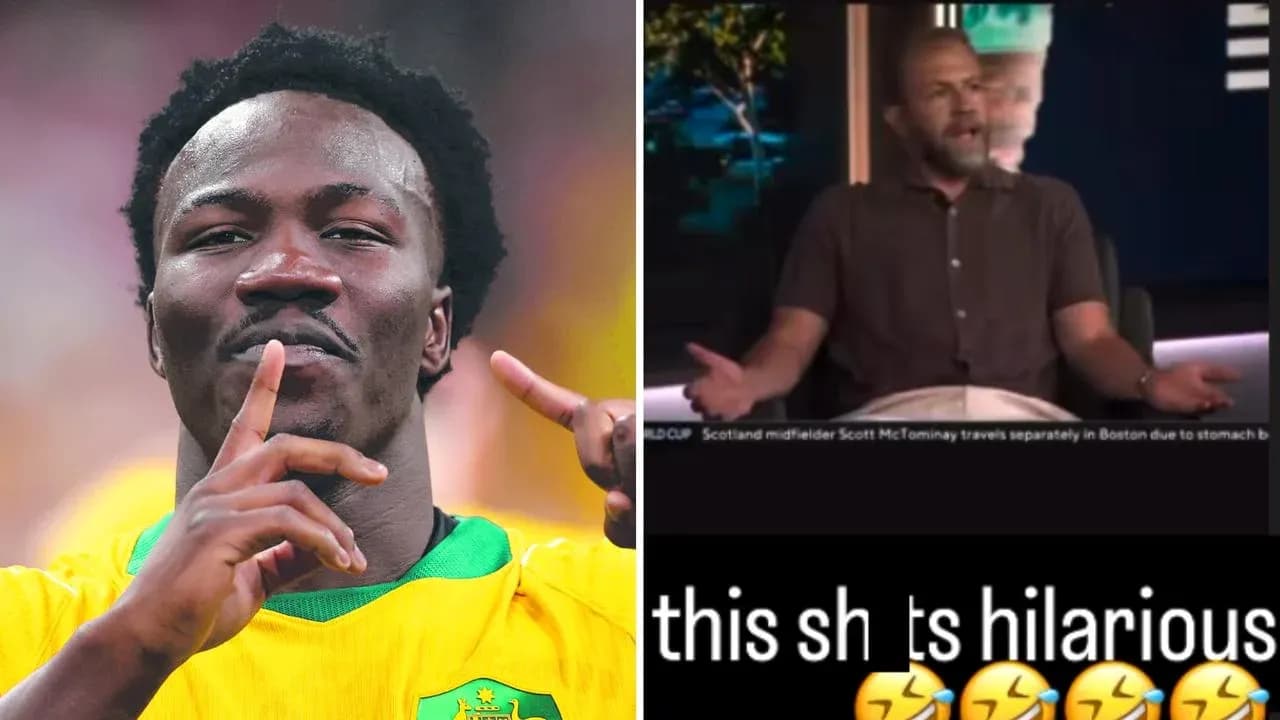
Grella’s original assessment has become must-watch content in Australia. Former AFL player Dan Gorringe reposted the clip, laughed, and fired back with a colourful “we’re gona f*** you up”. Grella re-shared that too, throwing on crying-laughing emojis and insisting he found it all “hilarious”.
The internet read it differently. The tone of a man definitely not rattled rarely needs that many emojis.
Now, with the US set to face Australia in Seattle at 5am AEST on Saturday, some of Grella’s colleagues are glancing nervously at the receipts.
“Grella’s going to be hired as their motivational speaker at this point,” former US midfielder Benny Feilhaber joked on CBS Sports Golazo. “He willed them to three points yesterday.”
Jimmy Conrad, another ex-US international, sounded a more cautious note. “Everybody keeps discounting Australia and that seems to be not the right thing to do,” he said. “So, thanks Grella. We appreciate that.”
The banter is light. The subtext is not. The co-hosts know they’ve poked a bear that doesn’t mind playing the underdog.
The darker arts, the brighter impression
If the US pundits needed a tactical briefing on what awaits, it came from an unlikely source. The Athletic’s senior football writer Simon Hughes, who watched the game in Vancouver, joined the CBS panel to explain how Popovic’s side pulled off only Australia’s fifth ever World Cup win.
“They were street wise,” Hughes said. “Some of the darker arts in the game, they weren’t afraid to get involved in that side of it.”
In his post-match column, he urged readers to “never underestimate true Australian grit”. On air, he expanded on that idea. This was a team that knew exactly who it was and played to the ceiling of its ability.
“Australia… really understood what their limitations were and they got the maximum out of what they could do,” he said. He argued they deserved the win, despite losing the numbers game in shots and possession.
“I always felt like Australia had control of what was going on,” Hughes added. When they needed Beach, he was there. That’s not luck. That’s structure.
He also pointed to something less tangible but just as powerful: the connection with the crowd. In Vancouver, he said, the fans “really, really believed they could effect this game and make an imprint on this tournament.”
His conclusion was blunt. Australia are going to be “quite difficult to stop”. If the US underestimate them, “they might have a few problems.”
The world’s second team?
Scroll through social media and you see it: a wave of neutrals quietly adopting the Socceroos as their second team.
Some are drawn to the defensive stubbornness, comparing their back line to an Arsenal title-winning unit. Others have leaned into the joke of “Haram Ball” – the tongue-in-cheek label for ultra-defensive, “anti-football” tactics – while admitting they can’t look away from the way Australia spring forward with such ferocity.
The appeal runs deeper than tactics.
On the Men in Blazers podcast, comedian and football obsessive Trevor Noah broke down the on-field puzzle with surprising precision. “Australia has giants at the back. You don’t just swing the ball in and hope for the best against Australia,” he said.
“If there’s one thing the Socceroos know how to do, it’s compact their defence, make sure that nothing gets in. You score by keeping it on the floor against these boys and they didn’t pick that up.”
Then he turned to the attack. This isn’t the old template.
“Their new attack up top is completely different to what we’ve seen in years before from like the Cahill and Harry Kewell days,” he said. “This was fast. It was like a lightning quick counter-attack.”
One player in particular grabbed his attention. “That boy Jordan Bos, number five. Yo, yo, I want to see which team he’s playing for next… that man is silky on the ball!”
Bos, Irankunda, Metcalfe, Beach. New names, new energy, same old Australian refusal to go quietly.
A team that looks like its country
Off the pitch, the Socceroos have added another layer to their appeal. A video recorded before the tournament has resurfaced and gone viral again in the wake of the Turkiye win.
In it, players talk openly about their backgrounds, their families, and what it means to pull on a shirt that they insist is the best reflection of modern Australia. One line cuts through: “our diversity is our strength.”
It is not a slogan cooked up in a marketing meeting. It’s visible on the team sheet, audible in the accents, and obvious in the way this group carries itself.
That authenticity resonates. It helps explain why a team written off as “the weakest in the group” now carries the mood of a feel-good story in the making.
The numbers say Australia are suddenly favourites to reach the knockout rounds. The noise says they’ve already won something else: respect, intrigue, and a growing band of admirers.
Next up is the USA in Seattle, with Grella’s words hanging over the fixture like a giant, flashing billboard.
Australia have heard every word. The only question now is whether the lay-up he promised turns into the upset that defines their World Cup.