The Art of Interceptions in Football: Dayot Upamecano's Mastery
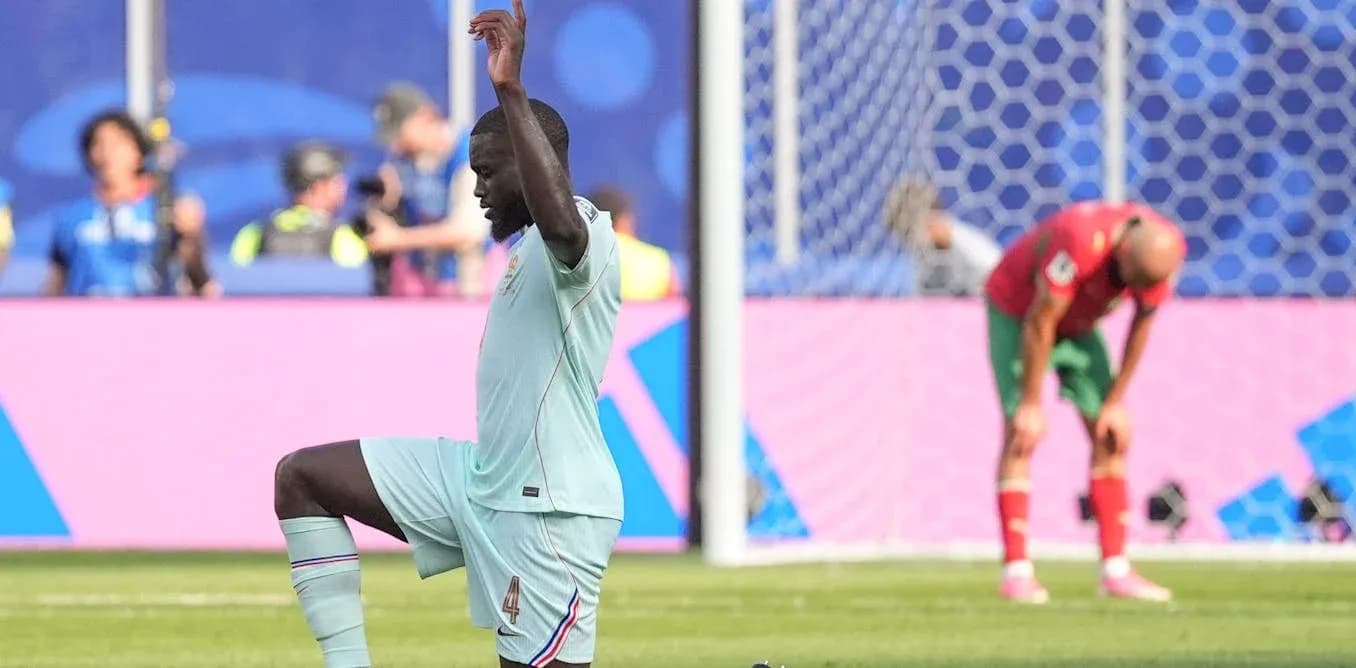
Dayot Upamecano sees the pass before most people in the stadium even realise it is on.
A shoulder opens. A midfielder glances wide. The weight shifts, the hips turn, and in that split-second the France defender has already started to move. One step, sometimes two, and the ball that was meant for someone else now belongs to him.
An interception takes less than a second. The calculation behind it is anything but simple.
The art inside a split-second
By the start of the 2026 World Cup semi-final week, Upamecano sat atop the tournament charts with 12 interceptions. It is a number that speaks to more than just his range or aggression. It shows how often an elite defender must run the mental gauntlet in modern football.
To cut out a pass, the brain and body have to work in lockstep. The defender judges speed, distance and angle while accelerating, changing direction and staying balanced. Every stride is a bet: can I get there first, or do I leave my line and my team exposed?
The process begins even before the ball is struck. Decades of research into anticipation in sport point to the same truth: the best players read pictures, not just balls. They draw on their understanding of the game state and on tiny visual cues – the passer’s posture, the angle of the approach, the shape of the hips – to predict where the ball will travel.
Once the pass is played, the equation sharpens. Speed becomes everything.
In an experimental study involving well-trained amateur footballers, players backed away from interceptions as passes grew faster. When they did commit, their success rate dropped. The ball was simply travelling too quickly for their bodies to cash the cheques their brains were writing.
Distance adds another layer. Work with senior male futsal players showed that the defender’s starting distance from the ball heavily influenced whether an interception was even on. Yet that initial judgment did not end the story. Players constantly adjusted their speed relative to the ball’s path until the action was over. The interception, in other words, is not a single decision. It is an unfolding negotiation between intention and reality.
Experience sharpens those instincts. A football-specific study comparing expert and less-expert athletes found both groups initially overestimated what they could intercept. Only with practice did their self-assessment begin to match their actual reach. The game, bluntly, told them the truth about their bodies, and they adapted.
When the legs and mind start to fade
That adaptation becomes far more complex when fatigue creeps in.
Mental fatigue – the drained, dulled state that follows sustained concentration – can quietly erode decision-making. In one study of 20 professional male footballers, a taxing 30‑minute mental task before a training match led to poorer passing decisions. Another study with well-trained male players showed that mental fatigue slowed and blunted football-specific choices.
Those experiments did not test interceptions directly, but the overlap is obvious. Cutting out a pass demands the same tools: selecting the right visual cues, judging speed and distance, forecasting what comes next and acting under extreme time pressure. Dull any of those edges and the timing goes.
Physical fatigue adds its own twist. A pass that was comfortably reachable in the 15th minute may be a desperate stretch in the 85th.
Research with 24 trained male players found that acute physical fatigue reduced both how far and how intensely they moved. It also altered aspects of their positioning and team behaviour. Players did not just slow down; their spatial choices changed.
A related study painted an even more nuanced picture. Those with stronger decision-making skills managed to hold their positioning and effectiveness under heavy physical load, in part by deliberately moving at a slower pace. They chose their moments. Players with weaker decision-making profiles pushed harder physically but lost defensive sharpness and positional discipline.
The message is clear: the smartest defenders adjust their movement to match what their tired bodies can still deliver. A weary centre-back must estimate the ball’s path while simultaneously updating a more uncomfortable truth – what he can no longer reach.
Cape Verde and the value of disruption
No team at this World Cup has embodied the power and limits of interceptions quite like Cape Verde.
On their tournament debut, they recorded 15 interceptions in their Group H opener, stifling Euro 2024 winners Spain in a 0-0 draw. Across four matches they averaged roughly 13 interceptions, a relentless defensive needle that helped them advance from the group before a wild 3-2 extra-time defeat to defending champions Argentina in the round of 32.
Those numbers do not prove interceptions were the sole engine of their success. A high tally can just as easily signal long stretches without the ball, a team forced to defend for most of the night. Yet the pattern matters. By consistently cutting out passes, Cape Verde disrupted opponents who dominated possession and carved out windows to counterattack before those sides could reorganise.
Interceptions, in their case, were not just acts of resistance. They were launchpads.
The problem of disguise
Of course, opponents are not passive participants in this chess match. They fight back with deception.
Research on sporting deception shows how attackers manipulate the very cues defenders rely on. A passer might deliberately shape towards one teammate, selling the idea of a simple ball, before whipping it into a different lane. By the time the true direction is revealed, the defender may already have shifted their weight, vacating the very space the ball is now attacking.
That creates a cruel dilemma. Wait, and you see more of the picture – but the ball has more time to travel and reach its target. Go early, and you maximise your chance of arriving first – but you also become a victim of disguise.
The best interceptors live in that tension. They gamble without losing their heads.
Training the invisible calculation
All of this has consequences for how teams prepare and protect their defenders.
Modern training theory argues that practice must preserve the key information and actions of competition. For interceptions, that means drills with moving opponents, varied pass speeds, realistic starting distances and deliberate deception. Static passing patterns and predictable balls do little to stress the decision-making engine that drives real interceptions.
Workload management has to look beyond GPS numbers. Tracking how far and how fast players run tells only part of the story. Fatigue can quietly erode the quality of their decisions even as their physical output holds steady. A defender might still cover ground, yet misjudge one pass, step late, and the entire structure collapses.
The aim is not to chase interception totals on a spreadsheet. It is to produce defenders who know which balls they can reach, who keep recalibrating that judgment as each pass unfolds and as their bodies tire.
When Upamecano steps in front of a pass, the crowd sees only the final lunge and the clean contact. The real work happened a heartbeat earlier, in a blur of prediction, experience and self-knowledge. At this World Cup, and in every major tournament to come, those hidden calculations may separate the teams who merely defend from those who truly control danger.