
Arsenal's Historic Champions League Semi-Final Victory
The final whistle at Emirates Stadium sounded less like a signal and more like a detonation.
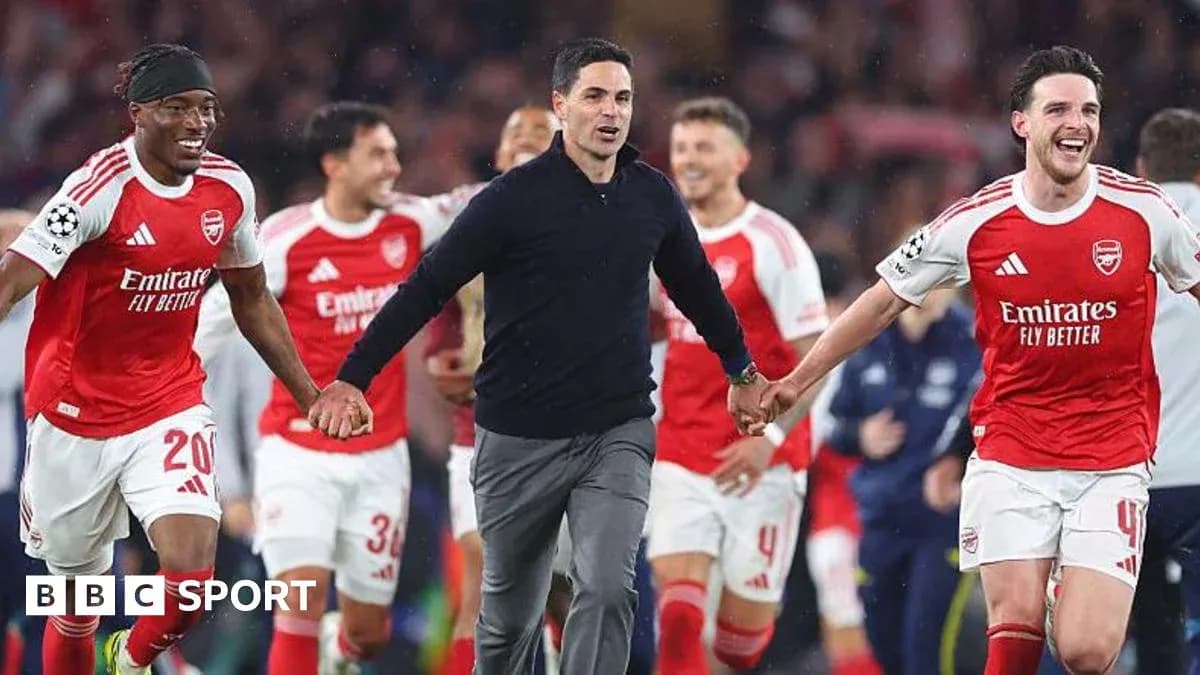
After weeks of tight shoulders and white knuckles, Arsenal blew the lid off north London on Tuesday night, beating Atletico Madrid to reach a Champions League final for the first time in 20 years – and only the second time in the club’s 140-year existence. This was not a routine semi-final win. It was a rupture in the club’s recent history, a night when anxiety finally gave way to unfiltered noise.
Budapest now beckons on 30 May, where Mikel Arteta’s side will face either Bayern Munich or Paris St-Germain. Tickets, flights, hastily arranged days off work – all of it is already in motion. Arsenal stand 90 minutes from becoming European champions for the first time. They are also top of the Premier League. A continental double is on the table.
And yet, in the middle of all that euphoria, the familiar debate crackled into life: are Arsenal celebrating too much?
The ‘celebration police’ clock in
Arsenal’s win means they could become the seventh English club to lift the European Cup or Champions League, and only the fourth to pair it with the league title in the same season, following Liverpool, Manchester United and Manchester City. That is the scale of what is suddenly within reach.
Wayne Rooney, who helped United complete that league-and-Europe double in 2007-08, watched the scenes at the Emirates and bristled.
“They deserve to be in this position but they haven't won it yet,” he said on Amazon Prime. “I think the celebrations are a little bit too much. Celebrate when you win.”
It was a blunt verdict from someone who has lived the sharp end of these nights. To Rooney, the line between joy and job-done is non-negotiable. Arsenal, in his view, stepped over it.
His comments landed in a fanbase that has spent the season walking a tightrope between belief and dread. Within minutes, one of their own fired back.
Former Arsenal striker Ian Wright, speaking on X, urged supporters to ignore the noise.
“Arsenal fans, let me tell you something: enjoy this. The celebration police will be out in force. Do not get nicked!” he wrote. “Enjoy yourselves, football's about moments and this is a big moment. Enjoy it and let's hope that in the final and after the final we have another massive moment. It's a great day.”
Two strikers, two eras, two very different readings of what a semi-final should feel like.
Wenger’s measured warning
Arsene Wenger knows better than most how rare these nights are. He took Arsenal to their only previous Champions League final in 2006, a 2-1 defeat by Barcelona that still stings in the club’s collective memory.
Watching on beIN Sports this time, he struck a balance between indulgence and insistence.
“They celebrated well tonight, which is normal. But you want more to focus already on the final and the next game,” he said. “The celebration is deserved and happiness is absolutely normal, but now the next step is of course to go to the final and win it.”
Wenger’s words cut to the heart of the argument. Enjoy the moment, yes. Just don’t let the moment consume the mission.
City, context and what winning feels like
Rooney’s irritation is not limited to Arsenal. He also bristled at Manchester City’s reaction after their 2-1 win over Arteta’s side last month, a result that dragged Pep Guardiola’s team right back into the Premier League title race.
“I think it was a little bit over the top,” he said after that game. “It is obviously a big win. I just think it's a little bit premature and it might come back to bite them.”
Danny Murphy, analysing the same scenes for the BBC, agreed City’s celebrations “looked a bit excessive, like maybe they had already won [the title]”. Yet he also offered a different reading: this was a group realising, in real time, that the title was back in their hands.
That distinction matters. Is a celebration about a trophy, or about a shift in belief? About a medal, or about momentum?
At the Emirates on Tuesday, it felt like something more than a single result. It felt like a release.
‘It was just joy’
For much of this season, Arsenal have lived under a strange kind of scrutiny. Top of the table, in the latter stages of every competition, yet constantly surrounded by talk of “bottling”, of quadruples and collapses, of whether this squad is built to last.
Scarlet Katz Roberts, from the Goal Difference podcast, captured that tension bluntly: Arsenal should celebrate.
If the football has often looked outstanding, the mood around it has not always matched. Every slip has been magnified, every draw framed as a crisis. The pressure has been relentless.
Against that backdrop, Tuesday’s scenes felt different. “Vibes,” as Roberts put it, suddenly mattered. The players streamed on to the pitch. “Freed From Desire” thundered around the Emirates. Supporters drowned out Martin Keown before kick-off and then kept going deep into the night.
It did not look choreographed. It looked human. It looked like a fanbase that had spent months bracing for impact finally allowing itself to feel the ride.
Arteta has been searching for that connection since the day he walked back through the doors. The club anthem “North London Forever”, once dismissed by some as forced, finally sounded like what it was supposed to be: a rallying cry.
For once, Arsenal did not look like a club debating its own identity. They looked like one moving as a single, noisy mass.
The science of letting go
There is also a colder, more clinical way to view all this noise.
Bradley Busch, a chartered sports psychologist who runs the training centre Inner Drive, saw Arteta and his players linking hands and sprinting towards each end of the ground and recognised something very specific: emotional contagion.
“The technical phrase that is used in research for this is known as ‘emotional contagion’, which basically says behaviours and attitudes and unity can spread and ripple through the team,” he told BBC Sport. “One way you can do that is through celebrating together.”
In other words, joy is not just a by-product of success. It can be a tool that strengthens it.
“On a more fundamental level, players aren't doing that to try to improve future performance – they're doing it because it's a sheer release of thinking and breathing about this stuff 24/7 and realising your goals,” Busch said. “In what is such a high-pressurised environment I think it's really healthy for it not all to build up and bubble, and to celebrate on the pitch.”
For those accusing Arsenal of going overboard, Busch had little sympathy.
Anyone suggesting the reaction was excessive “feels a bit like the old celebration police going on there,” he added. The only meaningful definition of over-celebration, in his view, is anything that “negatively impacts the future performance”.
That can happen mid-match, when a team believes the job is done and starts to showboat or ease off. Or in the days that follow, if the party bleeds into preparation. But a collective outpouring at full-time, followed by a return to work? That is something else entirely.
Busch did allow himself one personal aside. As a Tottenham fan, he admitted he “absolutely” hopes it is a case of over-celebration – but that, he stressed, is wishful thinking, not professional judgement.
Where joy meets jeopardy
Strip away the noise and one truth remains: Arsenal have not won anything yet. No silverware has been lifted. No ribbons have been tied to any trophy. The season can still twist, brutally, from here.
Yet that is precisely why Tuesday mattered. Nights like this are rare. For Arsenal, they have been painfully rare in Europe. To reach a Champions League final for only the second time in 140 years and not erupt would have been the stranger story.
Rooney’s standard is the standard of a serial winner: celebrate the destination, not the journey. Wright’s answer, and the mood at the Emirates, came from a different place. Football is built on journeys. Most clubs never reach the destination.
Budapest will decide whether this Arsenal side become legends or a glorious near-miss. The Premier League run-in will decide if they join Liverpool, United and City in the small group of English teams to conquer both home and Europe in the same season.
The question now is not whether they celebrated too hard on Tuesday night.
It is whether that night becomes the launchpad for something historic – or the memory they cling to if it all slips away.



