Arsenal Controls Match Against Burnley with 1-0 Victory
Arsenal’s 1-0 win over Burnley at Emirates Stadium was a controlled, possession-heavy performance built on Mikel Arteta’s 4-3-3 structure and Burnley’s inability to turn their 4-2-3-1 into any real attacking threat. The statistical profile – 61% possession, 13 total shots to 5, and a 1.03 to 0.21 edge in xG – underlines a match where Arsenal dictated territory and tempo, while Burnley largely defended deep and looked to survive rather than impose.
Defensively, Arsenal’s shape was almost never stretched. With D. Raya behind a back four of C. Mosquera, W. Saliba, Gabriel, and R. Calafiori, they limited Burnley to 5 shots and, crucially, 0 shots on goal. The combination of line height and counter-press meant Burnley’s lone forward Z. Flemming was often isolated; the visitors’ 39% possession and 325 passes (254 accurate, 78%) were mostly in their own half or in harmless wide areas. Raya’s 0 goalkeeper saves confirm how effectively Arsenal controlled the defensive box; the 0.21 xG conceded reflects a match in which Burnley rarely accessed central finishing zones.
In build-up, Arsenal’s 510 passes with 440 accurate (86%) and a 61% share of the ball show a patient, circulation-heavy approach. D. Rice as the central midfielder in the 4-3-3 acted as the pivot, dropping between or beside Saliba and Gabriel to start play. Full backs Mosquera and Calafiori provided width in deeper zones, allowing M. Odegaard and E. Eze to occupy interior half-spaces higher up. This structure created consistent 3v2 or 4v3 overloads against Burnley’s double pivot of Florentino and L. Ugochukwu.
Decisive Moment
The decisive moment tactically came in the 37th minute: K. Havertz’s goal for Arsenal, assisted by B. Saka, was the product of that territorial control. With Arsenal already pinning Burnley back, Saka’s position on the right of the front three stretched Lucas Pires and the Burnley back line, opening a channel for Havertz to attack the box. The goal aligned with the underlying numbers – Arsenal’s 9 shots inside the box versus Burnley’s 2 – showing how often Arteta’s side managed to get their forwards into central scoring positions.
Burnley's Defensive Plan
Burnley’s defensive plan under Mike Jackson was conservative: a 4-2-3-1 that often flattened into a 4-5-1 without the ball. K. Walker and Lucas Pires stayed relatively narrow to protect the half-spaces, while Florentino and Ugochukwu screened central passes. The high foul count – 16 fouls and 3 yellow cards – suggests a reactive, contact-heavy approach to slowing Arsenal’s combinations. Hannibal Mejbri’s 28' yellow card for Time wasting, long before the final phase of the match, indicated Burnley were already looking to disrupt rhythm rather than contest the ball higher up the pitch.
Despite that, Arsenal’s shot profile (13 total shots, 3 on goal, 3 blocked) hints at one tactical limitation: dominance of territory did not consistently translate into clear, high-quality chances. Burnley’s compactness in the final third forced Arsenal to shoot from less dangerous zones at times (4 shots outside the box), and M. Weiss’s 2 goalkeeper saves, combined with 0.85 goals prevented for Burnley, show that when Arsenal did break through, the visiting goalkeeper was efficient in preserving the scoreline from becoming more one-sided.
On the other side, Burnley’s attacking structure never really clicked. With L. Tchaouna, H. Mejbri, and J. Anthony behind Flemming, the idea was clearly to counter through mobile, technically strong attacking midfielders. However, Arsenal’s counter-press and rest defense – Rice anchoring with the two centre backs and one full back tucked in – meant transitions were smothered early. The absence of any shot on target and the low xG tally capture how rarely Burnley broke through Arsenal’s first and second defensive lines.
Substitutions
Substitutions from both coaches reinforced the tactical themes rather than radically changing them. For Burnley, Mike Jackson’s changes were largely like-for-like and aimed at injecting energy:
- 70': Z. Amdouni (IN) came on for H. Mejbri (OUT), adding a more penalty-box-oriented threat but still starved of service.
- 71': J. Laurent (IN) came on for L. Ugochukwu (OUT), seeking fresh legs in the double pivot.
- 78': J. Ward-Prowse (IN) came on for Florentino (OUT), adding set-piece quality and long passing but within the same 4-2-3-1 framework.
- 82': J. Bruun Larsen (IN) came on for L. Tchaouna (OUT), then B. Humphreys (IN) came on for M. Esteve (OUT), tweaks that freshened the flanks and back line without altering the team’s overall defensive posture.
Arteta’s substitutions were about game management and maintaining control of the central spaces as legs tired:
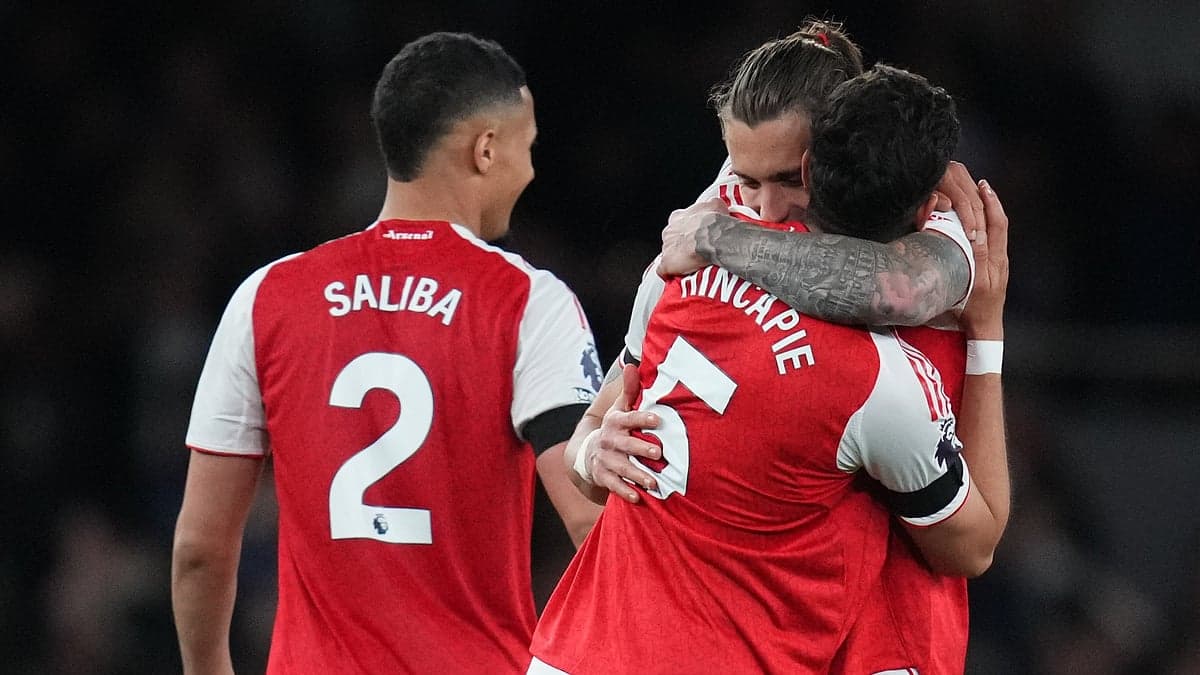
- 72': P. Hincapie (IN) came on for R. Calafiori (OUT), keeping the left side secure while preserving the back four structure.
- 73': V. Gyökeres (IN) came on for K. Havertz (OUT), offering a more direct, running threat in behind to pin Burnley deeper.
- 73': M. Lewis-Skelly (IN) came on for E. Eze (OUT), adding fresh energy and defensive discipline in midfield.
- 90+3': G. Martinelli (IN) came on for L. Trossard (OUT), and M. Zubimendi (IN) came on for M. Odegaard (OUT), late moves to reinforce control and protect the 1-0 advantage.
Discipline
Discipline played a clear role in shaping the match’s rhythm. The full disciplinary log, in chronological order:
- 28': Hannibal Mejbri (Burnley) — Time wasting
- 67': Kai Havertz (Arsenal) — Foul
- 90+1': Zian Flemming (Burnley) — Foul
- 90+4': Lucas Pires (Burnley) — Foul
Arsenal finished with 1 yellow card to Burnley’s 3, reflecting how often the visitors had to break up play under sustained pressure. The timing of Flemming’s and Pires’s late bookings, both for Foul, underlined Burnley’s increasingly desperate attempts to disrupt Arsenal’s game management in stoppage time.
From a statistical verdict, the 1-0 scoreline is aligned with the underlying data but arguably flatters Burnley slightly. Arsenal’s xG of 1.03 against Burnley’s 0.21, combined with 9 shots inside the box and 61% possession, points to a match in which Arteta’s side were clearly superior in both structure and chance creation, even if the finishing volume (3 shots on goal) did not turn dominance into a multi-goal margin. Defensively, Arsenal’s ability to concede 0 shots on target and keep Raya’s involvement minimal is a strong indicator of a high Defensive Index performance.
For Burnley, the attacking numbers – 5 total shots, 0 on goal, 0.21 xG – reveal a side that never solved Arsenal’s press or rest defense. Their 16 fouls and 3 yellows show the cost of relying on disruption over possession. In tactical terms, this was a controlled, professional home win: Arsenal’s structure and ball circulation were good enough to win comfortably, while Burnley’s 4-2-3-1 never evolved into a credible attacking threat.