Argentina's Tactical Dominance in World Cup Match Against Cape Verde Islands
Argentina’s 2-1 extra‑time win over Cape Verde Islands at Hard Rock Stadium was a territorial siege decided by structural superiority and depth rather than pure efficiency. Across 120 minutes in this World Cup Round of 32 tie, Argentina’s 4-4-2 imposed long phases of sterile dominance, while Cape Verde Islands’ 4-1-4-1 tried to compress space, counter selectively and survive under sustained pressure. The final scoreline — 2-1 after extra time, following a 1-1 draw in normal time — reflects Cape Verde Islands’ resilience more than parity in chance quality.
I. EXECUTIVE SUMMARY
Argentina finished with 64% possession, 22 total shots and an xG of 2.16, compared with Cape Verde Islands’ 36% possession, 16 shots and 0.45 xG. The game state swung repeatedly: Argentina led 1-0 at half-time, were pegged back to 1-1, then briefly trailed in extra time before turning the match with a late own goal. The pattern was consistent: Argentina building patiently with a high pass volume and accuracy (849 passes, 779 accurate at 92%), Cape Verde Islands defending in a mid-to-low block and trying to exploit transition with more direct play (476 passes, 408 accurate at 86%).
II. SCORING SEQUENCE & DISCIPLINARY LOG
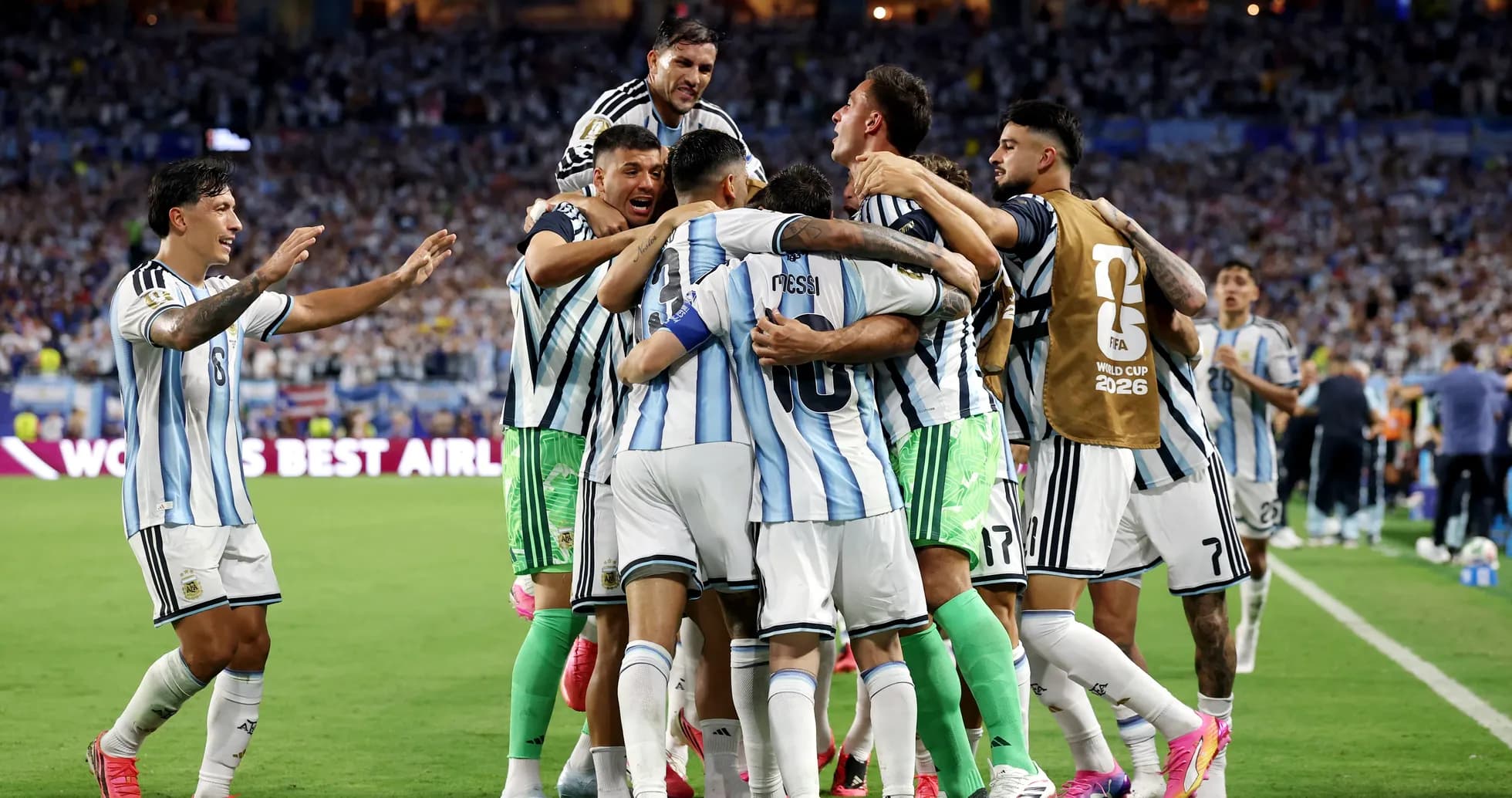
The opening goal on 29' came from a classic Argentine progression against a set block. From the back line, Lisandro Martínez stepped in aggressively, and the move eventually found Lionel Messi between the lines. Messi (Argentina) finished the move after combination play, officially assisted by Lisandro Martínez, reflecting how the left-sided centre-back was encouraged to break lines and join the first phase of attack.
Cape Verde Islands responded after the interval, capitalising on one of their few structured forays. On 59', Deroy Duarte (Cape Verde Islands), assisted by Ryan Mendes, equalised with a “Normal Goal”, a rare moment where Cape Verde Islands’ central midfielders could arrive higher and punish Argentina’s rest defence.
Discipline began to surface as Cape Verde Islands tried to disrupt Argentina’s rhythm. At 68', Kevin Lenini (Cape Verde Islands) received a yellow card — Foul — emblematic of the holding midfielder’s role in breaking up play in front of the back four.
Argentina kept pushing and reclaimed the lead at 93'. A set of sustained attacks culminated with Lisandro Martínez (Argentina) scoring, assisted by Alexis Mac Allister, again underlining Argentina’s use of centre-backs as active weapons on attacking set plays and second phases.
Extra time twisted the narrative. At 103', Sidny Lopes Cabral (Cape Verde Islands) struck to level the tie again with a “Normal Goal”, arriving from the defensive line to exploit a rare lapse in Argentina’s box organisation. But the decisive moment came at 111', when Diney Borges (Cape Verde Islands) put through his own net. The own goal is credited to Argentina, flipping the extra-time score to 2-1.
Late tension was capped by Argentina’s only booking: at 115', Gonzalo Montiel (Argentina) was shown a yellow card — Foul — after entering earlier in extra time, reflecting Argentina’s need to manage transitions and kill Cape Verde Islands’ late surges.
Final card count, locked to the events:
- Argentina: 1 yellow (Gonzalo Montiel — Foul)
- Cape Verde Islands: 1 yellow (Kevin Lenini — Foul)
Total: 2 cards.
III. TACTICAL BREAKDOWN & PERSONNEL
Lionel Scaloni’s 4-4-2 for Argentina was built on aggressive territorial control. Emiliano Martínez (Argentina) operated as a high starting-position goalkeeper, enabling a compact defensive line and quick restarts. His stat line — 3 saves and negative goals prevented (-0.6) — suggests that while he was not heavily tested in volume, the few shots he faced carried decent threat, and he marginally underperformed post-shot xG.
In possession, the back four of Nahuel Molina, Cristian Romero, Lisandro Martínez and Facundo Medina formed a wide first line, with Lisandro Martínez particularly proactive in stepping into midfield. This was crucial to Argentina’s progression: 849 total passes at 92% accuracy indicate a methodical, high-precision build-up. The double pivot of Enzo Fernández and Alexis Mac Allister provided circulation and vertical passing, with Rodrigo De Paul and Thiago Almada starting wide but frequently inverting to create overloads around Messi.
Messi and Lautaro Martínez as a front two created a flexible structure: Messi dropping into the right half-space to dictate, Lautaro stretching the last line. The 15 shots inside the box out of 22 total underline how Argentina consistently managed to penetrate into high-value zones, though Cape Verde Islands’ 6 blocked shots show their back line’s commitment to last-ditch defending.
Pedro Leitao Brito’s Cape Verde Islands lined up in a 4-1-4-1 with Vozinha (Cape Verde Islands) in goal. He made 8 saves, a high workload that, combined with a goals prevented figure of -0.6, implies he was frequently exposed to quality chances and conceded slightly more than post-shot models would expect. The back four of Steven Moreira, Pico, Diney Borges and Sidny Lopes Cabral stayed relatively narrow, with Kevin Lenini screening as the single pivot.
Out of possession, Cape Verde Islands compressed central spaces, allowing Argentina to circulate but rarely penetrate through the middle without heavy combination play. The 36% possession and 476 passes at 86% accuracy show that when they did have the ball, they were reasonably tidy but selective, often looking to use Ryan Mendes and Jovane Cabral as ball carriers in transition, with Nuno Da Costa as the focal point.
Substitutions were tactically significant. On 63', Nicolás González (IN) came on for Thiago Almada (OUT), and Julián Alvarez (IN) came on for Lautaro Martínez (OUT), adding more vertical running and pressing energy. For Cape Verde Islands, Dailon Rocha Livramento (IN) came on for Nuno Da Costa (OUT) and Jamiro Monteiro (IN) for Laros Duarte (OUT) at 67', adding fresh legs between the lines. Later, Hélo Varela (IN) replaced Jovane Cabral (OUT), and Willy Semedo (IN) replaced Ryan Mendes (OUT) at 80', signalling a shift towards more direct wide threats.
In extra time, Gilson Tavares (IN) for Kevin Lenini (OUT) and Yannick Semedo (IN) for Deroy Duarte (OUT) at 100' tilted Cape Verde Islands slightly more attacking but also loosened their central protection. Argentina responded by reinforcing their defensive right: Gonzalo Montiel (IN) came on for Nahuel Molina (OUT) at 104', a move aimed at stabilising the flank and securing the lead once the own goal arrived.
IV. THE STATISTICAL VERDICT
The underlying numbers strongly validate Argentina’s progression. With 22 total shots to Cape Verde Islands’ 16 and an xG of 2.16 to 0.45, Argentina generated both more and better chances. The 10 shots on goal versus Cape Verde Islands’ 5 align with the optical sense of a game largely played in Cape Verde Islands’ half. Argentina’s 7 blocked shots show Cape Verde Islands’ defensive bravery, but also how often Argentina worked shooting positions.
Possession (64% vs 36%) and passing volume (849 vs 476) highlight Argentina’s territorial dominance and control. Their 92% pass accuracy compared to Cape Verde Islands’ 86% reflects superior technical security under pressure. Both sides finished with 8 corner kicks, indicating that while Argentina dominated open play, Cape Verde Islands still forced their share of restarts.
Discipline was balanced — one yellow card each — and did not materially distort the tactical picture. The match ultimately followed the logic of the metrics: a superior side in overall form and attacking structure, Argentina, was pushed deep into extra time by a compact, resilient Cape Verde Islands unit whose defensive index was high but whose attacking output never truly matched the volume or quality of Argentina’s chances.