Argentina vs England: A World Cup Semi-Final Showdown
Under the closed roof of Mercedes‑Benz Stadium, a World Cup semi-final between England and Argentina was always going to feel like more than a game. It was a collision of footballing identities: England’s methodical, structure-first evolution under Thomas Tuchel against Argentina’s rolling wave of form and the enduring genius of L. Messi. Over 90 minutes that ended 2–1 to Argentina, the squads and their season-long tendencies told as much of the story as the scoreline.
I. The Big Picture – Two Machines at Full Throttle
Heading into this game, both sides arrived as near-perfect tournament machines. England’s overall record in this World Cup showed 7 matches played, with 5 wins, 1 draw and just 1 defeat. They had scored 14 goals in total and conceded 8, giving them a goal difference of +6. Their attacking rhythm had been consistent: 7 goals at home and 7 on their travels, with an overall scoring average of 2.0 goals per match. Defensively, they allowed 1.1 goals per game overall.
Argentina were even more ruthless. Across 7 matches in total they had 7 wins, no draws, no defeats, with 19 goals scored and 7 conceded, a goal difference of +12. Their attack was relentless: 2.8 goals per game at home and 2.5 on their travels, 2.7 overall, backed by a defence that conceded just 1.0 goal per match in every dimension. The group-stage tables had already flagged the contrast: England topping Group L with 7 points and a goal difference of +4, Argentina sweeping Group J with 9 points and a goal difference of +7.
The semi-final lineups reflected those identities. England returned to their trusted 4‑2‑3‑1, with J. Pickford behind a back four of R. James, J. Stones, M. Guehi and D. Spence. D. Rice and E. Anderson formed the double pivot, while M. Rogers, J. Bellingham and A. Gordon supported H. Kane. Argentina’s 4‑1‑4‑1 under Lionel Scaloni placed L. Paredes as the single shield, with G. Simeone, E. Fernandez, A. Mac Allister and J. Alvarez forming a fluid line behind L. Messi.
This was not just England against Argentina; it was structure against flow, with the margins dictated by which unit could bend without breaking.
II. Tactical Voids – Suspensions, Discipline and Emotional Edges
The most notable absence was J. Quansah for England, suspended through a sports court decision. His red card earlier in the tournament – one of only a handful of outright dismissals in the competition – had shaped Tuchel’s thinking. Without Quansah, England leaned heavily on M. Guehi and J. Stones as the central pairing, with E. Konsa and D. Burn waiting in reserve. It removed one rotation option in a position where freshness and composure are critical in a semi-final.
Discipline had been a running theme in England’s campaign. D. Rice, who carried 2 yellow cards in the tournament, anchored the midfield with a fine line between aggression and control. Across the World Cup, England’s yellow cards were spread, but there was a clear spike in the 31–45 and 61–75 minute windows, each accounting for 25.00% of their bookings. That pattern hinted at moments where emotional surges – the push before half-time, the stretch after the hour – could destabilise their structure.
Argentina, by contrast, had been relatively calm in regulation time. Their yellows were clustered late: 11.11% between 31–45, 11.11% from 46–60, then a noticeable surge in extra-time periods, with 44.44% of their yellow cards arriving between 91–105 minutes and 22.22% from 106–120. In a semi-final that stayed within 90 minutes, that meant Scaloni’s side were tactically aggressive but rarely reckless in normal time.
The penalty narrative also framed the psychological backdrop. England had been perfect from the spot in this tournament, scoring 2 penalties from 2 overall. Argentina, however, had a complicated relationship with penalties: 3 awarded in total, but only 1 scored and 2 missed, a conversion rate of 33.33%. The fact that L. Messi himself had missed 2 penalties in this World Cup added a strange tension: the greatest of his generation, yet fallible from 12 yards. In a tight semi-final, that history hung over every box incident.
III. Key Matchups – Hunter vs Shield, Engine Room vs Engine Room
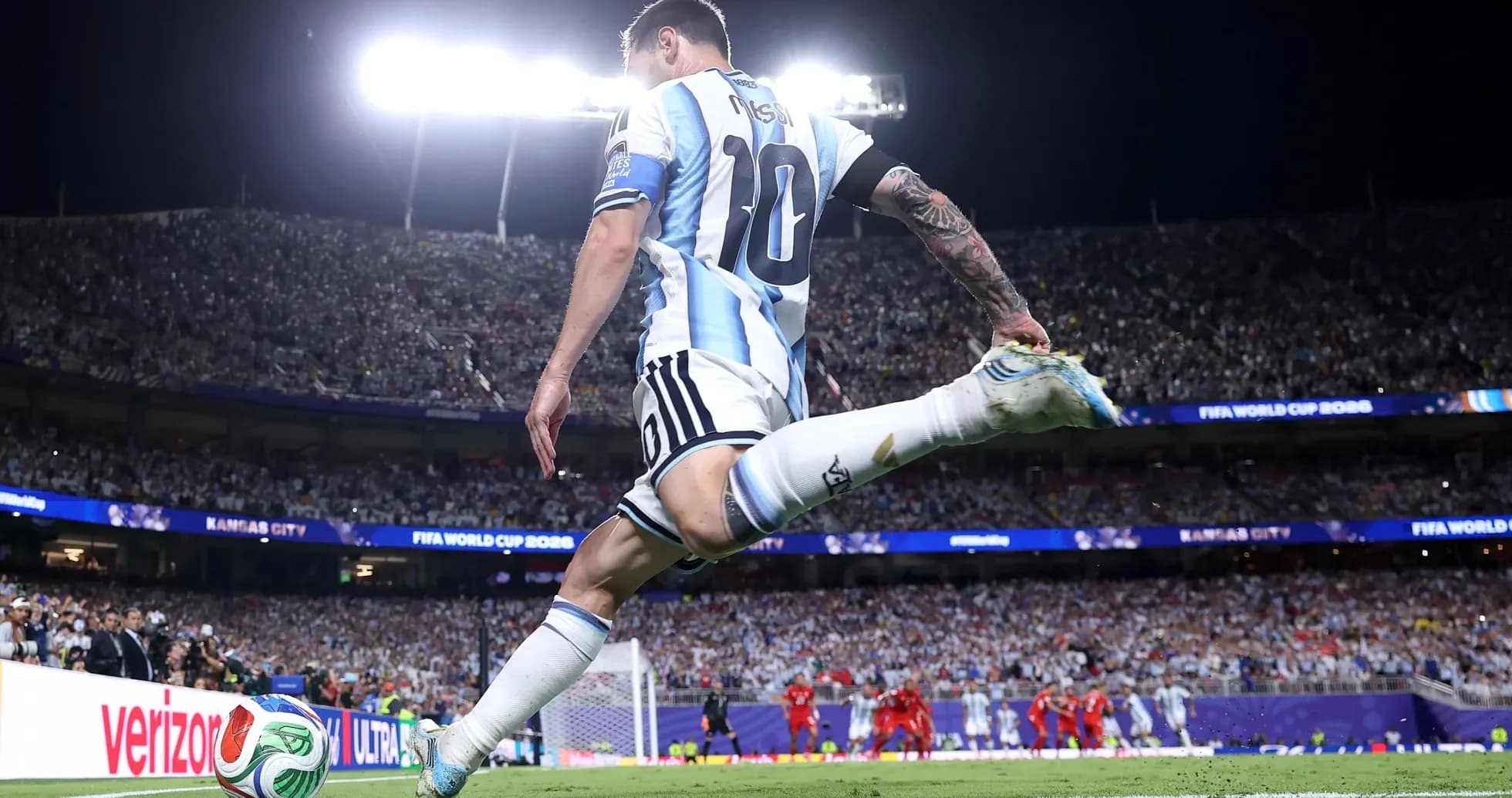
The defining duel was always going to be L. Messi against England’s defensive block. Messi entered the semi-final as the competition’s leading scorer with 8 goals and 4 assists, from 28 shots and 18 on target, plus 35 dribbles attempted with 24 successful. He had also created 26 key passes and drawn 16 fouls. England’s task was not to stop him outright – that is almost never possible – but to channel him into traffic.
That traffic was meant to be D. Rice. Across the tournament, Rice had completed 240 passes with 91% accuracy, made 4 tackles, 2 blocks and 2 interceptions, and taken 4 shots with 2 on target. His role in the double pivot alongside E. Anderson was to close the central lane where Messi loves to receive between the lines, forcing Argentina’s captain wider or deeper, away from the most dangerous zones.
Behind Rice, M. Guehi and J. Stones formed the last line of resistance. Stones’ reading of the game and Guehi’s mobility were key to stepping out to meet Messi or tracking J. Alvarez’s runs from the left side of Argentina’s midfield band. R. James and D. Spence, as full-backs, had to balance their overlapping impulses with the reality that a single mistimed advance could leave Messi, Alvarez or G. Simeone attacking space in transition.
On the other side, England’s “hunter” was a two-headed threat. H. Kane, with 6 goals and 1 assist in this World Cup, had 18 shots (12 on target) and a quietly influential passing game: 106 passes, 5 key passes, and 3 blocked shots defensively. He operated as both finisher and wall-pass outlet. Around him, J. Bellingham’s all-court profile – 6 goals, 1 assist, 15 shots with 11 on target, 8 key passes, plus 14 tackles and 3 interceptions – made him England’s true engine. When he drifted between Argentina’s lines, he asked questions of L. Paredes’ positioning and the timing of C. Romero and L. Martinez stepping out.
The wide duel of A. Gordon against N. Molina was another fault line. Gordon had 1 goal and 3 assists in the tournament, 5 shots (4 on target), 6 key passes and 25 dribbles attempted. His capacity to carry the ball and win fouls was designed to pin back Argentina’s right side and create crossing lanes for Kane. With B. Saka available from the bench – 3 assists, 6 shots, 5 key passes and 12 dribbles attempted – Tuchel had the option of flipping the wide dynamic late on, injecting fresh 1v1 threat against tiring full-backs.
In midfield, E. Fernandez and A. Mac Allister offered Argentina their own engine room. Their task was to overload Rice and Anderson, create angles around England’s double pivot and ensure Messi received the ball facing forward rather than with his back to goal. J. Alvarez, starting nominally as a midfielder, functioned more like a second forward, testing the channel between Spence and Guehi.
IV. Statistical Prognosis – Why Argentina’s Edge Told
On paper, this semi-final brought together two of the tournament’s most balanced sides. England’s overall scoring rate of 2.0 goals per match, paired with 1.1 conceded, suggested a team comfortable in controlled, medium-scoring contests. Argentina, at 2.7 goals scored and 1.0 conceded overall, projected a slightly higher-variance profile: more goals for, but not at the expense of defensive stability.
Argentina’s biggest wins – 3‑0 at home and 1‑3 on their travels – showed they could both dominate and counter-punch. England’s standout results, 4‑2 at home and 0‑2 on their travels, underlined a similar duality but with slightly more defensive leakage. Both teams had 2 clean sheets overall, but Argentina had never failed to score in this World Cup, while England had failed to score once.
Layer in the individual form, and the statistical balance tilts. Messi’s 9.07 average rating, 8 goals, 4 assists and 24 successful dribbles gave Argentina a decisive edge in the “game-breaker” category. England’s response – the combined 12 goals from Bellingham and Kane, plus the creative support of Gordon and Saka – was formidable, but more distributed. In a semi-final, where one moment of individual brilliance or one disguised pass can redraw the night, having the tournament’s most dominant player matters.
Defensively, both sides conceded roughly 1 goal per match overall, but Argentina’s unbeaten run of 7 wins from 7, compared with England’s 5 wins from 7, hinted at a team more comfortable in tight endgames. Their late yellow-card profile, spiking in extra-time rather than regulation, suggested a side that could maintain control and intensity through 90 minutes without tipping into chaos.
In that context, a 2–1 Argentina win fits the statistical and tactical prognosis. England’s structure, their double pivot, and their multi-pronged attack were always likely to keep them competitive and on the scoresheet. But Argentina’s slightly sharper attacking numbers, their perfect overall record, and above all the presence of Messi – even with 2 penalties missed in the tournament – gave them the higher ceiling.
The semi-final in Atlanta, then, felt less like an upset and more like the logical meeting point of two arcs: England’s rise into a modern, tactically sophisticated contender, and Argentina’s continued reign as a ruthless, Messi-led tournament side. On this night, the hunter in sky blue and white found just enough space between England’s shields to book a place in the final.