Anfield's End-of-Season Lament: Failure and Fractures
They tried to sing themselves into denial. As the final whistle went on Liverpool’s bleak 2025/26 campaign, The Kop reached for Bob Marley, belting out that “every little thing is gonna be alright.” It sounded less like defiance and more like a plea.
This felt like an ending. Not just to a season, but to a cycle that has defined Liverpool for the best part of a decade. Two more pillars of the modern era said their goodbyes. The squad Arne Slot inherited just two years ago has been stripped almost to the bone. Half of it gone. More expected to follow Mo Salah and Andy Robertson through the exit door in the coming weeks.
The 1-1 draw with Brentford technically did its job. It sealed Champions League football. It did nothing for the mood.
A season that collapsed
Liverpool staggered to the finish line. No wins in their final four league games. Just four victories in their last 14 matches in all competitions. That is not a blip. That is a collapse.
Strip away the caveats and the soft language: this season has been a failure. A flat, unforgiving failure.
Sixty points. Fifth place. On paper, it brings Champions League qualification. In context, it is a damning return. Last season, 60 points would have left Liverpool ninth and out of Europe altogether. The year before, seventh and still short. Three years back, ninth again. This is not a total that usually gets you anywhere near the elite.
You have to go back to 2003/04 to find a lower points tally that still snuck into the Champions League. That was Gerard Houllier’s final campaign, which ended with a polite handshake and a photoshoot on the Anfield pitch. It also ushered in the sense that something had run its course.
That same unease hangs over Anfield now. Supporters who lived through the early 1990s can feel the echoes: Graeme Souness dismantling Kenny Dalglish’s ageing title-winners, the upheaval, the missteps, and then the long, grey slide into mediocrity.
Salah’s warning shot
Mo Salah hears those echoes too. He has not hidden it. As his nine extraordinary years at the club drew to a close, he made his concerns public. He has seen what high standards look like here, and he knows how far this season has fallen short.
On the pitch, he did what Liverpool players at their best have always done: he spoke directly to the supporters’ values.
“They don’t care that much about the result as long as you sweat and give your blood here, they’ll love you forever,” he told Sky Sports.
In one sentence, he nailed the contract between the club and its people. Show up. Give everything. Walk through the storm, but do it together. That idea has been tested in the most brutal way this season, not least in the aftermath of Diogo Jota’s death in pre-season, a tragedy that shook the club to its core.
Salah’s message was simple. Effort, honesty, shared suffering. The fans will carry you if they feel you are carrying them.
Slot on the bench, alone
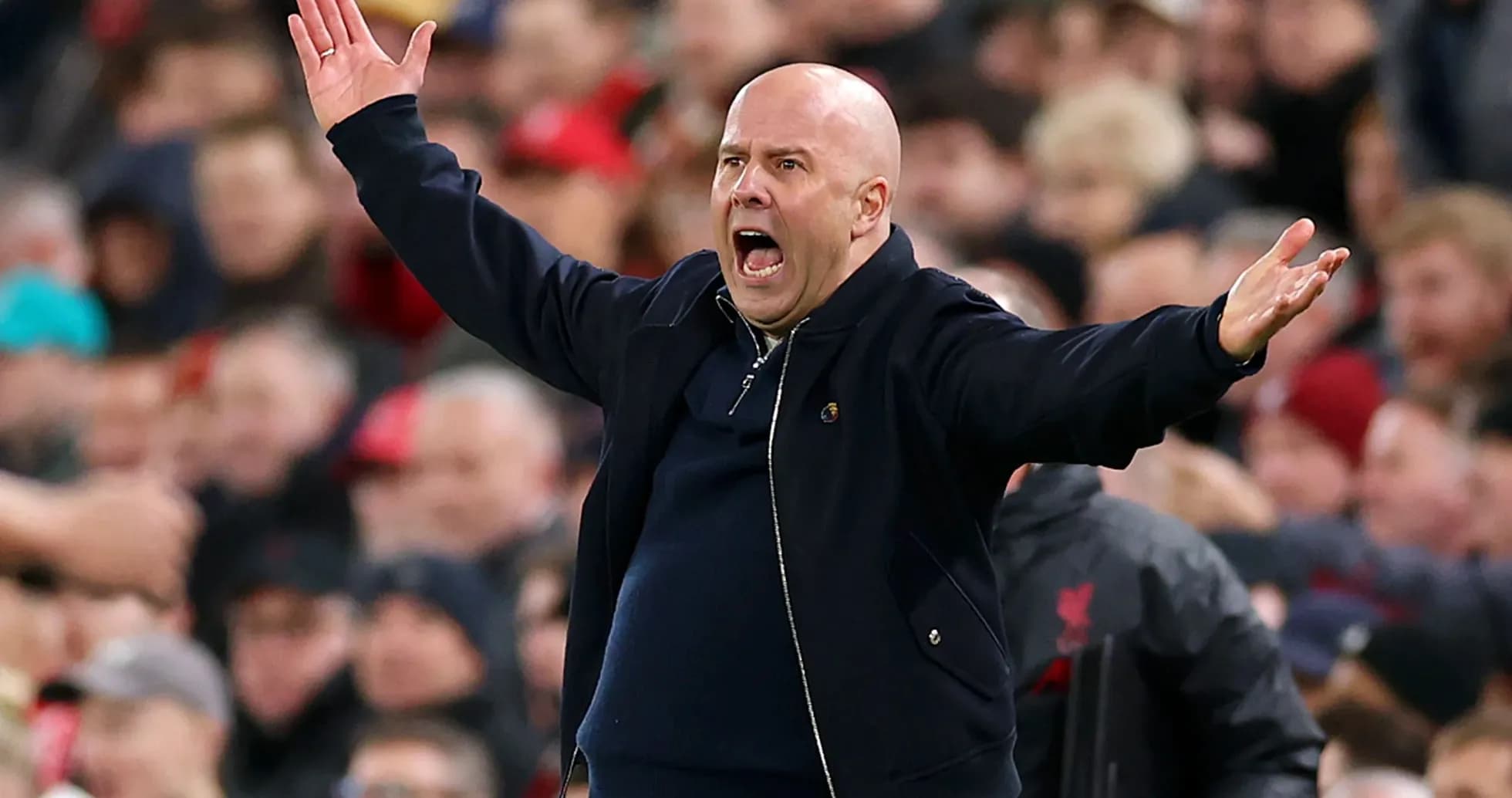
That is why the images at full-time jarred so badly. As the players embarked on the traditional lap of appreciation, Slot stayed on the bench, face set, watching on.
Maybe he meant well. Maybe he wanted the departing players to have their moment. Maybe he was simply drained and reflective. But perception matters here, and the perception was awful.
On a day when Liverpool’s supporters turned up yet again after enduring their lowest league win total in a decade – just 17 victories – their head coach sat apart, isolated, while the bond between players and fans played out without him.
This was his chance to show gratitude, to acknowledge the people who had stuck through a season of late goals conceded, tired legs and fading belief. He didn’t take it. For a fanbase already worried about a lack of connection, it felt like another misstep.
Injury excuses and a small-squad gamble
In his post-match press conference, Slot tried to condense the entire campaign into a single word.
“Injury,” he said.
On one level, he is right. Liverpool have been hit hard. Absences have disrupted rhythm, forced changes, exposed weaknesses. But this is also the same manager who, back in October, defended the decision to go with a lean group.
“This is a decision we have made together,” he said then. “I completely believe in this, because if you have 25 [players] it’s very hard to manage your squad.”
You cannot champion a small squad in autumn and then spend winter and spring lamenting injuries, the strain of midweek and weekend games, and the lack of options from the bench. Not when you knew the Champions League would expand and the Premier League would remain unforgiving.
Slot himself spelled out the risk. With two, three, four injuries, he warned, you end up with 15 or 16 players, including youngsters like Rio and Trey Nyoni, having to play “almost all the minutes” and things becoming “complicated.”
The reality? Trey Nyoni, the highly-rated teenager who debuted under Jurgen Klopp at 16, finished the season with just 21 league minutes. Federico Chiesa, marginalised yet again, managed only 318 league minutes. Wataru Endo played 170.
Kieran Morrison, Under-21s captain and player of the season, sat on the bench 13 times. He got on the pitch once, for five minutes in an FA Cup tie at Wolves.
So the squad was not just small on paper. It was smaller in practice, too, because several available players were barely trusted. Add in the failure to bring Harvey Elliott back in January – when Liverpool were crying out for quality off the bench – and the picture becomes even more damning.
These are not just misfortunes. They are choices.
Heavy defeats, higher standards
Slot has tried to frame the cup exits as understandable collateral. Lose 4-0 to eventual FA Cup winners Man City, 4-0 to PSG – a side unbeaten in two-legged European ties for two seasons – and you can argue about context and quality of opposition.
That argument will not land on Merseyside.
Virgil van Dijk, Robertson, Salah, Curtis Jones – the senior voices in the dressing room – have all been clear that this season has fallen below what Liverpool demand of themselves. The badge carries a standard. Competing for major honours is the baseline, not a distant dream.
Salah’s parting words to his teammates at the AXA Training Centre cut through the noise: “Being in Liverpool, winning something for Liverpool and winning games is the best thing that could happen to you all.”
Slot, for his part, described Champions League qualification as “our lowest base,” but then pointed to Chelsea and Tottenham missing out on Europe as evidence of how tough it is for big clubs.
For some supporters, that sounded like a softening of ambition. Liverpool do not measure themselves against who failed. They measure themselves against what is possible. Against trophies. Against the biggest nights. A 4-0 exit is not softened by the fact the other team went on to lift the cup.
Even the season’s best spell came with caveats. After a humiliating 4-1 home defeat to PSV – arguably the campaign’s nadir – Liverpool strung together a 13-game unbeaten run. On the surface, it looked like a revival.
Look closer. Draws with Leeds twice, Burnley and Fulham. Of the seven wins, two came against Barnsley in the FA Cup and a West Ham side that would end up relegated. The run papered over cracks rather than fixing them.
An uncertain summer
Now comes the hard part.
Slot’s own future is not nailed down, with only a year left on his contract. The same is true of key decision-makers Richard Hughes and Michael Edwards. Stability off the pitch looks as fragile as the squad on it.
On the playing side, the churn could be brutal. Up to nine first-teamers might move on. Salah and Robertson are already heading out. Ibrahima Konate is out of contract. Chiesa and Endo have been peripheral and could go. Curtis Jones, with a year left and strong interest from Inter Milan, is widely expected to depart. Alisson is wanted by Juventus. Joe Gomez has just a year remaining. Alexis Mac Allister could be sold if the price is right.
Strip that down and you see the scale of the rebuild. Next season, as it stands, Cody Gakpo will be Liverpool’s top current goalscorer at the club. Behind him? Centre-back Virgil van Dijk.
Slot has spoken of “a little transition” this summer, nothing as “drastic” as last year. The reality is staring him in the face. This is not tinkering. This is surgery.
The question is who performs it, and with what plan.
As the stands emptied and the last lines of Marley drifted away into the Anfield night, the message from The Kop was clear in its contradiction. Don’t worry about a thing, they sang.
They will. All summer long.