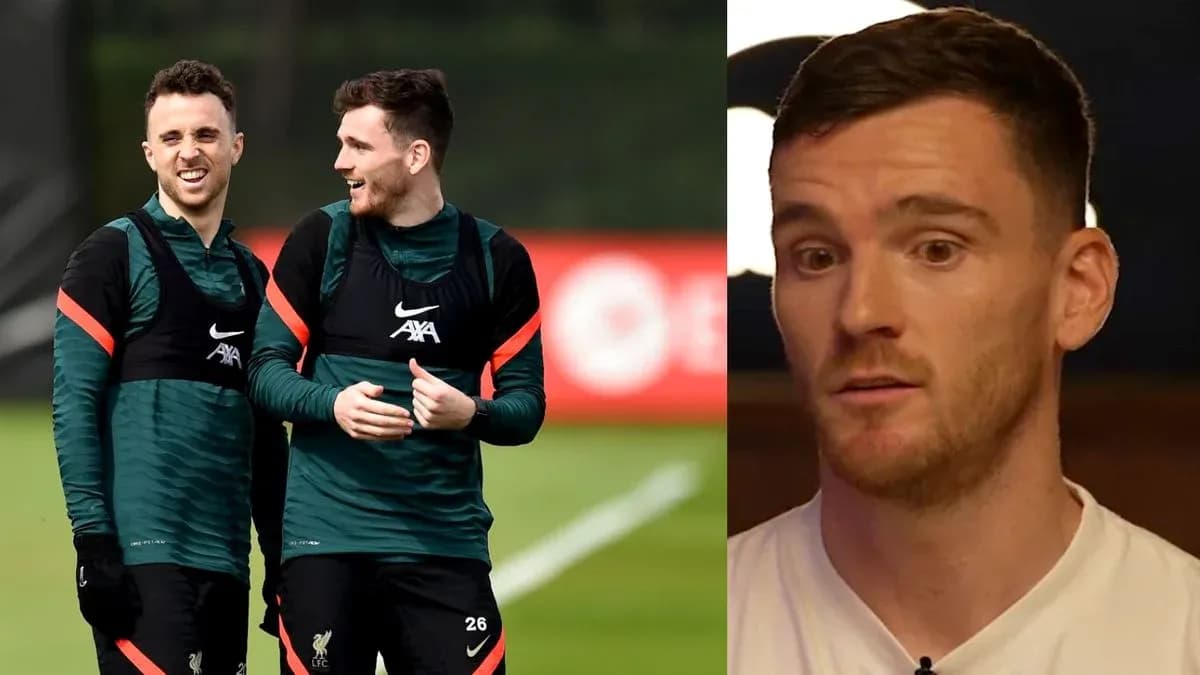
Andy Robertson on Liverpool's Grief After Diogo Jota's Death
Andy Robertson has laid bare the emotional toll behind Liverpool’s faltering title defence, admitting the squad “didn’t care about football” in the wake of Diogo Jota’s death.
Jota was killed in a car crash in Spain in July 2025, along with his brother Andre Silva, as they travelled back to England ahead of pre-season. Liverpool had just been crowned Premier League champions. The mood inside the club flipped overnight.
On the Stick to Football Podcast on Disney+, Robertson spoke with raw honesty about how deeply the tragedy cut through the dressing room.
“It's difficult to describe or talk about, really, because what we went through, it was horrendous,” he said. “Say if I'm talking about the new signings, they're coming into a club that is heartbroken.
“They’re trying, and that's where I felt so sorry for these guys because they'd signed and they were signing for big money and all that, if I'm talking about football. It took them months to settle in because we didn't care, we didn't care about football.
“That was the truth of it. We didn't care about football because you've just lost one of your best mates in the changing room.”
Liverpool, a machine of relentless standards for years, suddenly felt human, fragile, drained.
“That's why I probably have so much sympathy in football terms towards the new signings, because I think they came into a team that was, like... we were elite in everything that we did for years,” Robertson continued.
“And maybe we couldn't be that because of what had happened. And then they then started getting quite a lot of criticism. And that's why I think these lads will be absolutely fine at Liverpool. I would treat this season as their first season. That's the way I would do it.”
‘We lost that edge’
Robertson didn’t hide from the football side of it. He knows standards dropped. He just believes the reasons ran far deeper than tactics or form.
“I think all footballers, we all have that edge, don't we? And I think when you lose that edge sometimes then you can't perform to the best. And I think last season we lost the edge.
“I think when I look back on it now, I think we lost that determination a little bit and things like that because I know at times we were maybe going, ‘You know what, what's the point?’
“Like look at what Jota's family are going through. Look at his kids. But yeah, we were grieving. It was our mate at the end of the day. He’s not a footballer to us, he was a teammate, he was a friend.”
The left-back then revealed just how close he had been to Jota in the days before the accident.
“So, yeah, for us it was incredibly difficult. The week before he died, I was at his wedding. So that's one of the most difficult things you'll ever go through. Seeing him on the happiest day of his life, and then the next week you're seeing his family torn apart.”
Slot’s handling of a broken squad
On the pitch, Liverpool slipped. They finished fifth in the Premier League, and Arne Slot lost his job at the end of the season.
Robertson, though, was quick to defend the Dutchman and the way he tried to guide a shattered group through an unimaginable situation.
“We spoke a lot (in pre-season). The manager was really good, to be fair,” he recalled. “Like our pre-season was barely anything because, to be fair to Arne, he was like, ‘If you don't want to train, you don't train.’
“Say one day you come in and you're struggling or whatever, that was his attitude of the pre-season.”
Liverpool leaned heavily on support staff too.
“We had a psychologist that worked in the club anyway and he kind of set up little groups and it would just be like, if you want to grab a coffee and come round and talk and things like that.
“So we did that quite a few times, and I think that helped. But it was incredibly difficult times.
“But then you always just feel sorry for his family, for his wife. At the end of the day, their life got flipped completely upside down.
“Ours, we were heartbroken and everything like that, but for them daily, it must be so difficult even now.
“We managed to get through it together, I think, and we always just said, ‘Look, we'll always remember him,’ and everything like that.
“But we had to play football at the end of the day. We didn't have a choice in that. We tried to do it as best we could and that's why last season was so tough.”
From open-top bus to funeral
Robertson accepts the brutal reality of the sport: managers are judged on results, no matter the context.
“It's a difficult one. At the end of the day, football's based on results, and we didn't get enough results. And that was the fact,” he said.
But he also painted a stark picture of the emotional whiplash the squad endured.
“If you go back to the summer before, we have the biggest parade in Liverpool's history, right? We're on the open-top bus, we're going through the city centre, and I think over a million people had come out and seen us.
“The next day, we all shake each other's hands, we all go off for the summer. The next time we see everyone is at the airport heading over to Porto for his funeral. That's the next time I see all my teammates.
“So, from going from the highest of highs in terms of being on a parade with the Premier League trophy, and you're parading it round thousands and thousands of fans, to then seeing staff and players the way we were, like that, it's not normal.
“It's not normal what we went through. So, I think could it have been factored in? Yeah, maybe it could have.”
The season rolled on regardless. Expectations didn’t ease, even if the players were still processing what had happened.
“But then when the season goes on and things like that, we know that we then have to do better and we need to win games and things like that.
“And I get why then there was a lot of frustration around the way we were playing, the results that we were getting. I can understand it.”
‘We were covering over the cracks’
Liverpool actually started the league campaign fast. Five wins from five. On the surface, the champions looked ready to go again.
Robertson insists the story beneath the scorelines was very different.
“But what I would say is at the time at the start, the manager was really good and he helped us a lot. He understood the situation in terms of pre-season, in terms of not pushing us too hard, not trying to cause too much competitiveness or whatever, in case somebody was struggling that day or whatever.
“And, we then were starting slow, but we then go and win the first five games, and everyone thinks Liverpool are going to win the league again.
“We won the first five games but we were probably covering over the cracks at that point. And then after the international break, the cracks came.”
Those cracks cost Liverpool their title defence, cost Slot his job, and left a fanbase wrestling with a season that never truly felt normal.
Inside the dressing room, though, Robertson’s words make one thing clear: this was not just a campaign of dropped points and tactical debates. It was a year defined by grief, survival, and a squad still trying to work out what comes next without one of their own.