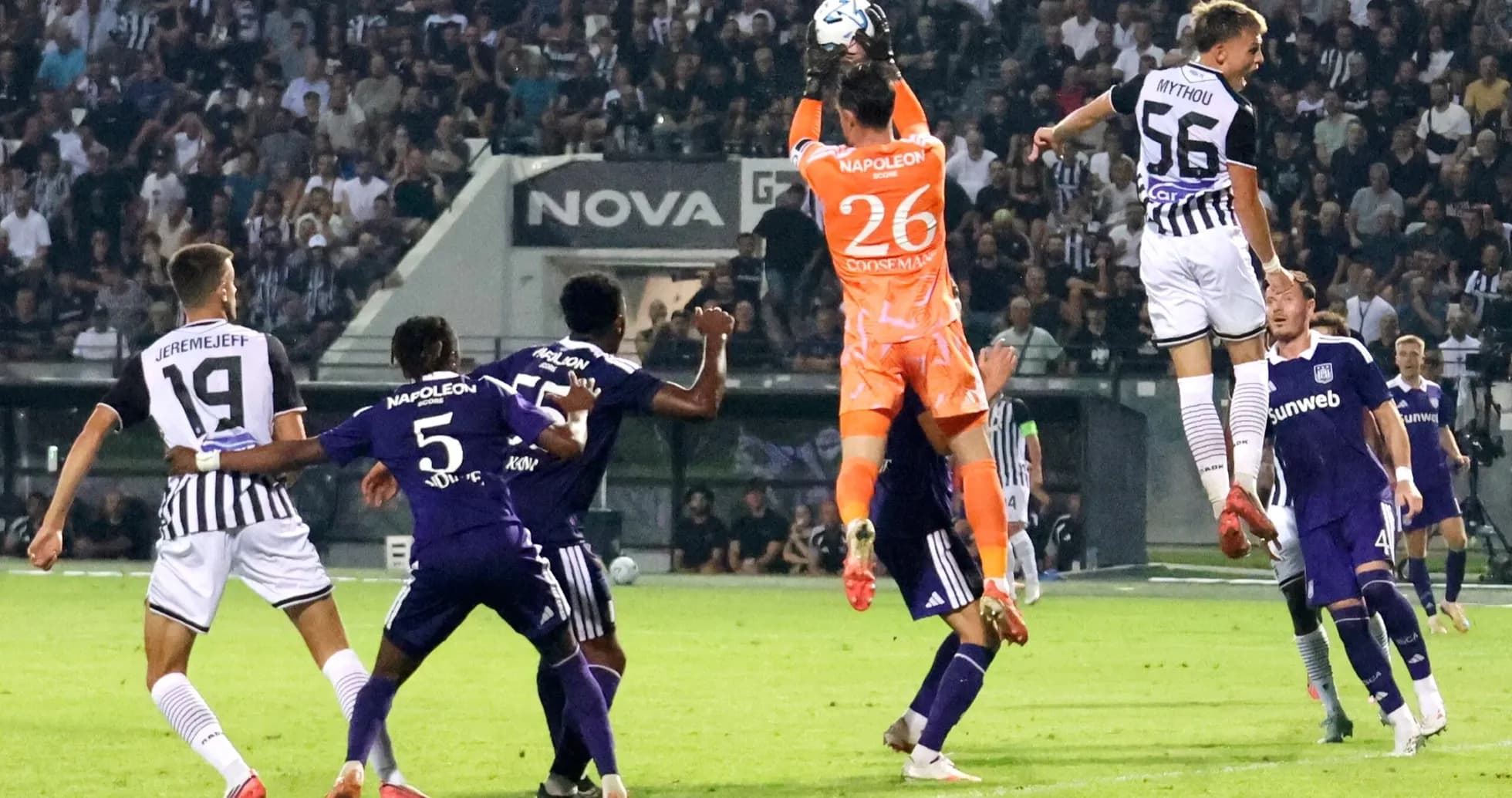
Anderlecht vs PAOK: Tactical Analysis of UEFA Europa League Qualifying
At Lotto Park in Anderlecht, this second leg of the UEFA Europa League 3rd Qualifying Round carries heavy seasonal weight: Anderlecht return home needing to protect and potentially build on their narrow aggregate advantage over PAOK to reach the play-off round, a key gateway to the main Europa League phase and the financial and sporting platform that comes with it.
Head-to-Head Tactical Summary
The only recent meeting in the data is the first leg in Thessaloniki on 6 August 2026 at Toumba Stadium, where PAOK hosted Anderlecht in the same Europa League 3rd Qualifying Round. Anderlecht won 1–0 away, leading 1–0 at half-time and maintaining that margin to full-time. That match showed Anderlecht’s capacity to manage an away tie with a disciplined defensive structure, while PAOK created too little to overturn the early setback. There are no other listed encounters, so the tactical picture is built entirely on that single, tightly contested game.
Global Season Picture
- League Phase Performance: There is no standings data available for either side in this Europa League campaign, so current goals for, goals against, points, and rank within the competition’s broader field cannot be precisely quantified from group or league-style tables.
- Season Metrics: In the league phase so far, Anderlecht have played 3 Europa League matches, winning 2 and drawing 1, and remain unbeaten. They have scored 5 goals and conceded 2, averaging 1.7 goals scored and 0.7 conceded per match, indicating a positive goal balance and relatively controlled defending. PAOK have also played 3 matches, with 2 wins and 1 loss, scoring 5 and conceding 3, for the same 1.7 goals scored per match but a slightly higher 1.0 goals conceded. Disciplinary profiles differ: Anderlecht have accumulated multiple yellow cards spread across all phases of the game and have already seen a red card late in a match, suggesting an aggressive or high-intensity defensive approach that risks suspensions. PAOK’s yellow cards cluster particularly around the end of each half, but they have not yet received a red card. Both sides have shown tactical flexibility in shape: Anderlecht have alternated between 4-4-2 (twice) and 4-3-3 (once), while PAOK have consistently used a 4-2-3-1 in all three matches, reflecting a stable structure built around double pivot protection and a line of three attackers behind a striker.
- Form Trajectory: Anderlecht’s form string of DWW shows a clear upward trajectory: they began with a draw and followed it with back-to-back wins, including the first leg in Thessaloniki. That pattern points to a team growing into the competition, tightening both performance and results. PAOK’s WWL sequence indicates they opened strongly with two wins but arrive in Brussels on the back of a defeat, precisely the home loss to Anderlecht. Momentum, therefore, is marginally with Anderlecht, while PAOK must show resilience in response to their first setback.
Tactical Efficiency
Across all phases of this Europa League campaign so far, the numbers point to a finely balanced tie in terms of attacking output, with both sides averaging 1.7 goals per match. Anderlecht’s defensive efficiency is marginally superior, conceding 0.7 per game versus PAOK’s 1.0, and that has translated into an unbeaten run and an away clean sheet in the first leg.
Anderlecht’s use of both 4-4-2 and 4-3-3 suggests they can toggle between a more direct, two-striker approach and a possession-oriented front three, depending on game state. Their ability to score in every match so far, without failing to find the net once, underlines a reliable attacking baseline. However, their card profile, including one red card, hints that their defensive aggression can become a liability if the second leg becomes stretched or emotionally charged.
PAOK’s consistent 4-2-3-1 structure offers stability and clear roles, with a double pivot shielding a back four and supporting transitions into attack. They have shown they can both control games (a 2–0 home win) and engage in higher-scoring contests (a 3–2 away win), but the 0–1 home defeat to Anderlecht exposed a vulnerability when chasing a game against a compact opponent. Their single clean sheet and one match without scoring underline a slightly more volatile performance profile: capable of strong attacking spells but not as defensively watertight as Anderlecht to this point.
Overall, Anderlecht appear marginally more efficient defensively and tactically adaptable, while PAOK’s efficiency lies in a stable attacking framework that needs sharper execution and risk management if they are to overturn the aggregate deficit away from home.
The Verdict: Seasonal Impact
This second leg is season-defining for both clubs. For Anderlecht, converting their first-leg advantage at home into progression would reinforce a positive early-season curve: unbeaten form, improving results, and a defensive platform strong enough to navigate European qualifiers. Advancing to the Europa League play-off round would keep alive the prospect of group-stage football, with all the financial, coefficient, and recruitment benefits that entails, and would validate their tactical flexibility and high-intensity approach despite the disciplinary risk.
For PAOK, failure to overturn the 0–1 deficit would abruptly cap a campaign that began with two wins and the promise of a deeper European run. Elimination here would shift the season’s focus back onto domestic objectives, but it would represent a missed opportunity to consolidate the club’s European profile and revenue stream. Conversely, if they manage to engineer an away comeback, it would reset their trajectory: the early defeat would be reframed as a wake-up call, and their stable 4-2-3-1 structure would be seen as robust enough to deliver under pressure away from home.
In strategic terms, this tie is less about title races or relegation and more about access to the Europa League’s main stage. Progression will shape budgets, squad retention, and competitive perception for the rest of 2026. Anderlecht are currently better positioned, but the margin is slim enough that the second leg’s tactical execution will heavily influence the narrative of both clubs’ seasons.