Anderlecht Dominates Kairat Almaty in Tactical Showdown
Kairat Almaty’s 4-4-1-1 at Central Stadium was structurally conservative but quickly came under stress against Anderlecht’s more assertive 4-3-3. With Anderlecht enjoying 67% possession, the game was largely played on Kairat’s terms defensively, yet the home side never managed to turn their compact block into a credible counter-attacking threat.
Out of possession, Kairat formed a narrow 4-4-1-1, with Edmilson as the highest reference and M. Gual dropping off the front line to screen Anderlecht’s first pass into midfield. The wide midfielders, O. Jukkola on one side and G. Mendonsa on the other, tucked in to protect the half-spaces, leaving full-backs E. Tapalov and L. Mata responsible for wide containment. The plan was to funnel play into central congestion, then spring forward through early balls into the forwards. However, with only 33% of the ball and just 2 shots on goal plus 2 shots off goal, Kairat’s transitions were sporadic and poorly supported.
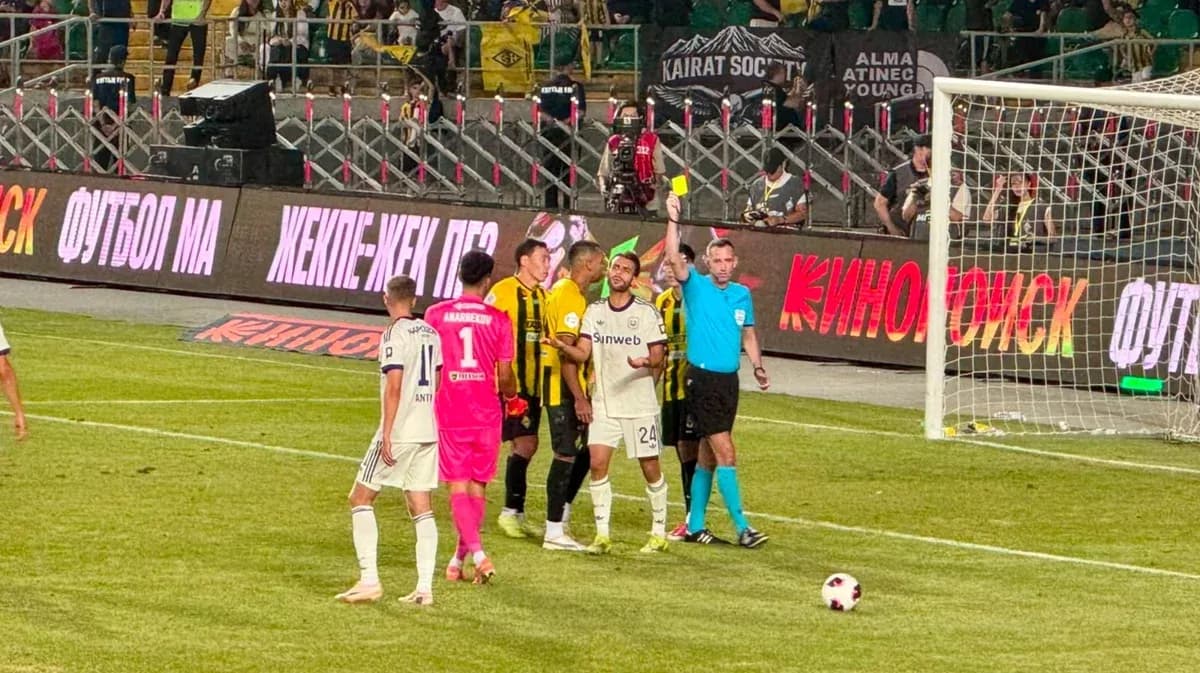
The early own goal from J. Oksanen shattered the intended game state. Trailing inside three minutes, Kairat were forced to defend deeper while still lacking the pressing height to disrupt Anderlecht’s first phase. The back four, anchored by Lucas Africo and Aleksandr Shirobokov, became increasingly reactive. Shirobokov’s red card on 39 minutes was a turning point: Kairat’s already stretched defensive structure had to be hastily reorganised, with the remaining defenders sliding across and the midfield line dropping even closer to T. Anarbekov’s penalty area.
With ten men and no ability to sustain possession, Kairat’s 4-4-1-1 morphed into something closer to a 4-4-0-1 out of possession, with Edmilson often isolated against three Anderlecht centre-backs and the holding midfielder. The lack of progressive passing options is reflected in the absence of passing metrics and the low shot volume; Kairat simply could not connect enough passes to move up the pitch consistently. Their 2 corner kicks and 1 offside underline how rarely they managed to pin Anderlecht back or threaten in behind.
Anderlecht, by contrast, used their 4-3-3 to dominate territory and rhythm. The back four of L. Augustinsson, G. Biancone, L. Petrot and A. Maamar had time to circulate possession, with M. Kana and E. Llansana stepping into midfield to create overloads. In the attacking third, the front line of M. Cvetkovic, D. Sikan and J. Nga Kana stretched Kairat horizontally, opening central lanes for L. Ambros to advance from midfield. The visitors’ 4 shots on goal and 5 blocked shots indicate a steady stream of attacking actions around the box, forcing Kairat into emergency defending.
The own goal that opened the scoring came from sustained Anderlecht pressure, with Kairat unable to clear their lines under a high press. Once ahead, Anderlecht kept the ball patiently, using their 67% possession to move Kairat’s block side to side. L. Ambros’s goal on 24 minutes was emblematic of that control: a midfield runner exploiting the space between Kairat’s lines as the home side’s 4-4-1-1 struggled to track late arrivals.
D. Sikan’s strike on 45 minutes, assisted by L. Ambros, underlined Anderlecht’s superiority in combining centrally and then finishing moves clinically. Even though the total shot numbers are not fully specified, the qualitative pattern is clear: Anderlecht consistently created better field positions, with Kairat forced into last-ditch blocks (1 blocked shot for Kairat against 5 for Anderlecht shows how often the visitors were able to test the defensive line).
Discipline further shaped the tactical picture. Kairat finished with 1 yellow card and 1 red card, the latter depriving them of Shirobokov’s presence in central defence and forcing a deeper, more passive stance. Anderlecht accumulated 4 yellow cards, a reflection of their aggressive counter-press and willingness to break up the few Kairat transitions at source. Yet those cautions never destabilised their structure; with a deep bench, Vitor Bruno could rotate his midfield and full-backs to maintain intensity.
Substitutions from Rafael Urazbakhtin were largely reactive, aimed at shoring up the defensive block and injecting energy rather than changing the game’s geometry. Without any significant uptick in shots or possession following the changes, Kairat remained pinned back and unable to meaningfully challenge Anderlecht’s control.
In statistical terms, the 0-3 scoreline aligns with the tactical balance. Anderlecht’s superiority in possession (67% to 33%), corners (8 to 2) and blocked shots (5 to 1) points to territorial dominance and sustained pressure. Kairat’s 2 shots on goal and 2 off target over 90 minutes, combined with their numerical disadvantage from the 39th minute, meant they rarely looked capable of mounting a comeback once the deficit grew.
While goalkeeper saves and advanced metrics such as xG and goals prevented are not specified, the available data already paints a clear picture: Anderlecht imposed their 4-3-3 structure, controlled the ball, and repeatedly forced Kairat into low-value, rushed clearances. Kairat’s 4-4-1-1, designed for compactness and counters, never translated into offensive volume, especially after the red card. The match ultimately became a controlled away performance in which Anderlecht’s tactical discipline and ball circulation were rewarded, and Kairat’s defensive game plan collapsed under early scoreboard pressure and numerical inferiority.