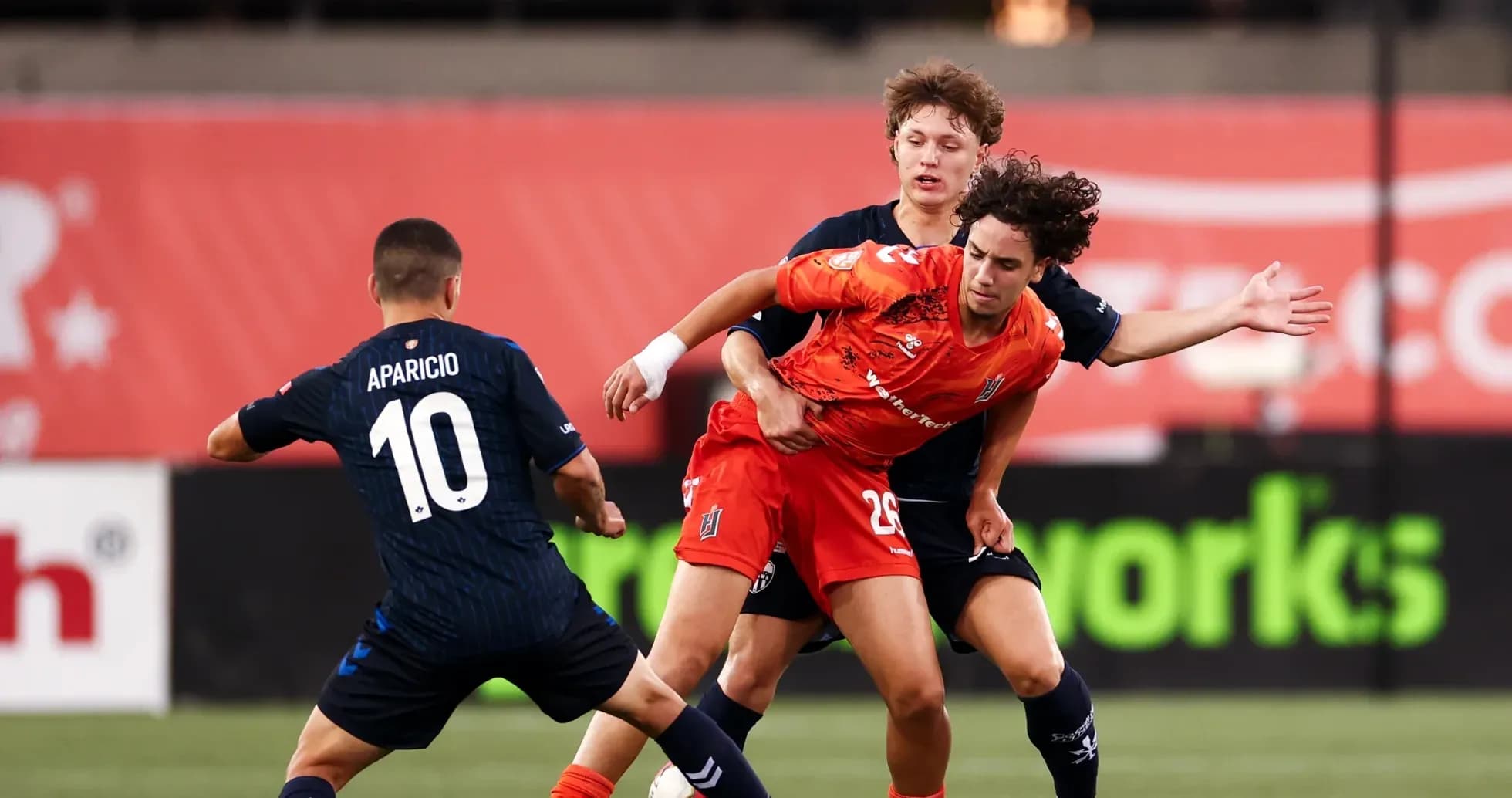
York United's Resilient 3-1 Victory Over Vancouver FC
Under the lights at York Lions Stadium, this Group Stage meeting in the Canadian Premier League felt like a clash of identities as much as a clash of league positions. York United, 6th in the table with 23 points and a goal difference of -13, came in as a chaotic, high-variance side: prolific at home, porous everywhere. Vancouver FC, 4th with 30 points and a goal difference of 2, arrived as a more balanced outfit, especially strong on their own turf but vulnerable on their travels.
Over 90 minutes, York’s 3-4-3 finally bent the story their way, turning a 1-0 half-time lead into a 3-1 full-time statement against a Vancouver side set up in a 4-2-3-1 that never fully solved the hosts’ attacking waves.
I. The Big Picture – Contrasting seasonal DNA
Heading into this game, York’s season numbers painted a wild picture. Overall they had scored 29 and conceded 42 in 20 matches; the goal difference of -13 underlined a team that lived on the edge. At home, though, they were a different animal: 21 goals scored and 23 conceded across 10 matches, averaging 2.1 goals for and 2.3 against. York at York Lions Stadium is almost a guarantee of drama.
Vancouver’s profile was tidier. Across 22 matches they had 30 goals for and 28 against, giving them that slender positive goal difference of 2. Their attack was steady rather than explosive: 1.5 goals per game at home and 1.2 on their travels, with an overall average of 1.4. Defensively, they were significantly tighter than York, conceding just 1.3 goals per match overall and 1.0 at home. Away, however, cracks appeared: 17 conceded in 11 away games, an average of 1.5 per match, with a record of 3 wins, 1 draw and 7 defeats on their travels.
In that context, a trip to a York side that thrives in chaos always looked like a stress test for Vancouver’s away resilience. The final 3-1 scoreline underlined just how unforgiving that test was.
II. Tactical Voids and Discipline – Who shaped the contest
With no listed absentees in the data, both coaches leaned into their preferred structures.
Martin Eustáquio doubled down on York’s most-used shape this season, the 3-4-3 that has started 6 of their league fixtures. Campos Ralston Kai Antonio anchored the back line from goal, shielded by a trio of defenders: L. Singh, F. Sturing and O. León. In front of them, a four-man band of C. Guzmán, S. Yeates, O. Bassett and K. Kibato gave York both ball progression and bite. The front three of L. Accettola, T. Skublak and J. Almagro offered width, pressing angles and direct threat.
On the opposite bench, M. Nash stayed loyal to Vancouver’s most trusted template, the 4-2-3-1 (used 7 times this season). C. Irving started in goal behind a back four of M. Doner, M. Campagna, Thomas Geoffrey Field and K. Proctor. The double pivot of D. Pecile and M. Polisi sat beneath an attacking trio of T. Bah, N. Mezquida and M. Amissi, all feeding central striker L. Mousset.
Discipline was always likely to matter. York’s season-long yellow-card distribution shows a clear spike between 61-75 minutes, where 23.73% of their bookings arrive, and another heavy band from 46-60 minutes at 18.64%. Vancouver’s own yellow-card profile peaks in the closing stages: 25.00% of their cautions come between 76-90 minutes, with another 19.44% from 46-60. This is a match-up primed for second-half tension, with both sides historically more combustible after the break.
York’s red-card history this season is concentrated: their only sending-off in league play has arrived in the 61-75 minute window, a reminder that their aggression can easily spill over. S. Gonzales, on the bench here, embodies that risk with 1 red card in just 12 appearances. Meanwhile, Vancouver have yet to see red in league action, reflecting a more controlled approach even as they commit to duels.
III. Key Matchups – Hunter vs Shield, and the Engine Room
The headline duel was always going to involve T. Skublak. York’s number 77 came into this fixture as one of the league’s most impactful forwards: 5 goals and 2 assists in 18 appearances, supported by 20 shots (12 on target) and a 7.23 average rating. He is not just a finisher but a reference point, winning 49 of his 97 duels, drawing 10 fouls and blocking 1 shot defensively.
Up against Vancouver’s away defence – 17 goals conceded in 11 away games – Skublak’s presence was the classic “Hunter vs Shield” confrontation. Vancouver’s back line, especially central pairing M. Campagna and Thomas Geoffrey Field, had to manage his physicality and movement while dealing with the wide threats of Accettola and Almagro. York’s season-long scoring surge between 46-60 minutes, where 36.00% of their goals arrive, intersected dangerously with Vancouver’s tendency to pick up more yellows in that same early second-half window. That is precisely the kind of zone where Skublak thrives: a game stretched, defenders on bookings, spaces opening.
Behind him, York’s creative spine added further layers. S. Yeates, with 1 goal, 2 assists and 10 key passes across 18 appearances, is a high-volume passer (420 completed at 87% accuracy) and a disruptive presser with 19 tackles and 2 blocked shots. His duel with Vancouver’s screening midfielder M. Polisi – who has 415 passes at 85% accuracy and 16 tackles – framed the “Engine Room” battle. If Yeates could drag Polisi into wider areas or force him into more defensive work, York’s forwards would find more room between the lines.
For Vancouver, the attacking burden was shared between L. Mousset and wide threat T. Bah. Mousset’s 3 goals and 1 assist in 16 appearances, plus his 26 duels won from 51, make him a classic penalty-box focal point. Bah, though, is the chaos generator: 3 goals, 1 assist, 21 tackles, 1 blocked shot and 119 duels contested, winning 63. He also sits high in the yellow-card charts with 5 bookings, a sign of his relentless edge. His ability to win fouls (26 drawn) and penalties (1 won) was designed to test a York defence that concedes 2.1 goals per game overall and is especially vulnerable late: 21.74% of their goals conceded come between 76-90 minutes, and 23.91% between 61-75.
That timing intersection was crucial. Vancouver’s late surge in yellow cards (25.00% in the 76-90 window) aligned with York’s habit of conceding late, setting up a scenario where Bah’s direct running could either win decisive set-pieces or draw bookings that destabilised York’s back three. Instead, York’s structure held together long enough to protect their advantage.
IV. Statistical Prognosis and Tactical Verdict
From a statistical lens, this fixture always leaned towards goals. York’s home matches average 4.4 total goals (2.1 scored, 2.3 conceded), while Vancouver’s away games average 2.7 (1.2 scored, 1.5 conceded). York’s attack is front-loaded into that 46-60 minute band, while their defence collapses most often between 61-90. Vancouver’s discipline curve – more yellows as the game wears on – suggested a second half of stretched spaces and risky challenges.
Vancouver’s penalty record, 2 taken and 2 scored with no misses, underlined their threat if they could draw contact in the box, particularly through Bah or Mousset. York, by contrast, had not taken a penalty in league play heading into this game. The margins, then, were always likely to be decided in open play and in how each side managed transitional moments.
York’s choice of the 3-4-3, a shape they have used more than any other this season, proved decisive. It allowed them to overload wide areas against Vancouver’s full-backs, pinning M. Doner and K. Proctor deep and reducing the attacking support they could offer. With Guzmán and Kibato working as industrious shuttlers and Yeates and Bassett knitting play, York were able to sustain pressure rather than rely solely on counter-attacks.
For Vancouver, the 4-2-3-1 offered theoretical control through Pecile and Polisi, but in practice they were often outnumbered in midfield as York’s wing-backs and forwards collapsed inwards. The visitors’ away fragility resurfaced: they could not keep York’s attack down in a stadium where the hosts had already scored 21 times in 10 home games before this match.
The 3-1 final score fits neatly within the statistical contours. York leaned into their high-scoring home identity, their top scorer and creative unit imposing themselves on a Vancouver defence that has struggled on its travels all season. Vancouver’s own attacking talents – Bah, Mousset, and the creative trio behind – found moments, but not enough to overcome a York side that finally balanced their familiar chaos with just enough control.
Following this result, York’s season narrative tilts slightly from reckless to resilient. For Vancouver, it is another reminder that if they want to turn a promising points total and positive goal difference into something more, their away “shield” must harden – especially in places like York Lions Stadium, where the game is always played on a knife-edge.