World Cup Last 16: England's Challenge and Surprising Upsets
Six days, 16 matches, and half the World Cup field is gone. The bracket has hardened, the noise has narrowed – and the first knockout round has already torn up a few carefully plotted paths.
The biggest tremor came from Germany. A side given roughly a 63% chance of progressing are out, beaten on penalties by Paraguay in the round’s standout upset. A heavyweight removed in a shoot-out lottery, and with them a chunk of the tournament’s expected shape.
Senegal almost produced a shock of similar size. They led Belgium and stood on the brink of a result that would have mirrored Paraguay’s in statistical scale, only to let it slip. The margins at this level are thin; the numbers simply put that cruelty into sharper focus.
Morocco’s win over the Netherlands felt like a surprise on the night, but the data paints it differently. Elo ratings had the Dutch at about 55% to go through – hardly overwhelming favourites, more a slight lean. It was one of the most balanced ties of the round, and it played out like it.
Then came the mismatches that refused to behave.
Cape Verde, given just a 10% chance of progressing, dragged holders Argentina into extra time and had them sweating. Congo, rated at 17% to advance, led England with a quarter of an hour to go. The supposed undercards brought chaos, and for long spells they bent the tournament narrative in their direction.
A familiar last 16 – with a fragile group of outsiders
The dust leaves a last 16 that looks, on the surface, very familiar. Asia has been wiped out. Africa is down to two representatives. Europe and South America once again dominate the knockout landscape.
From outside those traditional power bases, only Canada, Egypt, Mexico, Morocco and the United States remain. Five nations carrying the hopes of the rest of the world, yet between them they account for only about 3.5% of the probability of lifting the trophy. Romance is alive, but the cold maths is unkind.
At the top of the tree, Argentina are still the team to beat, but not quite as imposing as before. They survived Cape Verde after extra time, yet their overall chance of winning the World Cup has dipped slightly to 28%. Part of that slippage reflects what happened elsewhere: Germany’s exit has cleared a lane for France.
France now stand at a 14% shot to win the tournament, Spain at 16%. Both cruised through their last-16 ties – Spain easing past Austria, France brushing aside Sweden – and each is one step closer to the final without having been stretched.
England sit just behind them, up to 12%. That rise says as much about the shrinking field as it does about their own form, but the numbers are clear: they are in the cluster of serious contenders. The problem is the road ahead. Brazil and Argentina still loom on their side of the draw if they handle their own business.
First, though, comes Mexico in Mexico City.
England and the altitude question in Mexico City
On paper, England should have too much. The model that underpins these probabilities gives them expected goals of 1.6 to Mexico’s 0.6. That gap translates into a 62% chance of England winning in normal time, 13% for Mexico, and a 25% chance of a draw that would take the tie to penalties.
The complicating factor is the setting. Altitude in Mexico City has become the talking point, as it always does when a major tournament drifts into thinner air. Speculation has swirled for decades about whether playing high above sea level hands a decisive edge to the home side.
This time, there is hard evidence to interrogate the myth.
Thousands of international matches played at different altitudes sit behind the analysis. When those games are grouped in 500-metre bands, the headline picture is surprising. At or near sea level – within 250 metres either side – home teams win about 55% of the time. That band alone accounts for roughly a third of all internationals.
Between 250 and 750 metres above sea level, a zone that covers about 6% of matches, the home win rate barely shifts. Even in the 2000–2250 metre bracket, where Mexico City lies, the home side has historically won 52% of matches – slightly less than at sea level.
Raw win percentages, though, don’t tell the full story. Team strength matters, and it matters a lot.
The core of this work is an Economic Observatory Elo rating system, closely aligned with FIFA’s rankings and proven to predict international results well. Those ratings can be read as a probability: 1 if the home win is certain, 0 if the away win is nailed on, and everything in between for the rest.
By coding each match outcome as 1 for a home win and 0 otherwise, then subtracting the Elo prediction and taking the average, you get a measure of how much the home team over- or under-performs expectation. Put simply: do they win more often than they “should”?
The teams who regularly play at altitude tend not to be global heavyweights. Bolivia operate above 3000 metres. Ecuador, Ethiopia and Mexico play their home games above 2000 metres. Their Elo ratings are usually lower than those of the giants they host.
Once that is accounted for, the picture changes. Below about 1750 metres, home sides win about as often as the Elo model expects. Above that threshold, they start to outperform. The higher the altitude, the more the home team edges beyond expectation.
Even so, the effect is not enormous. At the highest altitudes, the over-performance gap sits at around 20 percentage points – a figure that still lies within the margin of error. There is a hint of advantage, not a guarantee of dominance.
For England in Mexico City, that nuance matters. The data does not point to a massive, insurmountable edge for the hosts. It does, however, leave room for Mexico to squeeze something from the conditions, especially with England having little time to adapt.
If we assume altitude trims England’s expected goals by 0.25 and boosts Mexico’s by the same amount, the balance shifts. England’s win probability drops from 62% to 48%. Mexico’s rises to 24%. The rest sits with the draw and the penalty lottery.
Even with that adjustment, England remain the stronger side by every major measure – both on past results and on squad value indicators such as Transfermarkt. Altitude drags the sides a little closer together. It does not turn this into a coin flip.
The rest of the last 16: favourites, traps and one awkward tie for France
Beyond Mexico City, the model throws out a clear set of expectations for the remaining last-16 ties.
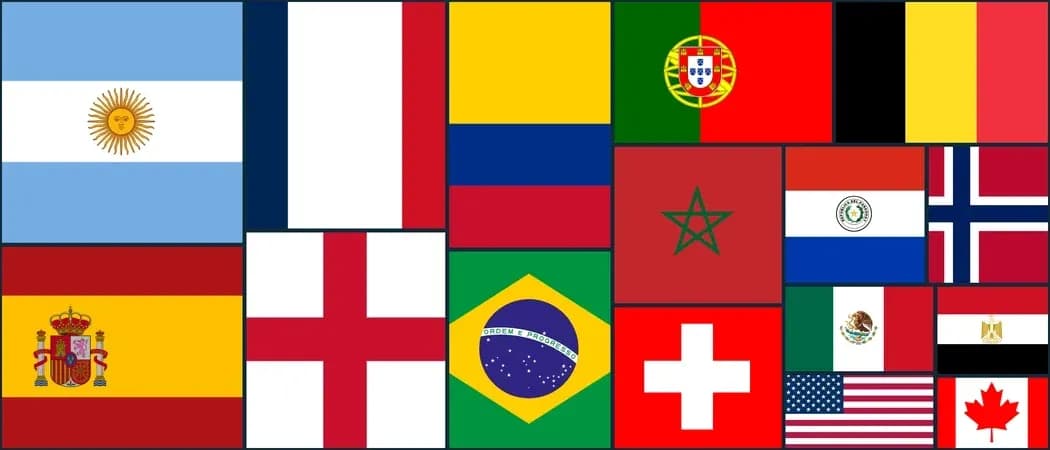
Argentina are 77% likely to progress against Egypt. England, factoring in their broader simulations, are rated at 74% to beat Mexico. Morocco are 70% favourites over Canada. Spain are given a 72% chance of knocking out Portugal in a heavyweight Iberian clash.
Colombia are 70% likely to go through against Switzerland. Brazil are 69% favourites over Norway. Belgium hold a 64% edge against the United States. France, fresh from swatting aside Sweden, are 62% likely to beat Paraguay.
That last number catches the eye.
France have been free-scoring and fluent. Paraguay have not. Yet the South Americans, flagged in the Group D preview as defensively resolute, have lived up to that billing since their opening game against the United States. They shut down space, they frustrate, they drag games into the kind of grind that blunts attacking sides.
The expected goals tell that story. France are projected at just 1.1 xG in this tie, Paraguay at 0.6. It is still advantage France, but by a thinner margin than their reputation might suggest. On this model, this is likely to be France’s sternest examination so far, and it comes at a stage where one misstep ends everything.
The bracket has lost Germany and a few illusions. The probabilities still lean towards the giants – Argentina, Spain, France, Brazil, England – but the first knockout round has already shown how fragile those numbers can be over 90 minutes and a set of penalties.
Now the tournament climbs into the heights of Mexico City and into the pressure of the last 16. England’s legs will feel the altitude. The favourites will feel the weight. Which will give first?