World Cup Tension Rises: England Faces Panama, Scotland Takes on Brazil
The World Cup has hit that awkward third step. Legs are heavier, nerves a little tighter, and the margins suddenly feel razor thin.
England discovered that in Boston.
England’s “second game fever” returns
A flat, goalless draw with Ghana has left Thomas Tuchel’s side short of the statement win they wanted and short of the certainty they expected. Qualification for the last 32 is almost there, but not quite. A point that felt like a shrug.
Jude Bellingham, again England’s standout, refused to panic. He called it “second game fever” – a familiar malaise. This was England’s fourth straight draw in a second group match at a major tournament, stretching back to Euro 2020. The pattern is becoming a habit.
His message was blunt: roll with it, learn from it, move on. Panama on Saturday now becomes less of a procession and more of a reset.
Harry Kane, who dragged a late chance over the bar from seven yards, cut a calm figure in the aftermath. He will not torture himself over one miss. A striker’s life, he said, is built on accepting that sometimes the ball simply refuses to go in. He trusts the next one will.
He also pushed back at the familiar accusation that England lean too heavily on him. Any No 9 at a big nation, he argued, carries that expectation. When he scores, it’s normal. When he doesn’t, the questions come. “It is what it is,” as he put it.
Eberechi Eze echoed that defiance. The Palace midfielder insisted the draw “changes nothing” about England’s mindset in Group L. The team, he said, remains confident, determined not to ride the emotional rollercoaster of a long tournament. Kane may be the “go-to” in attack, but Eze pointed to the depth of creativity around him. The goals, he believes, will be shared.
Controversy, complaints and a looming ban
The stalemate with Ghana has not passed quietly off the pitch.
In Spain, reports claim Paraguay have lodged a formal complaint with FIFA after Bellingham escaped punishment for covering his mouth while speaking to Jordan Ayew. Miguel Almiron, by contrast, became the first player sent off at this World Cup for the same gesture during Paraguay’s fiery win over Turkiye.
The Paraguayan FA argue the new regulation – allowing a red card for hiding the mouth in confrontational exchanges – is being applied inconsistently. FIFA will now have to stare down its own rulebook.
FIFA’s stance in Boston was that Bellingham’s exchange with Ayew was friendly, not hostile, and therefore not subject to sanction. That explanation will do little to cool the sense of grievance in Asunción.
On the pitch, another issue is brewing for England. Declan Rice’s yellow card against Ghana – their first of the tournament – leaves him one booking away from suspension. Under World Cup rules, two yellows before the end of the group stage bring an automatic one-game ban. If Rice is cautioned against Panama, he will miss the last-32 tie.
Rice limped off late in Boston and left the stadium with his leg strapped. The early word is that there is no long-term concern, but he and Reece James will be assessed before the weekend. Both could be rested, with England mindful of the bigger battles to come.
Calm in the stands, storms in the rulebook
If England’s performance underwhelmed, their supporters did not. Around 30,000 England fans filled the Boston Stadium, and UK football policing chiefs reported not a single arrest or major incident involving British nationals.
Chief Constable Mark Roberts hailed their behaviour as “excellent” and local police called it “exemplary”. The mood mirrored the scenes in Dallas earlier in the tournament – noisy, colourful, but controlled.
As the group stage edges towards its conclusion, FIFA faces a different kind of anxiety. Severe weather has already forced a lengthy delay in France’s match with Iraq, and the governing body has admitted that further storms could disrupt the carefully choreographed simultaneous kick-offs for final group games.
The rule is clear: the last two fixtures in each group should start at the same time, unless FIFA declares force majeure. The fear is obvious. If one match is pushed back and another goes ahead, the spectre of 1982 – and the “Disgrace of Gijón” – returns. With so many permutations riding on goal difference and late swings, any hint of manipulation would be toxic.
Scotland’s date with Brazil – and history
While England grapple with frustration and fine print, Scotland are staring at something far more visceral: Brazil, Miami, and a shot at the last 16.
Steve Clarke’s side staggered through a laboured win over Haiti, then suffered a gut-punch against Morocco, conceding inside 70 seconds and never recovering in a 1-0 defeat. The performance raised every doubt they thought they had parked.
Now comes Carlo Ancelotti’s Brazil, five-time world champions, beginning to find their rhythm after easing past Haiti. The stakes could hardly be clearer. Beat Brazil and Scotland are through, with a chance of topping Group C if Morocco slip against Haiti. A draw would almost certainly be enough as one of the best third-placed teams.
Even a narrow defeat might keep the dream alive. Lose by a single goal, as they did against Morocco, and three points with a goal difference of -1 could still squeeze them into the round of 32. It would be a nervy wait, but not a hopeless one.
Ancelotti has shown Scotland full respect. He called them “fighters”, praised their organisation and highlighted the experience of Scott McTominay and John McGinn. Easy World Cup games, he said, disappeared a long time ago.
Brazil could also unleash Neymar for the first time at these finals. The forward has recovered from a calf problem and trained well, according to Ancelotti, who insists the 32-year-old is ready for anything from 45 minutes to the full 90. His return adds another layer of menace to a side already bristling with attacking options, though Barcelona’s Raphinha misses out with a hamstring injury.
Scotland’s record against Brazil on the biggest stage is bleak – meetings in 1974, 1982, 1990 and 1998 all ended without a Scottish win. The Tartan Army, though, have not arrived in Miami to recite history.
They have taken over the city’s beaches and bars, kilts and bagpipes turning Miami Beach into a travelling carnival. Local authorities have praised the “unforgettable atmosphere”, mirroring the warm reception Scotland fans enjoyed in Boston earlier in the tournament.
The scheduling adds its own tension. FIFA’s policy since 1982 means Scotland’s clash with Brazil kicks off at the same time as Morocco vs Haiti. No peeking at another scoreline, no calculated risk. Clarke’s men will have to live every second, knowing that a famous upset could even send them through as group winners.
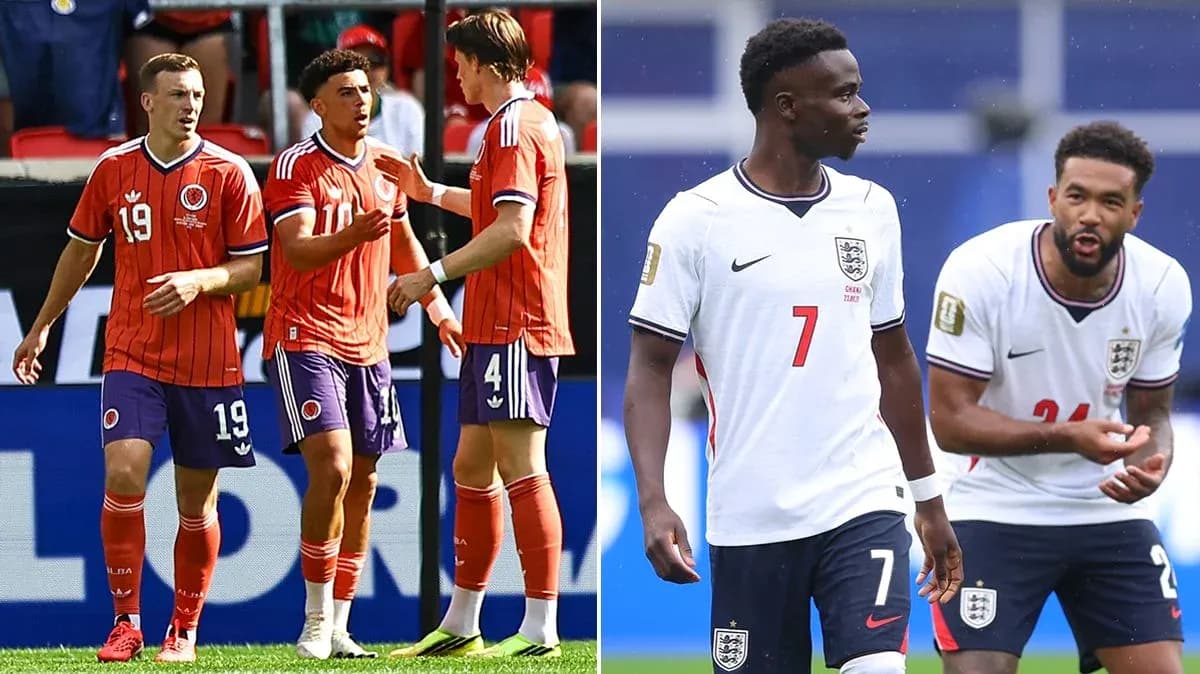
And waiting in the distance, just visible through the haze of permutations, is Mexico City on July 6. As it stands, England sit top of Group L and Scotland third in Group C – a collision course for a last-16 showdown. Results against Panama and Brazil will decide whether that prospect hardens into reality or fades into another “what if” in British World Cup folklore.
Ronaldo roars back, Germany refuse to coast
Away from the British storylines, Cristiano Ronaldo has re-entered the World Cup narrative with characteristic volume. Written off after a poor showing in Portugal’s opener against DR Congo, the 39-year-old struck twice in a ruthless 5-0 demolition of Uzbekistan.
He promptly told the world he was “back”. Bruno Fernandes, who created Ronaldo’s second, admitted the squad felt a sense of relief. Their captain, he said, remains the reference point in attack, and seeing him score in a World Cup again matters – to the dressing room as much as to the headlines.
Portugal now face Colombia in Miami to decide who tops Group K, with Ronaldo once more at the centre of everything.
Germany, already through to the knockouts, refuse to treat their final group game as a formality. Midfielder Nadiem Amiri has promised they will approach the Ecuador clash “like a final”, determined to protect momentum and respect the integrity of the group. No experiments for the sake of it, he insisted. The message is simple: keep winning, keep the belief flowing.
Injuries, selection calls and a witch doctor’s spell
The World Cup always throws up its stranger subplots. This one belongs to Ghanaian “witch doctor” Nana Kwaku Bonsam, who claimed to have cast a spell on Harry Kane before the England–Ghana match, then took credit for the striker’s blank night in Boston.
Now, with Panama looming, he says he has “released” Kane so he can score again. It is theatre, superstition and sideshow all rolled into one – but it speaks to the magnetic pull of the tournament that even the bizarre finds its place.
Elsewhere, the injury ledger continues to shape plans. Brazil lose Raphinha. Argentina will likely be without Cristian Romero until the last 16 as he nurses a muscle issue. Yet Lionel Scaloni has no intention of resting Lionel Messi against Jordan, despite Argentina having already wrapped up Group J. Messi, chasing the Golden Boot with five goals in two games, wants to play at least 45 minutes in Dallas. His manager will oblige.
Sweden, on the other hand, are still dealing with the scars of a 5-1 hammering by the Netherlands. Coach Graham Potter has bristled at criticism of captain Isak Hien, blamed for three of the goals. Potter has nailed his colours to the centre-back’s mast: if he is manager, Hien plays. Responsibility, he insists, lies with him, not the player.
Ticket fury, seismic shocks and a nation on edge
Off the pitch, the cost of following this World Cup has drawn political fire. Former UK prime minister Gordon Brown has condemned what he calls “extortionate” ticket prices, claiming ordinary families are being priced out and calling for a full inquiry once the tournament ends. He highlighted a final ticket said to be 30 to 40 times the price of the Euro final in Germany. For a competition built on global passion, it is a stark accusation.
In the United States, the tournament has already felt the force of nature. A magnitude 5.6 earthquake shook Mendocino County in California, with tremors reaching as far as Sacramento, just a day before USA’s decisive group game against Turkiye in Los Angeles. There is no tsunami warning, but the reminder is clear: not everything at this World Cup can be controlled by schedules and strategy.
Christian Pulisic, at least, offered the simplest update of the week. Asked if he would be fit to face Turkiye after missing the win over Australia, the USA star replied with a single word: “yes”. Mauricio Pochettino’s side are already through, Turkiye already out, but the hosts still want a statement.
And somewhere in the middle of all this noise, England and Scotland prepare for nights that will sharpen or shatter their campaigns.
England must shake off “second game fever”, manage Rice’s tightrope, and trust that Kane’s next big chance finds the net rather than the night sky. Scotland must stare down Neymar, Brazil and decades of history, knowing that even a point could rewrite their place in World Cup lore.
Two nations, one tournament, and a week that will decide whether their paths cross in Mexico City – or separate long before the real drama begins.