
World Cup 2026: Messi, Mbappe, and the Magic of Football
The World Cup has a way of making time feel elastic. One generation fades, another arrives, and every four years football rewrites its own mythology. Yet here in 2026, the story somehow circles back to the same familiar names: Lionel Messi, Cristiano Ronaldo, Kylian Mbappe, Erling Haaland.
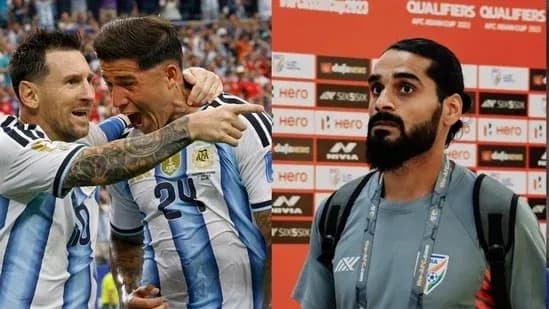
And watching it all, with a defender’s eye and a fan’s heart, is India centre-back Sandesh Jhingan.
The 30-year-old, part of Zee5’s expert panel for the tournament, has been tracking every twist of a World Cup many doubted when FIFA stretched it to 48 teams. Those doubts have taken a beating. Cape Verde, Japan, Egypt, and a string of so-called minnows have ripped up the script, turning the group stages into something far more competitive than many expected.
But one man still towers above the chaos.
Messi at 39: “He makes you feel like a kid”
Messi, at 39, has started this World Cup as if he’s rewinding his own highlight reel. Five goals in two games, hat-tricks, braces, the full catalogue of finishes. The numbers look like a glitch. The performances don’t.
“For an athlete, the hardest thing is consistency,” Jhingan says. “That longevity, to keep performing at such a high level, that’s the greatest talent you can have. What he has done is incredible.”
He talks about Messi not like a pundit dissecting data, but like someone who still gets swept up in the emotion of it. During a Zee show, he saw a 100-year-old fan in the stands.
“When you watch Messi, it gives you that feeling of being a kid,” he says. “That 100-year-old lady must have felt like a 10-year-old watching him play. He gives you that kind of joy.”
The numbers explain part of it. The feeling explains the rest.
The machine behind the magician
Argentina’s title defence has not just been about Messi’s genius. They have yet to concede a goal. Blocks, tackles, bodies thrown in front of everything. It looks like a team that understands exactly what it is.
For Jhingan, the foundation is clear: structure.
“The reason Messi is doing so well is because the team’s shape and compactness are so good,” he explains. “A lot of credit goes to Argentina’s coaching staff. The best coaches adapt around the players they have, not the other way around.”
Argentina have moved through games with a kind of tactical elasticity. Sometimes they drop deep, sometimes they sit in a mid-block, but they never lose their organisation. That discipline serves a simple purpose: win the ball, give it to Messi, let him tilt the game.
“The defenders and midfielders know their job is to win the ball back and get it to Messi because they trust he can create something special,” Jhingan says. That trust, he believes, feeds the entire squad’s confidence.
“Reliant on Messi”? So what, if you’re winning?
Lautaro Martinez’s work against Austria summed up the collective effort. He pressed, tracked back, linked play, ran the channels. Yet the narrative persists: Argentina lean too heavily on Messi; the strikers aren’t scoring enough.
Jhingan shrugs off the concern.
“If I’m an Argentine player or a fan, I wouldn’t mind being called reliant on Messi as long as the team is winning,” he says. “But the reality is they’re not just dependent on him; they’re built on a strong system.”
He circles back to organisation, compactness, and timing. When to sit back. How to hunt the ball together. How to create the perfect stage for Messi and the other attackers to decide games.
“At the end of the day, they’re winning consistently and have already reached the next stage,” he points out. For him, that’s the only verdict that matters. The coaching staff, he insists, deserve huge credit for crafting a system where every player knows his role.
Mbappe and the weight of history
If Messi is the enduring legend, Mbappe is the man sprinting towards the pantheon.
The France forward has turned the World Cup into his personal theatre since 2018. Goals, finals, moments that stick to the memory. At 27 or 28, he’s already forcing his way into conversations usually reserved for Messi and Ronaldo.
“With his goals and his numbers, it’s incredible,” Jhingan says. “What he has achieved is mind-blowing, but he knows he has a long way to go.”
The comparison with Messi and Ronaldo is inevitable. Unfair, perhaps, but unavoidable.
“How do you put him in that bracket?” Jhingan asks. “They are the pillars, the standard. It’s up to him if he can maintain this, because what Messi and Ronaldo did in the past 20-odd years is unbelievable.”
Mbappe, in Jhingan’s eyes, has every tool: pace, finishing, mentality. The challenge now is durability—staying fit, staying hungry. One thing already stands out.
“Whenever the World Cup is there, that guy just brings an extra level,” he says, recalling 2018 and 2022. “That’s the sign of a big player. On the big stage, they get that extra edge in them.”
Lamine Yamal: the nightmare one-on-one
If Mbappe is already established, Lamine Yamal is the fresh chaos defenders now have to solve.
The teenager hasn’t started every game or gone the full 90, but he has left a mark. Every time he receives the ball, he looks straight at his man and drives. No hesitation. No safety-first passes. Just confrontation.
“If you’re in a one-on-one with Lamine, most of the time he’s going to get past you because that’s his biggest quality,” Jhingan admits. “He’s one of those players you pay to watch.”
From a defender’s standpoint, the trap is obvious: trying to turn it into a personal duel.
“You can defend a striker or winger perfectly for 90 minutes, but one shot, one deflection, and the headlines say he won the battle,” he says. The job, as he sees it, is not to win every tackle. It’s to reduce the number of times you’re exposed.
“My job is to keep the team compact, limit the space he receives in, and cut the supply,” he explains. That demands collective work—midfielders pressing, forwards pressing, a high defensive line. Yamal will still get chances. The aim is to make them as rare and as rushed as possible.
Ronaldo, the bench, and the armchair critics
While Messi glides through another World Cup and Mbappe surges on, Ronaldo remains under the harshest spotlight of all.
He has just delivered a clinical performance against Uzbekistan, yet the noise doesn’t stop: Is he too old? Should he be benched? Is he holding his team back?
Jhingan doesn’t tiptoe around it.
“I’m going to give a bold statement,” he says. “All this debate is from the ones who never played professional football, or who never played much of it professionally.”
He isn’t saying fans can’t have opinions. He is saying the only opinion that truly matters belongs to one man.
“At the end of the day, it’s Martinez who decides. He’s the head coach. If he thinks he’s good enough, he will play.”
Ronaldo, like Messi, lives under a microscope. Every blank draws talk of age, decline, ego. Every goal is treated as defiance.
“If you see him at club level, he scored a lot,” Jhingan notes. “I think he was the top scorer in the Saudi league. And he scored many goals in the qualifiers also. But people tend to forget that and just pinpoint.”
The expectation, for Jhingan, is familiar: when the doubts grow loud, Ronaldo usually answers.
Golden Boot race: the giants are circling
The numbers at the top end of the tournament are starting to swell. Messi already has a “very healthy lead” with five goals. Mbappe is looming. Haaland is in the mix. And Ronaldo, Jhingan predicts, is about to join them properly.
“I think it could be between Messi and Mbappe,” he says of the Golden Boot. “It’s still early, two games, but Messi has that lead now.”
He refuses to rule out Haaland. The Norway striker arrived with the expectation of a heavyweight boxer walking into a title fight; the goals were always likely to come.
And Ronaldo?
“I think today Ronaldo will kind of open his account in a big way,” Jhingan says, backing the veteran to do what he has done his entire career: feed off doubt, turn it into fuel, and shut the critics up.
“It’s going to be a tight race,” he adds. “Messi is there, Mbappe is there, Haaland is there. More goals, more fun, more excitement.”
For neutrals, that’s the dream scenario. The sport’s biggest names, all chasing the same prize, all still capable of bending games to their will.
Heart over head: backing Japan’s dream
When the conversation turns to potential champions, Jhingan doesn’t hide his bias.
“I’m going to be biased. I’m going to root for Japan,” he says with a smile you can almost hear. “I hope they make it.”
Japan, like several Asian and African sides, have embraced this expanded World Cup as a stage, not a burden. They press with intensity, attack with courage, and carry a belief that no longer feels naive.
“Of course, Argentina and all are there,” he concedes. The defending champions look ruthless. The European giants are circling. The usual heavyweights remain dangerous.
But Jhingan is clear. He wants an Asian team to rip through the old hierarchy.
“I’ll say Japan,” he repeats. “I want them to go as high as they can.”
In a World Cup where a 39-year-old Messi is still dancing, Mbappe is chasing history, Ronaldo is fighting the clock, and a teenager like Lamine Yamal is terrifying defenders, that wish doesn’t feel out of place at all.
This tournament has already broken the mould. Who says it’s finished yet?



