
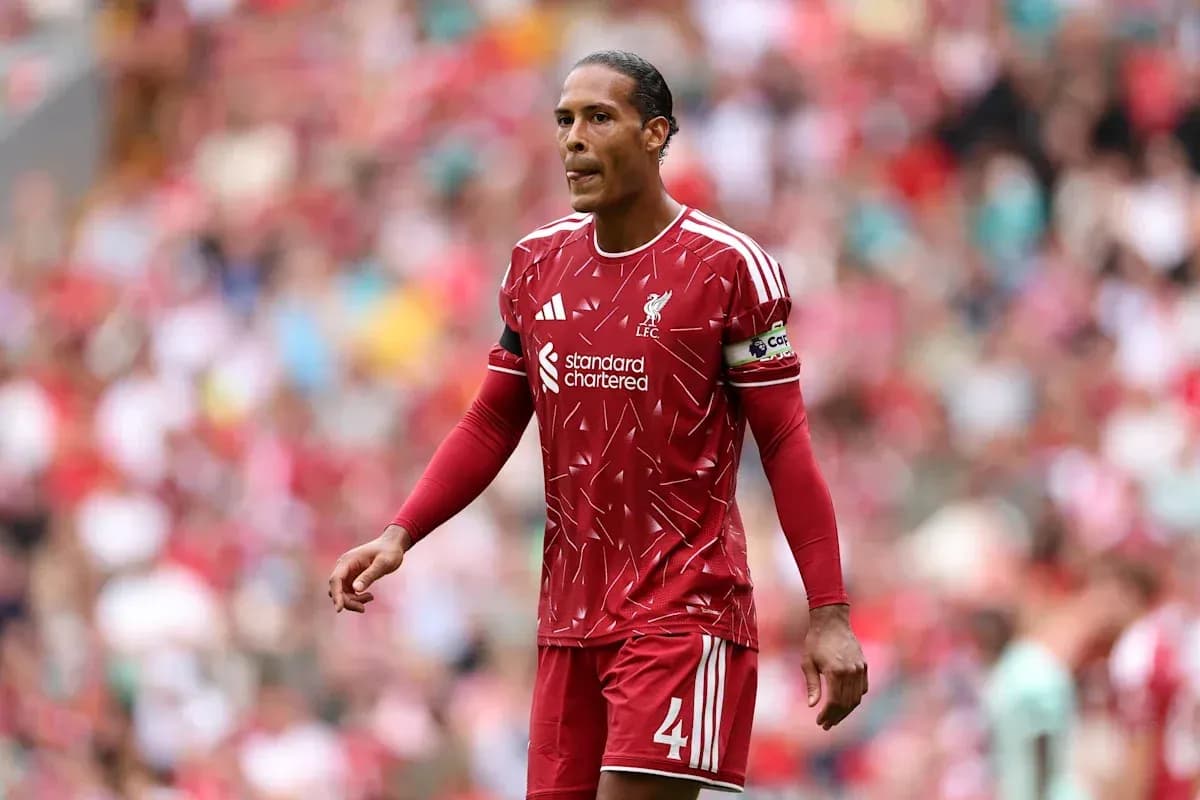
Virgil van Dijk on Liverpool's Transition Season
Virgil van Dijk has lived through enough Liverpool cycles to know what this one is.
Not a reset. Not a farewell tour. A transition – with all the turbulence that word carries on Merseyside.
A New Bench, A New Reality
Two years on from lifting the Premier League title under Arne Slot, Liverpool find themselves under the command of Andoni Iraola and staring at a very different landscape.
Last season’s slump forced change. Slot is gone. The summer has stripped away not just a manager but pillars of the dressing room. Mo Salah, the face of Liverpool’s modern era in attack, has moved on. Andy Robertson, a relentless presence down the left for so long, has departed too.
The dressing room looks different. The training sessions sound different. The expectations? Those remain the same.
“It definitely feels like a bit of a transition, for sure,” van Dijk admitted, acknowledging what everyone around Anfield can sense. The badge still demands trophies, but the route back to the summit is no longer familiar.
For the captain, that shift is not an excuse. It is a responsibility.
“It’s down to everyone associated with Liverpool to make sure that we’re building something that will be successful for the years to come,” he said. The message was clear: this is not a holding pattern. It is a construction site.
Competing on All Fronts
There is no soft landing for a club of Liverpool’s scale. While Iraola shapes his ideas and a remodelled squad finds its rhythm, the fixture list offers no sympathy.
“This year we want to be successful, but there’s a lot of work to be done still,” van Dijk said, fully aware of the demands. The Premier League, League Cup, FA Cup, Champions League – the full gauntlet awaits.
He knows what that schedule does to a squad. It stretches depth, exposes weak links, punishes any lapse in standards. “We all know how difficult it is to be playing in the Premier League, League Cup, FA Cup, Champions League, so we need everyone at their best.”
The pressure will not just be on Iraola’s tactics or the new-look attack. It will fall heavily on the man wearing the armband.
The 35-Year-Old Anchor
At 35, van Dijk stands at the point in a defender’s career where every question contains an implied doubt.
Can he still go every week? Can he still dominate every three days in a league that grows faster and more unforgiving with each season?
He did not wait long to answer.
“Yes. What, are you going to say I’m 35 years old and I can’t do it?” he shot back when asked if he could handle the weekly grind. The defiance matched the body of work. Van Dijk has rebuilt his game and his body before; he is not about to concede to the calendar.
“At the end of the day you have to look after yourself,” he explained. There was no self-congratulation in his tone, just a standard he refuses to drop. “I won’t say I’m lucky, but you have to do everything in your power, and that’s the bare minimum for me, because I feel the responsibility to be ready each and every game.”
Every three days, the routine repeats. Recovery, preparation, detail. “Every three days I’m doing everything in my power at home, at the training ground, to be ready to play a game. So, for me, I feel good.”
He described himself as a “late bloomer,” a reminder that his peak arrived later than most. Perhaps, he hinted, that might yet extend his career at the top. “Maybe… It is what it is, I feel fine, and I want to be part of a successful Liverpool team.”
Wearing the Shirt, Carrying the Weight
Transition seasons can be cruel. They test patience, expose gaps, and tempt a club to compromise on its identity. Van Dijk has no interest in that.
His focus returns, again and again, to what the shirt demands.
“I want to make all the fans proud all over the world that support us wherever we go,” he said. The route to that pride has never changed in his mind. “That’s by winning games, that’s by showing what it means to wear that shirt every time, and that’s for me the bare minimum anyway, so I will keep going.”
New manager. New dressing room hierarchy. New challenges on four fronts.
The transition is real. So is the standard the captain intends to uphold.



