
United States Dominates Australia 2-0 in World Cup Clash
Soccer won. That much felt inevitable on a bright, temperate Friday in the Pacific north-west, in one of the few World Cup fixtures where both nations even agree on what to call the sport.
What nobody could script was how quickly the United States would seize control of a heavyweight Group D contest, or how thoroughly they would silence the idea that Australia were a “layup.” A 2-0 victory, in front of 66,925 fans in a heaving Seattle Stadium, pushed the hosts into the knockout rounds and left them eyeing top spot in the group, pending Turkey v Paraguay later in the day.
A stage dressed for a statement
This was no ordinary group game. For the US and Australia, every World Cup seems to double as a referendum on the sport’s future back home, a battle for attention against codes that have long dominated their sporting landscapes. That weight hung over the afternoon, but it didn’t drag it down. It sharpened it.
Three pockets of yellow-clad Australia supporters clustered at the south end and never stopped singing. They were loud, defiant, and ultimately drowned out. This was a partisan American crowd in one of the sport’s capitals in the United States, and the stagecraft matched the stakes.
A quartet of military helicopters thundered overhead, perfectly timed with the final note of the national anthem. It was a choreographed jolt of spectacle, a surge of patriotic noise that rolled around the stadium and set the tone before a ball had even been kicked.
The main pre-game question, though, hovered over Christian Pulisic. The US star had limped out of the opener at half-time with a calf issue and spent the week training away from the group. Mauricio Pochettino’s confirmation shortly before kick-off that Pulisic was unavailable sent a murmur through the stands and raised a fair tactical question: without their talisman, could the US unlock a disciplined Australian back line?
Early scare, early breakthrough
Australia arrived armed with motivation. A week of dismissive chatter from some US pundits had painted the Socceroos as a formality, a tune-up rather than a test. Inside the American camp, the tone was very different. Players and staff lined up to praise Australia’s quality, almost chanting it, as if reminding themselves not to underestimate a side that had impressed in its own opener.
The warning landed in the very first minute.
Alex Freeman, perhaps too eager, played a loose pass out of the back. Mohamed Touré pounced, driving toward goal. Chris Richards stood his ground, forced Touré wide, and the resulting low shot from a tight angle slipped harmlessly into Matt Freese’s arms. A half-chance, but a clear signal: Australia were not here to make up the numbers.
That was as generous as the US would be for a while. The hosts settled, tightened their passing, and began to probe down both flanks. The patterns were sharp, the intent obvious.
The breakthrough came from the very space where Pulisic might normally operate. Antonee Robinson stepped up from left-back and fizzed a ball into Folarin Balogun, who had drifted wide. Balogun simply burned Jacob Italiano for pace, hit the byline, and drilled a low cross into the six-yard box. Defender Burgess, caught in the wrong place at the wrong time, could only deflect the ball into his own net.
Another early own goal, another early US lead at this World Cup. Paraguay had crumbled under that pressure in the opener. Australia did not.
They steadied almost immediately and nearly hit back two minutes later. Touré again provided the platform, holding the ball with his back to a compact US defence. Mathew Leckie spun into space at the top of the box and tried an audacious outside-of-the-boot effort around Richards. The idea was better than the execution; the shot flew high and wide, but it was a reminder that Australia could still sting.
Bruises, bookings and a second blow
The contest began to look like what both camps had promised: physical, edgy, contested in every pocket of grass.
Nishan Velupillay crunched into Tyler Adams right in front of the US bench, sparking anger in the technical area and a roar from the stands. Jordan Bos collected the first yellow card soon after for a hand to Weston McKennie’s face. Alessandro Circati joined him in the book later, clipping Malik Tillman’s heel as the US midfielder darted toward the box. The free-kick that followed was bravely cleared, but Australia were increasingly living on the edge.
In the 39th minute, the game paused with a thud. Freeman and Paul Okon-Engstler clashed heads in an aerial duel, both players collapsing and needing treatment. The stadium fell into an uneasy hush. After a few tense moments, both men rose and carried on.
Freeman did more than that. He changed the match.
The move began with Tillman, wrestling Velupillay near the byline to keep the ball alive and eventually winning a dangerous free-kick. Robinson rolled the set piece back to the top of the area, where Sergiño Dest met it with a driven shot. Harry Souttar launched himself into the path of the effort, but his block only diverted the ball into chaos.
Freeman reacted first. The defender bundled the rebound over the line from close range. The flag went up, the goal went to review, and for a moment the stadium held its breath. The decision came: onside. Goal.
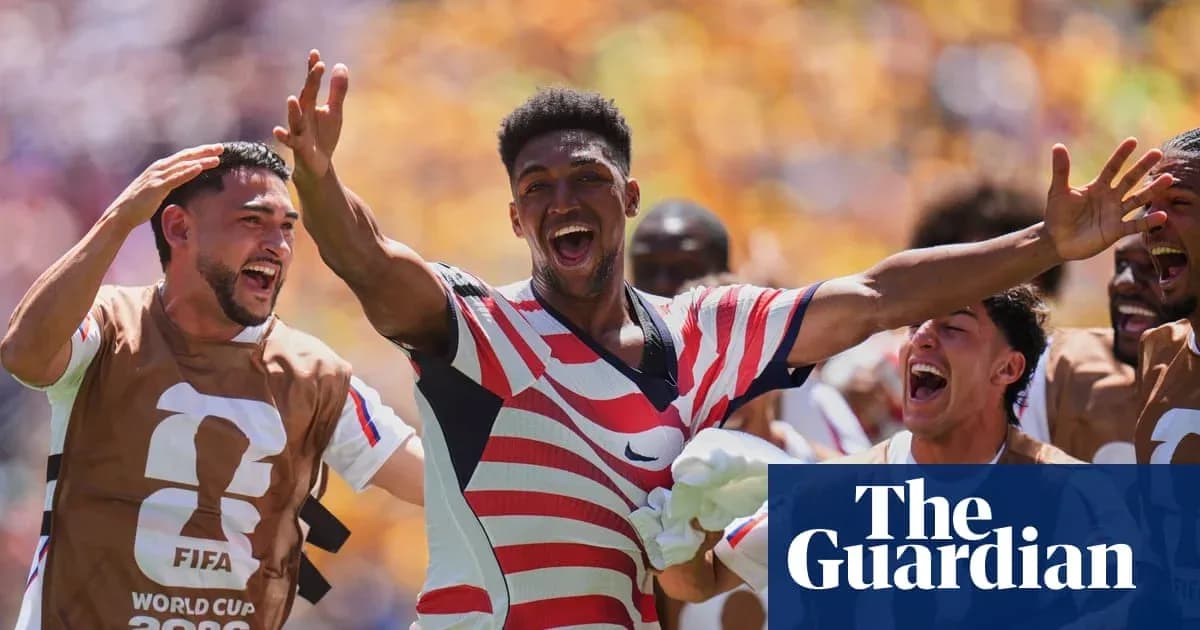
Freeman, by then retreating to his natural centre-back station, ended up celebrating at the opposite end of the pitch from where he had scored, engulfed by teammates streaming from the bench. The US had their cushion. Australia had a mountain.
Popovic rolls the dice
Tony Popovic had seen enough of the first-half pattern. At the break, he tore into his bench.
Jason Geria replaced Burgess. The heroes of Australia’s opening win, Nestory Irankunda and Connor Metcalfe, came on for Touré and Velupillay. The shape shifted into a more aggressive 4-3-3 in possession, snapping back into a five-man line when the US had the ball.
The gamble opened the game up immediately.
Seven minutes after the restart, McKennie picked Australia’s pocket in midfield and slid a perfectly weighted pass into Balogun’s path. With only Souttar chasing, the US forward drove toward goal. The angle narrowed, the pressure grew, and Balogun’s shot was blocked, but the warning was unmistakable: Australia’s bolder approach carried real risk.
It also carried threat. Robinson picked up the United States’ first booking in the 56th minute as he tried to halt a developing move down his flank. Australia were finally finding space in wide areas.
Just past the hour, Popovic added more craft. Cristian Volpato came on for Leckie, and the Sassuolo man nearly made an instant impact. Irankunda tore down the right and cut the ball back into the box. Volpato arrived in stride but leaned back and sent his shot over the bar. Minutes later, Metcalfe found room to shoot, only for Freese to gather comfortably.
Australia were no longer clinging on. They were asking questions.
Hanging on, pushing back
Popovic kept pushing chips forward, sending on Jackson Irvine for Okon-Engstler to add legs and late runs from midfield. Pochettino answered by reinforcing the barricades. Robinson, Dest and Ricardo Pepi made way for Sebastian Berhalter, Auston Trusty and Joe Scally, a clear signal that the US were ready to suffer a little to protect what they had.
The shift in personnel tilted the game’s rhythm. Australia enjoyed more of the ball, slinging crosses in and forcing the US into emergency defending. Circati went close in a scramble, while other half-chances and near-misses flickered just beyond their reach.
The physical tone hardened again. Challenges flew in, tempers frayed, and the crowd roared “USA” as much to lift their players as to vent at every collision. Souttar, Balogun and Italiano all picked up late yellow cards in the tangle of on- and off-the-ball incidents that marked the closing stages.
Even the referee was not spared. Felix Zwayer suffered an odd injury that briefly delayed the final whistle before he was able to continue. It felt briefly as if even the match official might not make it to the end unscathed.
He did. So did the US.
As the clock ticked into added time and the tension threatened to sag, Balogun turned to the stands and windmilled his arms, demanding more noise, more celebration. The crowd responded in kind. For one loud, defiant night, Seattle was exactly what the scoreboard said it was: Soccer City, USA.
The United States now move on with six points, a clean sheet intact, and a statement made without their brightest star. The question for the rest of Group D is simple: if this is what they look like short-handed, what happens when Pulisic is back on the pitch?



