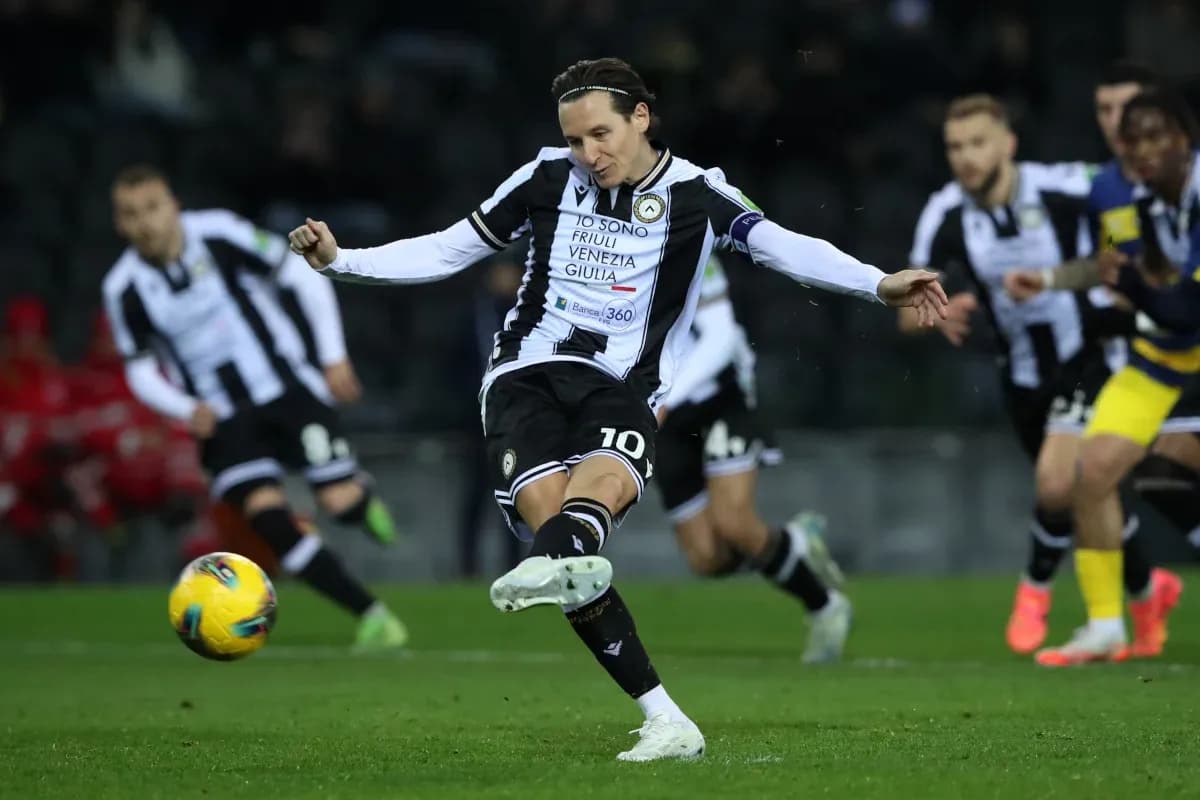
Udinese vs Parma: Tactical Analysis of Serie A Defeat
Udinese’s 1–0 home defeat to Parma at Bluenergy Stadium in Serie A Round 33 was a study in territorial dominance without incision versus compact, opportunistic counter-attacking. The hosts controlled possession (57%), generated more shots (16–10) and corners (10–5), and yet were undone by a single, well-executed transition early in the second half. Parma, set up in a 3-5-2, accepted a lower share of the ball but produced the higher xG (1.23 to Udinese’s 1.13), converting their only shot on target. Udinese’s 3-4-1-2 had structural control but lacked penalty-box presence and vertical threat once chasing the game.
Udinese started in a 3-4-1-2 with Maduka Okoye behind a back three of Oumar Solet (28), Christian Kabasele (27) and Thomas Kristensen (31). The wing-backs, Hassane Kamara (11) on the left and Kingsley Ehizibue (19) on the right, were key to width and crossing volume, supported centrally by Jesper Karlstrom (8) and Jakub Piotrowski (24). Nicolò Zaniolo (10) operated as a free attacking midfielder behind a front pair of Jürgen Ekkelenkamp (32) and Arthur Atta (14). The structure delivered possession and territory but not enough clean looks from central zones: 10 of Udinese’s 16 shots came inside the box, yet only three hit the target, underlining poor shot quality selection and Parma’s box defending.
Parma’s 3-5-2 was built for resilience and rapid counters. Zion Suzuki (31) anchored the back line of Abdoulaye Ndiaye (3), Mariano Troilo (37) and Alessandro Circati (39). The wing-backs Enrico Delprato (15) and Emanuele Valeri (14) stayed relatively conservative in the first half, prioritising line integrity over high pressing. In midfield, Mandela Keita (16) sat as the primary shield, with Adrián Bernabé (10) and Hans Nicolussi Caviglia (41) looking to connect quickly to the front two, Gabriel Strefezza (7) and Mateo Pellegrino (9). Parma accepted Udinese’s circulation but consistently narrowed the central lane, forcing the home side wide and into crosses that their back three could manage.
Tactical Shift
The pivotal tactical shift came immediately after half-time. At 46', Nesta Elphege (23) (IN) came on for Pellegrino (9) (OUT), a like-for-like change on paper but with a different profile: Elphege offered more depth running and aggression in transition. Just five minutes later, Parma’s game plan crystallised. At 51', Elphege finished a normal goal, assisted by Strefezza. The pattern matched Parma’s broader approach: regain in midfield, Strefezza drifting into a half-space to receive, then a direct vertical pass exploiting Udinese’s high line and the spaces outside the wide centre-backs. Elphege’s timing behind Solet and Kabasele punished Udinese’s slightly stretched rest defence, which had been tilted forward to sustain pressure.
Conceding first forced Kosta Runjaic to tilt the structure further towards attack. At 64', Kamara (11) (OUT) made way for Juan Arizala (20) (IN), and Piotrowski (24) (OUT) was replaced by Idrissa Gueye (7) (IN). Functionally, this injected more dynamism and ball-carrying from midfield and the left side, with Arizala pushing higher as an attacking wing option and Gueye adding vertical runs from deeper zones. However, the trade-off was a gradual erosion of Udinese’s central control in rest defence; Parma’s counters remained a latent threat even if they did not translate into further shots on target.
Carlos Cuesta responded proactively to protect the lead and refresh the pressing lines. At 66', Strefezza (7) (OUT) was replaced by Jacob Ondrejka (17) (IN), and Bernabé (10) (OUT) by Christian Ordoñez (24) (IN). Parma thus traded some creativity for work rate and defensive coverage in the half-spaces. Ondrejka offered fresh legs to chase long clearances and press Udinese’s build-up, while Ordoñez helped Keita close central lanes against Zaniolo and Ekkelenkamp.
Discipline-wise, Udinese’s frustration began to surface as they struggled to break Parma’s block. At 70', Zaniolo received a yellow card for a foul, a direct consequence of Parma escaping pressure and Udinese being late into the duel. The caution limited his aggression in counter-pressing and slightly reduced his willingness to commit in 50-50s, which Parma exploited by occasionally playing through his zone.
Midfield Solidification
Cuesta’s next move further solidified the midfield. At 72', Nicolussi Caviglia (41) (OUT) was replaced by Nahuel Estévez (8) (IN), adding defensive intensity and experience to the central trio. Runjaic doubled down on attacking presence at 73': Ekkelenkamp (32) (OUT) was replaced by Adam Buksa (18) (IN), and Ehizibue (19) (OUT) by Oier Zarraga (6) (IN). Buksa gave Udinese a more traditional penalty-box reference, useful against Parma’s deepening block, while Zarraga’s introduction suggested a shift towards a more possession-heavy right side, with less pure width and more interior combinations.
Parma’s back line was refreshed at 75' when Ndiaye (3) (OUT) was replaced by Sascha Britschgi (27) (IN), maintaining the physical profile and aerial security against an increasingly cross-oriented Udinese. The final Udinese change at 81' saw Kristensen (31) (OUT) replaced by Branimir Mlačić (22) (IN), another indication of Runjaic’s willingness to adjust the back line’s distribution and perhaps push one of the defenders into wider or more advanced zones in possession.
The second Udinese yellow card, to Karlstrom at 84' for a foul, encapsulated the late-game dynamic: Udinese pushing numbers, Parma breaking sporadically, and the home midfielders forced into recovery tackles in transition. Both cautions were explicitly for fouls; there were no cards for dissent, simulation, or other offences.
Goalkeeping Contrast
In goal, the statistical contrast was stark. Okoye did not register a single save; Parma’s only shot on target was Elphege’s goal, which he could not keep out. On the other side, Suzuki made three saves, aligning exactly with Udinese’s three shots on target, and effectively preserved a clean sheet without any recorded overperformance relative to xG prevention (goals prevented listed as 0). His interventions, while not spectacular in volume, were decisive in maintaining Parma’s lead, especially as Udinese increased their crossing and shooting frequency in the final 20 minutes.
From a statistical verdict, the match underlined efficiency over volume. Udinese’s 1.13 xG from 16 shots, with 10 inside the box, reflects a side that reached advanced zones but often shot under pressure or from suboptimal angles. Parma’s 1.23 xG from only 10 attempts and a single shot on target suggests fewer but clearer openings, mainly via transitions and more direct play through the front two. The foul count (11 for Udinese, 8 for Parma) and card distribution (2 yellows, both to Udinese; none to Parma) mirror a game where the hosts carried the emotional burden of chasing and increasingly resorted to riskier defensive actions.
Overall Form-wise, Parma demonstrated a mature ability to manage an away fixture: compact mid-block, selective pressing, and ruthless exploitation of a key transition window just after half-time. Udinese’s Overall Form in this match shows structural organisation and possession control but a lack of cutting edge and composure once behind. Defensively, Udinese’s Defensive Index for this specific game is compromised by conceding the highest-quality chance they faced, while Parma’s Defensive Index is strong: three saves, no goals conceded, and a disciplined card record, all under sustained territorial pressure.