
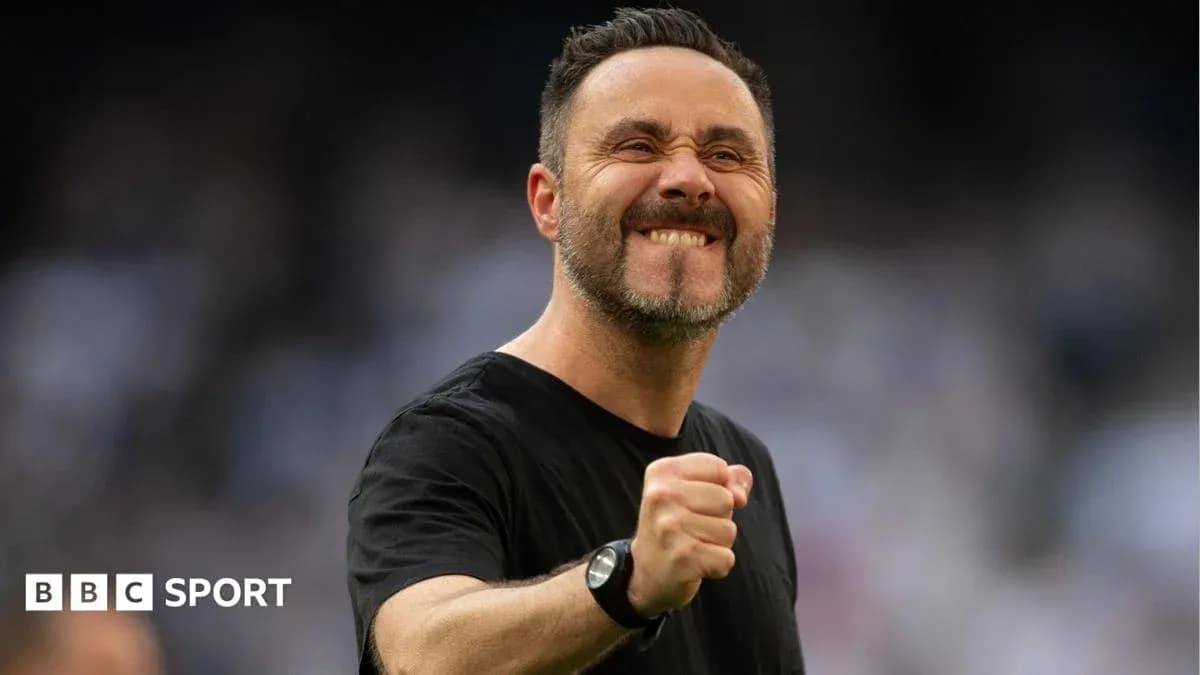
From Tears to Triumph: Tottenham's Transformation Under De Zerbi
There was a point last season when Roberto De Zerbi looked around the Tottenham dressing room and wondered aloud: “Did we pass away?”
Players lay on the floor at the Stadium of Light, some in tears, after a 1-0 defeat at Sunderland in his first game in charge. It was not just a bad afternoon. It felt like a club on life support.
That was game one of a seven‑match scramble to stay in the Premier League. Survival arrived only on the final day. The scars were obvious, the mood funereal, and the new head coach was trying to drag a broken squad through a relegation run‑in they had never expected to face.
Four months later, the scene could not be more different.
From tears in Sunderland to coffee in Sydney
In Sydney, on a private floor of the team hotel a short walk from the Harbour Bridge and Opera House, Tottenham’s players are laughing over flat whites poured by their own barista. The soundtrack is the clatter of table tennis battles, not the silence of a traumatised dressing room.
This is where a club-record £237m worth of new signings are being folded into a group that suddenly dares to talk about trophies again, about climbing back into the top tier of English football’s hierarchy instead of clinging to the bottom rung.
Sandro Tonali, the £100m headline act from Newcastle, is here. So is £85m midfielder Mateus Fernandes from West Ham. Jan Paul van Hecke has joined the defensive unit, Andrew Robertson has arrived at left-back, and Martin Dubravka adds depth in goal.
Only Marcos Senesi, fresh from Argentina’s World Cup final exploits, missed the tour of Australia and New Zealand. His extended break is over; he is now on the pitches at Hotspur Way, the final piece of a recruitment drive that has changed the face of De Zerbi’s squad.
“I deserve to want the top players, because now Tottenham deserves to build up a top team,” he says. It does not sound like a plea. It sounds like a statement of intent.
Two plans, one escape
Tottenham entered the summer with an unusual fork in the road: one transfer plan for relegation, another for survival. The club had stared into the abyss and drawn up a contingency for the Championship.
De Zerbi insists he would have stayed even if they had gone down. Instead, he is working from Plan A – the Premier League version – which includes “respecting the will” of senior figures such as captain Cristian Romero and goalkeeper Guglielmo Vicario, whose futures still hang in the balance.
He laughs as he recalls his first days at the club. “At the beginning of my time in April I had one million individual meetings,” he says. Players told him whether they wanted to stay. His answer was blunt.
Yes, help me to stay up, and then I help you to leave. If you don’t help me to stay up, you stay underwater with me.
The message landed. Tottenham stayed up. The rebuild could begin.
New power structure, same restless coach
The club has not just changed its squad. It has changed the people running it.
Vinai Venkatesham, the new chief executive, now leads the organisation on behalf of the Lewis Family Trust. He and technical director Johan Lange – the only major survivor of the previous regime – handle the negotiations.
They are backed by director of football operations Rafi Moersen and performance director Dan Lewindon, both recruited from City Football Group. Lewindon’s brief is clear: fix Spurs’ injury record.
De Zerbi, though, does not stand back. He inserts himself into every corner of the club, and nowhere more than the transfer market.
“In the transfer market, when I want one player, I become like a shark,” he says. “No chance to say no.”
That relentlessness helped deliver Fernandes and Tonali, two deals that sent a jolt through the Premier League. Spurs beat Manchester United and Manchester City to those midfielders, then saw off Chelsea to land Van Hecke.
“I love working in the transfer market. It’s not a pressure, it’s one of the nicest parts in my work, in my job,” he says. The appeal, he explains, lies in ownership of the decision. When the coach calls the player, he takes responsibility and starts building a bond.
With Fernandes, that bond began at home. De Zerbi spoke to the midfielder’s parents, telling his father he would be a “second dad” in England. The family bought into the vision. Tottenham got their man.
Texts, grudges and a decisive trip to Brescia
Transfers can turn on tiny moments. De Zerbi understands that, and he exploits it.
After a 2-2 draw with Brighton in April, when Georginio Rutter’s 95th-minute equaliser rocked Spurs’ survival hopes, Van Hecke had supplied the assist. De Zerbi messaged him afterwards.
You wanted to push down Tottenham for Brighton when you made the assist to Rutter. Now you have to come to me. You have no choice.
It was half-joke, half-challenge. It stuck.
With Tonali, the move began the morning after Spurs secured survival with a final-day win over Everton. De Zerbi sent a text, then flew to Brescia to sit in the midfielder’s home. That meeting proved decisive. Club staff finished the job in a series of follow‑up talks.
Now the coach is openly teasing what he calls a final attacking “bomba” – two forwards, one expected to be Manchester City’s Savinho. The rebuild is not done yet.
Spending big, thinking long
The numbers are eye-catching. So is the timing, with the Lewis family injecting £100m into the club in June. De Zerbi rejects any suggestion of recklessness.
He insists he is under “no pressure” to justify the outlay, arguing Tottenham are simply doing what Chelsea, Arsenal and Liverpool have done in recent years: investing heavily to reset their trajectory.
The club has sold too. Luka Vuskovic’s £45m move to Brighton brought in a substantial fee. Questions remain over midfielder Lucas Bergvall and England full-back Djed Spence, but the broader strategy is clear.
“We assessed the request of Vuskovic [to join Brighton], with Vinai, with Johan together, because I consider Tottenham’s money my money,” De Zerbi says. “It’s like the owner is my father, I think you don’t want to ask your father to lose money.”
So Spurs aim high on sales, low on purchases, and stretch the plan over five seasons. This is not a one‑window sugar rush. It is a rebuild with a timeline.
That discipline also shaped the decision not to sign Joao Palhinha permanently from Bayern Munich. The problem was not ability; De Zerbi rates the midfielder. The problem was the overall financial package. Tottenham walked away.
Cleaning the air after Sunderland
The damage from Sunderland was not limited to the players. Staff at the training ground carried the same gloom.
“The day after I organised a meeting without players and I said, ‘The first one I see say something negative, I send you home immediately’,” De Zerbi recalls. He wanted to kill the culture of defeatism at the root.
Two seasons of struggle had left their mark. Spurs had finished 17th the previous year, though that campaign ended with a Europa League triumph under Ange Postecoglou and without the same suffocating fear of relegation. The following season, that fear was real. It scarred people.
De Zerbi talks about changing “behaviour, attitude and spirit” as much as tactics or personnel. He knows the trauma lingers.
So he took his players for “one big dinner in Mayfair, with alcohol”. He wanted them to relax, to feel like a team again, not a group waiting for the next crisis. He still believes they were unlucky in their final matches and could have secured safety earlier, but he also believes the players viewed themselves more harshly than anyone outside.
“I think they considered themselves in that moment worse than the people thought,” he says. The healing, he admits, is ongoing.
Next time, he wants the players to organise the dinner themselves. That will be the sign the dressing room truly belongs to them again.
“With love, friendship and care, you become top, top, top,” De Zerbi says.
From Sunderland’s tears to Sydney’s table tennis, Tottenham have travelled a long way in a short time. Now comes the hard part: proving that this version of Spurs is built to rise, not just survive.



